We work within the regulatory framework of the reserve bank of India and the state co-operative act making it firmly within the formal banking standards
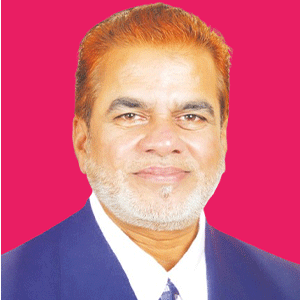
Haji Sarfarzahmed S Umachigi, President

Local banking continues to play a quiet but steady role in India’s financial landscape, especially in districts where small traders, farmers and self-employed workers depend on accessible credit. These areas have experienced increasing demand of fair lending, transparent deposit schemes and daily banking to enable the growth of the areas. This has compelled community-driven institutions to volunteer and cover any gaps that big commercial players often overlook.
In this context is The Azad Co-operative Bank Limited., Gadag, which is built by Founder Sayed Tajuddinsaheb R Umachigi on the base of shared values and social trust. It is not just a financial place but a pillar of local life, connecting neighborhood needs with reliable services. Its roots can be traced to 1961 when the bank started as a small credit society where its leaders had the vision that people should be served regardless of the community.
It began with a small share capital of ₹3,200 and only eleven members but even in those early times it received public goodwill to expand. On March 08, 1964, the society was converted into a co-operative bank and RBI issued license on fifth September 1997 through the relentless efforts of Founder Chairman Late Shameer Abdul Razaksaheb R Umachigi and with the guidance of the state co-operative department. Since its inception the concept was to offer reliable services to people who needed a trustworthy financial partner for their everyday lives.
With time, the bank expanded its reach to Gadag and Betageri. Membership increased progressively and customer base expanded both in rural and urban pockets. The most remarkable aspect was that it targeted individuals who tend to be on the margin of mainstream banking. Small merchants, fruit seller, vegetable sellers and flower sellers received assistance, and so did farmers and families who wanted education loans or housing loans. With the transition of industries and emergence of new needs, the bank continued providing credit to micro and small enterprises, as well as sectors related to export activity, social infrastructure and renewable energy. This continued interaction helped it become a household name in the district.
Steady Growth & Everyday Trust
The steady and gradual increase in trust and financial strength has characterized the growth of the bank. It had grown to 5,742 members as of March 2025. Furthermore, it registered a net profit of 1.13 crore on a total turnover of ₹10,029.65 crore and deposits stood at 85.11 crore. The bank operates under the Reserve Bank of India and the KCS Act 1959, and its deposits are covered under DICGC insurance, thus protecting the interest of depositors. “We work within the regulatory framework of the reserve bank of India and the state co-operative act making it firmly within the formal banking standards”, says Haji Sarfarzahmed S Umachigi, President, The Azad Co-operative Bank.
Despite having two branches, it has managed to stay well through personalized services. Customers make remittances using RTGS and NEFT, get SMS notifications related to transactions and access UPI capabilities to make payments more easily. Also, its mobile banking plans attract the young account holders into the fold, indicating that the bank wishes to remain relevant without losing its community orientation.
We work within the regulatory framework of the reserve bank of India and the state co-operative act making it firmly within the formal banking standardsHaji Sarfarzahmed S Umachigi, President
The bank’s efforts have also been recognized across several years. Awards from the All India Development Association in 2012, the Karnataka Sahakari Ratna Rajya Award in 2017, the Banco Blue Ribbon Award in 2019 and the Best Bank Award at the 2025 Akhil Bharat Sahakari Sapthah reflect its continued engagement with co-operative standards and customer service. These accolades, won through dedicated leadership, are milestones on its path from a small society to a recognized name in the region.
As it grew, the bank also contributed to the district’s economic life in ways that extended beyond financial lending. Many members found confidence and independence through timely loans and guidance. The institution supported new ventures, helped families manage aspirations and became a familiar anchor for communities working toward self-reliance.
Looking Toward a Shared Future
The bank now aims to expand its area of operation beyond Gadag, Dharwad and Haveri districts, keeping its roots firm as it moves ahead. It is also nearing its Platinum Jubilee, a milestone that reflects decades of steady work shaped by values, people and shared purpose. What began as a small step in 1961 has grown into an institution woven into the rhythm of everyday life in its region.
The story of The Azad Co-operative Bank is not one of sudden leaps but of patience, trust and quiet progress. “It stands today as a reminder of what community-driven banking can achieve when it listens to the people it serves and grows with them”, Haji Sarfarzahmed S Umachigi concludes.