Instead of viewing blockchain as abstract technology, we grounded our efforts on real-world implementation, and viewed infrastructure as something that has to run silently, securely, and under constant oversight
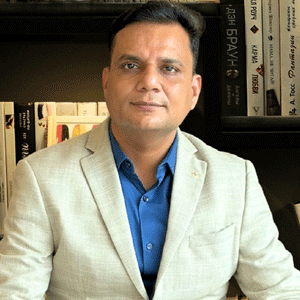
Anuj Ojha, Founder & CEO

Behind every digital financial transaction sits a question of trust. In India’s BFSI landscape, that question has grown louder as systems scale, volumes rise, and institutions are pushed to work faster without losing control. Regulators are testing, banks are cooperating and digital rails are being remodeled silently in the background.
Also, trade finance platforms, tokenized assets, and real-time verification systems are no longer pilots on paper. This indicates a system in which infrastructure is more important than buzzwords.
It is within this shifting ground that Vaspan Technologies enters the picture. Founded as a deep-tech engineering firm, the firm has carved a niche for itself by working where regulation, systems, and trust intersect. Its initial sense was on minimizing friction, enhancing visibility, and allowing easier coordination between institutions that are regulated without requiring to destroy the old system. “Instead of viewing blockchain as abstract technology, we grounded our efforts on real-world implementation, and viewed infrastructure as something that has to run silently, securely, and under constant oversight,” says Anuj Ojha, Founder & CEO at Vaspan Technologies.
Engineering for Oversight and Accountability
From the start, the firm’s foundation has been shaped by real constraints. Banking systems cannot be replaced overnight. Compliance cannot be bolted on later while audits cannot rely on assumptions. Vaspan Technologies built its work around these realities, designing permissioned blockchain systems that align with expectations set by regulators such as the RBI and SEBI. The emphasis has never been on experimentation for its own sake, but on systems that can stand up to scrutiny.
This approach reflects the backgrounds of the people behind the firm. The team brings together system architects, engineers, compliance professionals, and product specialists who understand how financial oversight works in practice. Their experience spans NBFCs, insurance players, and emerging fintechs, grounding innovation in deployment feedback rather than theory. The result is a design mindset that treats architecture as the product, not just the code that runs it.
The problems Vaspan Technologies addresses are not new, but they are persistent. Manual reconciliation between institutions slows down operations. Audit trails are usually fragmented across systems. Visibility of data remains uneven, particularly when multiple parties are involved. In most situations, the challenge is less about competency and more about coordination.
Blockchain here becomes a supporting layer rather than the headline. Vaspan Technologies embeds compliance rules directly into smart contracts, reducing manual checks and intervention. Permissioned networks provide a regulated and auditable access that is within regulatory limits. Just as importantly, the systems are built to integrate with existing banking infrastructure, extending current workflows instead of replacing them.
This design philosophy has found traction in areas such as trade finance, invoice financing, and eKYC, where multiple stakeholders need shared visibility without surrendering control. As AI systems increasingly rely on verified data, blockchain plays a quieter but critical role as a trust layer, ensuring that what is analyzed has a clear and traceable origin.
Scaling at a Measured Pace
The firm’s growth mirrors its measured approach. What began as a small team working primarily with banking clients has expanded into a 30-plus-member organization operating across sectors. Along the way, Vaspan Technologies has extended its work into real estate platforms and even fisheries, where blockchain-backed auction and cash-flow systems are improving transparency in hardware management and payments.
Instead of viewing blockchain as abstract technology, we grounded our efforts on real-world implementation, and viewed infrastructure as something that has to run silently, securely, and under constant oversightAnuj Ojha, Founder & CEO
Geographically, the firm has moved beyond India, engaging with clients in the US and the UK, while also participating in discussions around government-led pilots at home. GIFT City has emerged as an important focus area, particularly as tokenization and regulated digital asset frameworks gain momentum. Yet, the pace has remained deliberate. Growth has followed deployment, not the other way around.
What stands out is the firm’s insistence on collaboration. Client relationships begin with problem discovery rather than solution selling. Small, targeted improvements often precede broader system redesigns. Over time, this approach has positioned Vaspan Technologies less as a vendor and more as a long-term product partner.
The Next Phase of the Work
Looking ahead, the firm’s roadmap stays close to its core beliefs. Credit and trade finance systems remain a priority, especially those that connect banks, MSMEs, and digital platforms. Foundational components for BFSI infrastructure are being refined, with a strong emphasis on compliance-first design. Real estate tokenization, particularly through regulated frameworks associated with GIFT City, is another area of sustained interest.
Beyond finance, Vaspan Technologies continues to explore sectors where trust gaps affect everyday operations, from fisheries to public infrastructure. The common thread is not blockchain itself, but the need for systems that institutions can rely on without second guessing their foundations.
In an environment where technology narratives change quickly, Vaspan Technologies has chosen a steadier path. “By treating blockchain as infrastructure rather than spectacle, and architecture as responsibility rather than abstraction, Vaspan Technologies reflect a broader shift underway in India’s regulated digital economy. One where progress is measured not by announcements, but by systems that quietly hold,” Anuj concludes.