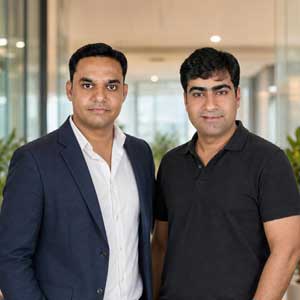
Bharat Phulsunge, Partner & Chief Business Officer, Mukesh Malik, Partner & CEO, GK Consulting
Business consulting is increasingly being judged not by the sophistication of a recommendation, but by what changes after the consultants leave the room. As organizations contend with AI adoption, automation, tighter regulatory expectations, data governance and increasingly interconnected operations, transformation has become an execution challenge as much as a strategic one. A new technology layer cannot compensate for fragmented ownership, inefficient workflows or weak controls. Businesses therefore need consulting partners capable of connecting strategy with processes, people, technology and governance.
Positioned around this execution imperative, GK Consulting has built a full-stack consulting model spanning process transformation, technology, outsourcing, audit and compliance, technology products and startup business services. Started out in 2010, the group has worked with 232+ organizations across 15+ industries, advised on $300 million+ in assets and developed an ecosystem of 22+ partners. Its operating philosophy is captured in a three-stage approach: Simplify, Solution, Scale — understand and simplify the problem first, build the appropriate intervention and scale only after proving that it works.
Helping drive this approach is Bharat Phulsunge, Partner and Chief Business Officer, who brings more than two decades of experience in business and process transformation. His experience reinforced a recurring observation: organizations rarely suffer from a shortage of strategies; the larger problem is converting those strategies into changes that survive day-to-day execution. This perspective has shaped GK Consulting into an organization that stays involved beyond recommendations, supporting clients through redesign, implementation, automation, outsourcing and compliance.
Building Capabilities Around the Problem
GK Consulting began as a problem-solving practice grounded in a fundamentals-first approach, using process re-engineering and continuous improvement to simplify complexity before building solutions. Rather than expanding according to consulting trends, the firm progressively added capabilities in response to the problems clients were encountering.
As it redesigned processes, technology naturally became an important enabler, leading the firm into automation, RPA, AI and analytics. When organizations sought support in managing redesigned operations, process outsourcing followed. Increasing regulatory complexity subsequently strengthened its audit and compliance capabilities. Where available technologies could not adequately address client requirements, GK Consulting developed technology products, while demand from entrepreneurs brought startup business services into its ecosystem.
“What has remained unchanged is the belief that process must precede platform. This is particularly relevant today, when organizations can feel pressured to deploy AI simply because competitors are doing so. GK Consulting takes the opposite view: automation does not inherently simplify a process; a simplified process is what should be automated”, says Bharat Phulsunge, Partner and Chief Business Officer.
GK Consulting began as a problem-solving practice grounded in a fundamentals first approach, using process re-engineering and continuous improvement to simplify complexity before building solutions
Bharat Phulsunge, Partner & Chief Business Officer, Mukesh Malik, Partner & CEO
Its diagnostic approach therefore begins without a predetermined technology or service. If an approval workflow contains excessive handoffs and unclear accountability, automating it may merely accelerate inefficiency. The priority is first to redesign ownership and workflow. Conversely, when a sound process remains repetitive or error-prone, AI, RPA, analytics or low-code/no-code technologies can create meaningful gains. Where skills and execution discipline are the constraint, capability building may come first.
Making Transformation Measurable
The firm's distinction lies in connecting consulting recommendations with execution accountability. Engagements can extend from diagnosis and solution design through implementation, outsourcing and audit, with milestone- and outcome-oriented models tying progress to measurable improvements in efficiency, governance, cost optimization and business performance.
“Our exposure to sectors including BFSI, manufacturing, supply chain and pharmaceuticals has also created cross-industry knowledge spanning operational excellence, financial process management, governance and technology ecosystems. This allows GK Consulting to focus not only on implementing change but also on strengthening an organization's capacity to absorb and scale it”, speaks Bharat Phulsunge.
A transformation undertaken for a mid-sized NBFC illustrates the approach. Loan disbursals had stretched to nearly three weeks, initially suggesting a technology problem. Diagnosis instead revealed fragmented ownership: teams were repeatedly entering, verifying and approving the same information because accountability was unclear and confidence in shared data was low.
GK Consulting first removed duplicate checkpoints and established clear ownership across credit, operations, compliance and technology. Automation was introduced only after the redesigned process had stabilized, supporting activities such as data capture and final sign-off. Disbursal timelines subsequently moved from weeks to days. More importantly, the improvement endured because technology supported a redesigned operating model rather than masking its weaknesses.
Scaling AI-Native, Governed Transformation
Over the next three to five years, GK Consulting expects AI and automation to reshape consulting alongside regulatory, ESG and data-governance requirements. Its focus is therefore on embedding governance directly into transformation — combining process architecture,financial controls, information security and compliance with technologies that enable intelligent monitoring, predictive risk signals and faster decision support.
A significant part of its next growth phase will center on Specialized Global Capability Centers (GCCs). As enterprises move from generic shared-service structures toward centers dedicated to finance, risk, compliance, operations and other specialist functions, GK Consulting sees an opportunity to design process ownership, governance, technology and capability building into these centers from inception. The objective is to create AI-native processes rather than retrofit automation onto legacy workflows, enabling expertise to scale without headcount increasing at the same rate.
“The firm is also strengthening its wider ecosystem through strategic partnerships and platforms such as Entrecon and Aihsadhya Innovation, which connect it with 100+ ecosystem stakeholders, founders and venture-building cohorts. These networks provide an environment to test emerging ideas and translate relevant innovations into practical enterprise applications”, shares Bharat Phulsunge.
For GK Consulting, however, growth is not about accumulating capabilities for their own sake. Its ambition remains anchored in the principle on which the organization was built: stay attached to the problem rather than the solution. By carrying that discipline into AI-native operating models, Specialized GCCs and increasingly complex transformation programs, the firm aims to ensure that consulting does not end with recommendations, but with measurable change that organizations can genuinely own and sustain.