
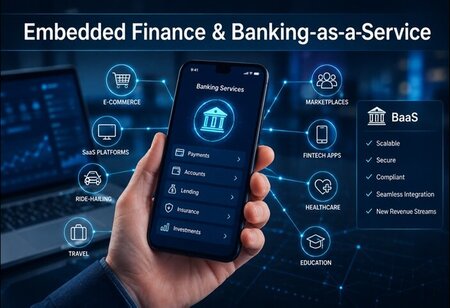
According to Research intelo, The global embedded finance & banking-as-a-service- BaaS market was valued at $138.0 billion in 2025 and is projected to reach $552.4 billion by 2034, expanding at a compound annual growth rate (CAGR) of 16.8% from 2026 to 2034. This extraordinary growth trajectory is underpinned by the accelerating convergence of financial services with non-financial digital platforms, enabling brands ranging from e-commerce giants and SaaS vendors to gig economy operators and healthcare networks to deliver seamless, contextually relevant financial products directly within their native user experiences.
Introduction
Financial services are no longer confined to bank branches, banking applications, or traditional financial institutions. Increasingly, payments, lending, insurance, accounts, cards, and other financial capabilities are being integrated directly into the digital products people already use. This transformation is creating a powerful ecosystem around the Embedded Finance & BaaS market, where technology companies, retailers, marketplaces, software providers, and financial institutions increasingly collaborate to deliver financial experiences within non-financial environments.
The significance of this market extends beyond convenience. Embedded finance is changing where financial products are discovered, how they are purchased, and which companies control the customer relationship. BaaS, meanwhile, provides much of the regulated infrastructure and technology required to make these experiences possible. Together, they are helping reshape the architecture of modern financial services.
What Is Embedded Finance?
Embedded finance refers to the integration of financial products or services directly into a non-financial company's digital platform, application, or customer journey. Instead of asking customers to leave an e-commerce website, business platform, mobility application, or marketplace to access a financial service, the financial capability is presented exactly where it becomes relevant.
For example, an online marketplace can provide sellers with integrated payment accounts, a ride-hailing platform can facilitate digital payments, an enterprise software provider can offer invoice financing, and an e-commerce platform can provide merchants with working-capital solutions.
The central idea is simple: finance becomes a feature of another product rather than a separate destination.
What Is Banking-as-a-Service?
Banking-as-a-Service is a model in which regulated financial institutions and specialized technology providers make banking infrastructure and capabilities available to other businesses through technology platforms and APIs.
BaaS can provide components such as account infrastructure, payment processing, card issuing, compliance capabilities, transaction management, and other banking functions. A non-bank company can then build customer-facing financial experiences without developing an entire banking infrastructure independently.
This distinction is important. Embedded finance describes the customer experience and distribution model, while BaaS often represents part of the infrastructure and enablement layer behind that experience.
How Do Embedded Finance and BaaS Work Together?
The relationship between the two can be understood as a layered ecosystem.
At the foundation are regulated financial institutions, payment networks, banking infrastructure providers, compliance systems, and technology platforms. Above this infrastructure sits the BaaS layer, where APIs and financial technology capabilities can be accessed by third-party businesses.
The final layer is the customer-facing application. This could be a retailer, marketplace, accounting platform, mobility service, travel company, software provider, or another digital business.
When these layers operate effectively, the customer may not even recognize that multiple organizations are involved. They simply experience a smooth financial service within the application they already trust.
Why Is the Embedded Finance & BaaS Market Growing?
One of the strongest growth drivers is the increasing demand for frictionless digital experiences. Customers expect transactions to be fast, convenient, transparent, and integrated into the platforms they already use.
Businesses are also discovering that financial services can strengthen customer relationships. A software platform that provides payments, business accounts, expense management, or financing can become more deeply embedded in a customer's daily operations.
Another major driver is the expansion of API-based financial infrastructure. APIs enable different systems to communicate and exchange data or financial instructions, making it easier to connect banking capabilities with digital platforms.
The growing maturity of fintech ecosystems is also lowering the technical barriers to financial innovation. Companies no longer necessarily need to build every component themselves; they can combine specialized infrastructure providers to create tailored financial products.
Key Market Segments
The market can be examined across several dimensions, including financial service, business model, enterprise type, application, and geography.
Payments and Transaction Services
Payments represent one of the most visible forms of embedded finance. Businesses can integrate payment acceptance, digital wallets, account-to-account transfers, virtual cards, and other transaction capabilities into their platforms.
For marketplaces and digital commerce businesses, integrated payments can improve checkout experiences while giving the platform greater control over transaction flows.
Embedded Lending
Embedded lending allows financing to appear at the point where customers or businesses need capital.
A merchant using an e-commerce platform, for instance, may receive a financing offer based on business activity. The value proposition is particularly strong when financial decisions can be connected to relevant transaction or operational information.
However, responsible lending requires careful attention to affordability, underwriting quality, transparency, and regulatory obligations.
Embedded Banking Accounts
Digital platforms can increasingly offer account-like financial experiences to businesses or consumers. These services may include account management, money movement, payment capabilities, and related financial tools.
For business software platforms, integrated financial accounts can transform an application from a productivity tool into a broader financial operating environment.
Embedded Cards
Virtual and physical card capabilities are another important component. Businesses can use embedded card infrastructure for employee spending, expense management, customer rewards, marketplace payouts, or controlled purchasing.
The ability to issue and manage cards through software can create new opportunities for companies that previously had little connection to traditional banking infrastructure.
Embedded Insurance
Insurance can also be incorporated into non-financial customer journeys. Travel platforms, automotive services, e-commerce businesses, and other digital companies can present relevant insurance protection during the purchasing process.
This approach can make insurance more contextual because the product appears alongside the activity that creates the underlying risk.
Also Read: Digital Banking Platform Market To Reach USD 44.8 billion by 2033
What Industries Are Adopting Embedded Finance?
Embedded finance is spreading across industries because financial transactions are already part of many commercial relationships.
- E-commerce companies can integrate payments, merchant financing, wallets, and customer credit capabilities.
- Software-as-a-Service platforms can add payments, expense management, accounts, payroll-related financial services, or financing capabilities.
- Marketplaces can provide seller payouts, payment acceptance, accounts, cards, and working-capital products.
- Mobility platforms can integrate payments, driver financial services, insurance, and other transaction capabilities.
- Travel businesses can incorporate payments, foreign-exchange services, insurance, and financing into booking journeys.
- Gig-economy platforms can provide workers with faster payouts, financial accounts, cards, and other financial tools.
This broad applicability is one reason the market should not be viewed simply as a fintech niche. It represents a structural shift in how financial services can be distributed.
The Role of APIs in Market Development
APIs are among the most important technological foundations of embedded finance and BaaS.
They allow software applications to communicate with financial infrastructure without requiring users to understand the technical complexity behind each transaction. Through APIs, a business can connect its application with services such as payments, account creation, card management, identity verification, or transaction processing.
This modular approach encourages innovation because businesses can assemble financial capabilities according to their specific requirements.
The result is a move away from monolithic financial technology toward increasingly composable financial infrastructure.
Artificial Intelligence Is Adding Another Layer
Artificial intelligence is becoming increasingly relevant to financial infrastructure and embedded financial experiences.
AI can support areas such as fraud detection, transaction monitoring, customer service, risk assessment, personalization, and operational automation. When applied responsibly, these technologies can help businesses identify unusual transaction behavior and improve the efficiency of financial workflows.
However, AI does not eliminate the need for human oversight. Financial decisions can affect people's economic lives, making explainability, data quality, bias management, privacy, and regulatory compliance essential considerations.
Regulation: The Market's Most Important Reality Check
The rapid development of embedded finance does not mean financial regulation becomes less important. In many cases, it becomes more complicated because several organizations can participate in a single financial experience.
- Responsibilities involving customer identification, anti-money-laundering controls, transaction monitoring, consumer protection, data security, licensing, and reporting must be clearly defined.
- Regulatory expectations also differ between jurisdictions. A model that works in one country may require substantial modification in another.
Therefore, successful participants will need more than innovative interfaces. They will require strong compliance frameworks, transparent partnerships, robust risk controls, and clearly defined responsibilities.
Data Security and Trust
Financial integration creates another major challenge: protecting sensitive information. As financial capabilities move into non-financial platforms, businesses must carefully manage authentication, authorization, encryption, fraud prevention, privacy, and data governance. Trust is especially important because customers may interact with a familiar technology brand while the underlying financial service is provided by another organization.
A seamless customer experience therefore requires invisible complexity behind the scenes. The easier the financial service appears, the more sophisticated the underlying security and operational architecture may need to be.
What Is Driving Competition in the Market?
Competition is increasingly moving beyond price.
- Technology providers compete on API quality, integration speed, geographic coverage, reliability, compliance capabilities, product breadth, developer experience, and scalability.
- Financial institutions compete by determining how effectively they can provide infrastructure to digital businesses while maintaining regulatory discipline.
- Technology companies compete for customer ownership by embedding increasingly valuable financial services into their platforms.
This creates an ecosystem where banks, fintech companies, infrastructure providers, software companies, payment firms, and digital platforms may simultaneously be partners and competitors.
Challenges Facing the Market
Despite its potential, the Embedded Finance & BaaS Market faces several obstacles.
- Regulatory complexity can increase operational costs and slow expansion across countries.
- Third-party dependency can create concentration and continuity risks when businesses rely heavily on external financial infrastructure.
- Fraud and cyber threats can become more sophisticated as transaction volumes increase.
- Customer trust can be damaged quickly when financial products are poorly explained or unexpectedly priced.
- Unit economics also matter. Adding a financial product does not automatically make it profitable. Companies must understand acquisition costs, transaction economics, credit risk, compliance expenses, infrastructure costs, and customer lifetime value.
The strongest business models will therefore be those that combine convenience with sustainable economics and responsible financial practices.
Global Market Outlook
The global outlook for embedded finance and BaaS remains closely connected to digital commerce, fintech adoption, API-based infrastructure, and the increasing expectations of digitally native customers.
Developed markets may benefit from mature financial infrastructure and sophisticated fintech ecosystems, while emerging economies can present opportunities where mobile-first financial adoption is accelerating.
Regional strategies will nevertheless need to account for local banking system, regulatory frameworks, payment preferences, consumer behavior, and financial inclusion requirements.
The future is unlikely to be identical across countries. Instead, embedded finance will evolve according to the characteristics of each financial ecosystem.
What Will the Future of Embedded Finance Look Like?
According to Research intelo, The next stage of the market may be less about adding isolated financial products and more about creating complete financial ecosystems around specific customer journeys.
A business platform could potentially manage payments, accounts, financing, insurance, cards, and financial analytics within one environment. Customers may increasingly expect these services to work together rather than operate as disconnected products.
This could make the boundary between financial and non-financial businesses increasingly difficult to define.
The most successful companies may not necessarily be those that look like banks. They may be companies that understand customer workflows exceptionally well and integrate financial capabilities at exactly the moments when they create value.