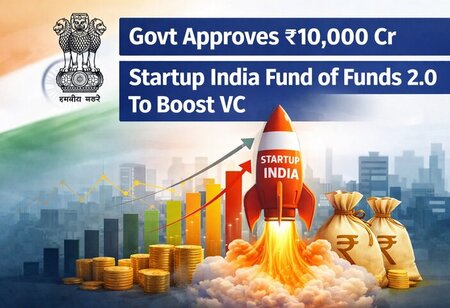
The Central Government has approved the launch of the Startup India Fund of Funds 2.0 with a total corpus of Rs 10,000 crore, aimed at strengthening India’s startup ecosystem by mobilizing domestic venture capital.
Key Highlights
- Government approves Rs 10,000 crore Startup India Fund of Funds 2.0 to boost venture capital access.
- Scheme targets deep-tech, early-stage startups, strengthening domestic capital and innovation-led growth across sectors.
The initiative, notified by the Department for Promotion of Industry and Internal Trade (DPIIT) under the Ministry of Commerce and Industry, marks a significant step in accelerating innovation-led growth and addressing funding gaps across startup stages and sectors.
Focus on Deep-Tech, Manufacturing and Early-Stage Startups
The newly approved Startup India Fund of Funds 2.0 will build on the success of the earlier Fund of Funds for Startups launched in 2016 and will adopt a segmented and targeted investment approach.
Key focus areas include:
- Deep-tech and emerging technologies
- Early-stage and growth-stage startups
- Innovation-driven manufacturing under ‘Make in India’
- Sector-agnostic investments across industries
The fund is expected to catalyse investments in artificial intelligence, semiconductors, clean energy, and advanced manufacturing, sectors that typically require long-term capital support.
Investment Structure Through AIFs
Similar to its predecessor, the scheme will not invest directly in startups. Instead, it will deploy capital through SEBI-registered Alternative Investment Funds (AIFs), which will:
- Raise additional funds from private investors
- Invest in eligible startups in tranches
- Provide mentorship and strategic support
This structure is designed to leverage private capital participation while strengthening the venture capital ecosystem in India.
Enhanced Flexibility and Broader Scope
The Startup India FoF 2.0 introduces several operational enhancements to better address the evolving needs of the startup ecosystem:
- Higher contributions in sectors with limited private capital.
- Support for larger fund sizes in capital-intensive industries.
- Longer investment horizons for R&D-heavy startups.
- Encouragement for smaller VC funds targeting early-stage ventures.
The scheme also acts as an umbrella platform, allowing contributions and co-investments from ministries, departments, and institutional investors.
Also Read: Indian Startup Ecosystem: Funding Deals, M&A, Regulatory Update & More
Governance and Implementation Framework
The Small Industries Development Bank of India (SIDBI) will continue as the primary implementing agency, alongside additional domestic agencies selected for execution.
A structured governance mechanism has been put in place:
- Venture Capital Investment Committee (VCIC): Evaluates and recommends AIF proposals.
- Empowered Committee (chaired by DPIIT Secretary): Oversees implementation and performance.
- Inter-ministerial representation: Ensures coordination across sectors.
The initiative comes at a time when India’s startup ecosystem has expanded rapidly, with over 2 lakh DPIIT-recognised startups as of 2025.
Experts believe the new fund will:
- Unlock long-term domestic capital
- Reduce dependence on foreign funding
- Accelerate innovation and job creation
- Strengthen India’s position as a global startup hub
Recent developments also highlight the government’s continued push to support innovation, with FoF 2.0 expected to drive the next phase of startup growth and deepen the venture capital market.