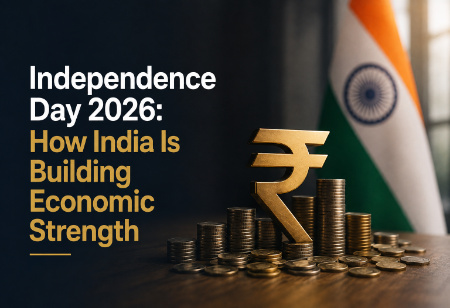
As India marks its 80th Independence Day, the country’s economic story is increasingly shifting from building scale to building strategic capability.
A few decades ago, India often depended heavily on other countries for resources and capital. Today, the whole spectrum is changing. From homegrown semiconductors and critical minerals to defense, pharmaceuticals, renewable energy, and digital infrastructure, the government’s recent decisions clearly points out a purpose: building the capabilities India needs to drive its next phase of economic growth from a position of greater strength.
Several major policy decisions, investment programs and industrial initiatives announced or advanced in 2026 point to a clear direction: India strives to achieve its next phase of growth to be driven by manufacturing, technology, infrastructure, exports and greater domestic capacity.
This year’s policy moves show that India's growth story is no longer centered only on expanding consumption or services. The government is increasingly targeting the foundations that can help India become a strong participant in global value chains.
From manufacturing ambition to industrial capacity
The Union Budget 2026-27 placed manufacturing at the center of the government’s economic agenda, with targeted measures across seven strategic and frontier sectors. These include biopharma, chemicals, capital goods, construction and infrastructure equipment, and container manufacturing. The government also proposed Rs 10,000 crore over five years for Biopharma SHAKTI to build domestic capabilities in biologics and biosimilars.
Kushal Desai, Chairman & Managing Director, APAR Industries, said: “The opportunities are across the board. Even in India, the data centre expansion is there. There is also an expansion happening in solar and wind.”
Electronics and semiconductors have received an even more strategic push. The government’s Electronics Component Manufacturing Scheme, backed by Rs 22,919 crore, aims to attract Rs 59,350 crore of investment and generate Rs 4.56 lakh crore in production over its tenure. The objective is not simply to manufacture finished electronics but to increase domestic value addition and integrate Indian companies into global supply chains.
Ashwini Vaishnaw, Union Minister for Electronics & IT, said: “The top priority for ISM 2.0 will be creating a design ecosystem, so that deep tech startups get the opportunity to develop the next Qualcomm.”
The semiconductor push has also moved into its next phase. In July, the Union Cabinet approved Semicon 2.0 with an outlay of Rs 1.275 lakh crore, expanding the focus from fabs and packaging to chip design, materials, equipment and supply-chain capabilities. The government says 12 semiconductor manufacturing projects have now been approved with cumulative investments of more than Rs 1.64 lakh crore.
These developments suggest a broader shift in industrial policy: India is trying to build ecosystems rather than isolated factories.
The next layer: minerals, exports and infrastructure
The same strategic thinking is visible in India’s approach to critical minerals and industrial inputs. The government is planning specialized processing parks for minerals such as lithium and nickel, which are increasingly important for electric vehicles, energy storage and advanced manufacturing.
Anil Agarwal, Executive Chairman, Vedanta, said, “We have the resources, but we need technology.” He has also argued that India needs to reduce its reliance on foreign raw materials as demand for critical minerals rises.
The government has also moved to encourage domestic production of rare-earth permanent magnets through a Rs 7,280-crore scheme. The initiative has already attracted bids from major companies, highlighting industry interest in developing capabilities that are critical for electronics, EVs and renewable-energy technologies.
At the same time, recent changes to the mining taxation framework aim to provide greater predictability for companies by limiting the ability of states to introduce new taxes and levies on mineral rights outside conditions approved by the Center. For investors, such regulatory consistency can be as important as financial incentives when deciding where to commit long-term capital.
Infrastructure remains another pillar of the strategy. Over the past decade, programs covering roads, railways, logistics, ports, airports, digital networks and energy have increasingly been treated as instruments of economic competitiveness rather than standalone public works.
The direction becomes clearer when these initiatives are viewed together. India is attempting to reduce liabilities in critical supply chains, attract global capital, strengthen domestic manufacturing and create the infrastructure needed to move goods and technology at scale.
A different definition of economic independence
India’s economic independence in 2026 is therefore taking a different form from the self-reliance narrative of earlier decades. The objective is not isolation from global markets but stronger participation in them from a position of greater capability.
Pankaj Patel, Chairman, Zydus Lifesciences, has emphasized the need for a “supporting mindset” from government and regulatory bodies as India seeks to strengthen its life sciences capabilities.
The government’s export-focused Budget measures, including a proposed Rs 10,000-crore SME Growth Fund, reinforce this ambition by attempting to connect smaller Indian businesses with global value chains and international markets.
Sanjiv Puri, Chairman & Managing Director, ITC, said, “We create our own brand. We want to create our own intellectual property, and also do away with imports as much as possible.”
The real test will be execution—whether announced investments translate into factories, skilled jobs, exports, technology capabilities and globally competitive Indian companies.
But the policy direction is increasingly difficult to miss. On this Independence Day, India’s economic message is moving beyond “Made in India” towards a more ambitious goal: designing, manufacturing, supplying and competing from India for the world.