
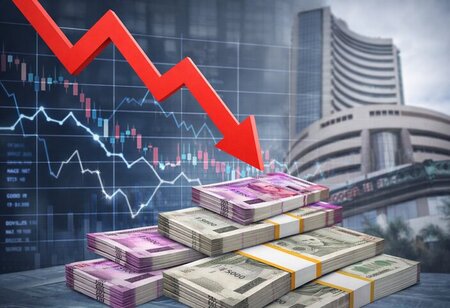
India’s equity markets witnessed a significant correction in the March 2026 quarter, with the country’s total market capitalisation (mcap) shrinking by nearly $639 billion, marking the sharpest quarterly decline since the market crash during the COVID-19 pandemic in 2020.
Key Highlights
- India’s total market capitalisation plunged $639 billion in the March quarter amid global volatility.
- Sharp correction marks biggest quarterly wealth erosion since the COVID-19 market crash.
The steep fall reflects growing volatility in the Indian stock market amid global economic uncertainties, geopolitical tensions, and continued foreign investor outflows. According to market data, the combined value of all listed companies in India dropped to about $4.65 trillion, the lowest level since April 2025, compared with roughly $5.3 trillion at the beginning of 2026, representing a decline of around 12.1 percent in market value.
Benchmark indices also mirrored the broader weakness. The BSE Sensex and Nifty 50 have fallen approximately 10.8 percent and 9.5 percent respectively so far in 2026, reflecting widespread selling pressure across sectors. Mid-cap and small-cap stocks also witnessed declines as investors adopted a cautious approach amid market uncertainty.
Also Read: Sensex Drops 580 Pts; Nifty Below 23,500 for First Time since Apr 2025
Analysts attribute the correction to several macroeconomic factors, including foreign institutional investor outflows, subdued corporate earnings growth, and geopolitical risks that have increased global market volatility. Rising crude oil prices have also added to investor concerns, particularly for an energy-import-dependent economy like India. Experts warn that a sustained increase in oil prices could widen India’s current account deficit and exert inflationary pressure on the broader economy.
Interestingly, the amount of market value erased from Indian equities in the March quarter is larger than the entire stock market capitalisation of several mid-sized economies, highlighting the scale of the correction.
Despite the recent downturn, market experts remain cautiously optimistic about India’s long-term growth prospects, citing strong domestic consumption, structural reforms, and continued economic expansion as factors that could support a recovery once global uncertainties ease.