
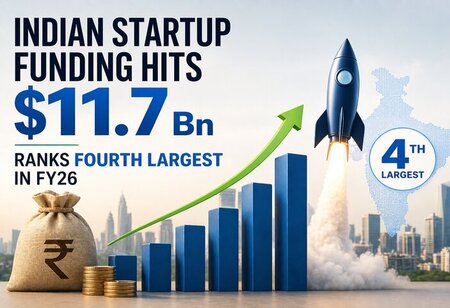
Indian startup funding ecosystem retained its position as the world’s fourth largest funding hub in FY26, raising $11.7 billion across 1,632 deals, according to a report by Tracxn. Despite an 18% year-on-year decline from $14.3 billion in FY25, the funding levels marked a 20% recovery from FY24, indicating a steady recalibration rather than a downturn.
Key Highlights
- Indian startup funding declines to $11.7 billion in FY26, but remains fourth globally amid recovery.
- Early-stage investments surge sharply, while IPO activity and unicorn creation signal growing ecosystem maturity.
The country continued to rank behind the United States, United Kingdom, and China, reinforcing its strong global standing even amid tightening capital flows.
A key trend shaping the ecosystem was the sharp 34% drop in deal volumes, significantly steeper than the decline in overall funding. This suggests a clear shift in investor behaviour-away from broad-based funding toward fewer, high-conviction bets.
Industry experts interpret this as a sign of maturity, where capital is increasingly directed toward startups with stronger fundamentals, clearer revenue models, and scalable potential rather than speculative growth.
Early-Stage Resilience, Late-Stage Slowdown
Early-stage funding emerged as a bright spot, rising 33% to $4.8 billion, even as the number of deals declined. In contrast, late-stage investments fell sharply by 38%, highlighting continued caution among investors when deploying large capital.
Sectorally, enterprise applications led the funding charts with $3.6 billion, followed by fintech and retail, which attracted $2.4 billion each-reflecting sustained interest in scalable, tech-driven business models.
IPO Boom Signals Market Maturity
FY26 turned into a landmark year for public listings, with 47 tech IPOs-the highest ever for India-marking a 52% increase over the previous year. Notable listings included Lenskart, Groww, Meesho, and Physics Wallah. Retail and enterprise tech dominated IPO activity, while a growing share of late-stage companies entering public markets highlighted investor preference for profitability and scale.
Also Read: Indian Startups: Funding Slowdown, Early-Stage Deals, M&A & More
Unicorn Pipeline Expands
India added six new unicorns during the year, including Neysa, Navi, and Juspay, taking the country’s total unicorn count to 125. However, profitability remains a concern, with only a small fraction of unicorns currently generating consistent profits—underscoring the ongoing challenge of balancing growth with sustainability.
While headline funding numbers may suggest a slowdown, the underlying trends point to a more disciplined and resilient ecosystem. India’s startup landscape is transitioning from rapid expansion to strategic consolidation where quality, scalability, and profitability are becoming the defining metrics of success.