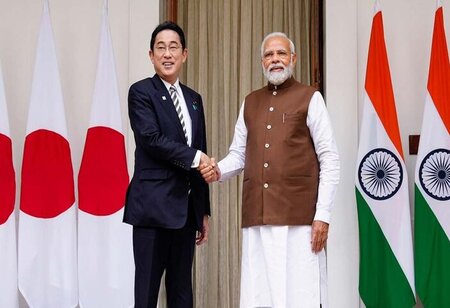
Japan’s decision to target $68 billion (10 trillion yen) in private investment in India over the next decade signals a major strategic and economic shift, positioning India at the center of Tokyo’s long-term growth and Indo-Pacific strategy. The investment commitment covers important industries such as semiconductors, artificial intelligence (AI), critical minerals, advanced manufacturing, clean energy, health care, mobility, startups and digital technologies.
Key Highlights
- Japan plans $68 billion investment in India across technology manufacturing and critical minerals.
- India emerges as key supply-chain alternative amid Japan’s strategic China diversification efforts.
The decision follows a trend of Japanese firms cutting ties with China and diversifying supply chains, especially for products such as semiconductors and solar panels, as tensions between the two countries continue and economic stability remains fragile.The shift comes at a time when Japanese firms are seeking to diversify their supply chains and decrease reliance on China amid geopolitical strains, economic uncertainty, and worries about supply-chain resilience, particularly in the case of semiconductors and solar panels. Reports indicate that Japanese FDI in China has been drastically falling over the past few years and India has grown to be a preferred option for long-term capital investment and industrial cooperation.
India Emerges as a Key Alternative to China
With the investment commitment comes more than just capital inflows for India. It solidifies the country's status as an increasingly important global manufacturing, technology and innovation hub.
The investment roadmap follows up on an earlier announced 5 trillion yen investment from Japan, which was fulfilled ahead of schedule in 2022. The new goal is anticipated to bolster India's Make in India, Digital India, semiconductor production, and diversification of its supply chain goals.
The development of India's massive consumer base, a large pool of skilled labor, the strengthening of infrastructure and government support for both the country and its neighbors to the east have made it an increasingly appealing prospect for Japanese companies looking for long-term growth outside of China, industry observers said.
Semiconductors, AI and Critical Minerals Take Centre Stage
The bulk of the projected investment is likely to be in strategically crucial areas that are growing in significance to the world's economy.
The key areas of interest for Japan and India are semiconductors, artificial intelligence, rare earth minerals, clean energy, advanced mobility solutions, and digital infrastructure. In addition, both nations are building ties in new technologies, including AI studies and startups, talent development and technology transfer.
This collaboration is a step in the right direction, as India strives to develop a local semiconductor industry and minimize its reliance on foreign imports for vital technologies.
India-Japan Trade Still Has Untapped Potential
Even though the two countries enjoy cordial ties and expand strategic cooperation, experts feel that more than a third of the potential for economic engagement is still untapped between India and Japan.
Bilateral trade in FY26 between the two countries was around $27.47 billion, with India's share in Japan's total global trade being a mere 1.75%.
Experts say that while political ties between New Delhi and Tokyo are very strong, business, academia, research institutes, startups and civil society are expected to move closer to each other to reap the benefits of the partnership to the fullest.
Founding Vice Chancellor of OP Jindal Global University, C Raj Kumar said, “The lessons that we need to learn are not that India should emulate China. That is myopic. The lesson is that India and Japan should emulate the seriousness with which China and Japan invested in building robust, sustainable, economic, educational, cultural, and societal linkages between both the countries.”
The experts opined that more cooperation among India and Japan in the fields of education, research, innovation, tourism and talent mobility can give a big boost to the India-Japan economic corridor.
Also Read: Japan's MUFG Unveils $250 Million Fund for Indian Startups
Strategic Partnership Extends Beyond Economics
The investment pledge also signifies the convergence of two nations' geopolitical vision of a Free and Open Indo-Pacific.
The ties with India have strengthened significantly in the areas of economic security, resilient supply chains, critical technologies, and regional stability. Recent steps taken involve cooperation in semiconductors, AI, digital public infrastructure, defence manufacturing and critical mineral supply chains.
The partnership is considered to be one of the key steps in the development of alternative manufacturing and technology ecosystems in the Indo-Pacific region and a step toward minimizing the risk of concentration of supply chains.
A Defining Opportunity for India's Growth Story
The proposed investment roadmap of $68 billion would help India move to a big industrial transformation in the coming decade. A higher level of Japanese investment could generate employment, improve manufacturing capabilities, facilitate technology transfer and enhance the competitiveness of Indian industries in high value activities.
But analysts say that for the opportunity to be fully realized, there will need to be ongoing reforms, ease-of-doing-business improvements, greater research collaboration and more people-to-people engagement.
The India-Japan partnership has the potential to become one of the most significant economic and strategic ties in Asia if it is successfully implemented, potentially influencing the future of the Indo-Pacific region's technology, trade, and supply chains.