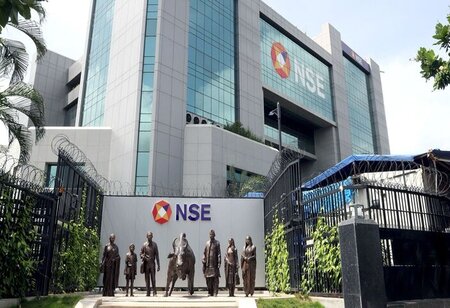
The National Stock Exchange of India (NSE) has finally submitted its Draft Red Herring Prospectus (DRHP) with the Securities and Exchange Board of India (SEBI), marking a significant step towards what is set to become one of the largest initial public offerings (IPOs) in India's capital market history.
It is an important step toward the country's largest stock exchange making its debut listing, which has been under way for almost 10 years. With India's financial markets dominated by NSE and its estimated market valuation in the unlisted market at around Rs lakh crore, the proposed IPO is likely to gain ample investor interest.
Key Highlights
- NSE files DRHP for IPO expected to be valued at around Rs 30,000 crore.
- SBI leads shareholder stake sale as exchange advances long-awaited public listing.
Rs 30,000 Crore IPO Likely Through Offer for Sale
It is proposed to offer up to 14.89 crore shares in the public issue, which would be entirely in the form of an Offer for Sale (OFS), accounting to almost 6% of NSE's equity paid-up capital, as per the DRHP.
The IPO is not a new share issue, so there will be no proceeds to the exchange as a result of the offering. Rather, the generated proceeds will end up with current shareholders who are liquidating their shares.
Using the market estimates, analysts estimate the IPO value to be around Rs 30,000 crore, which would make it one of the biggest public offerings in India, and also one of the largest in the history of India.
Long-Awaited Listing After Years of Delays
The plans to go public were initiated by the NSE in 2016. But for several years, it was hampered by regulatory concerns, governance issues, and the co-location controversy.
The recent offering suggests that the exchange has met several regulatory musts, allowing it to advance its much-anticipated plans to list. Market experts believe the IPO is a milestone for India's financial markets and a testament to the capital markets' maturing and deepening ecosystem in India.
SBI to Lead Shareholder Stake Sale
The OFS will take place in part to help some well-known institutional investors monetize their holdings.
State Bank of India (SBI) is likely to be the biggest selling shareholder with an offer of nearly 2.48 crore shares. Other big names include Mauritius-based MS Strategic, Canada Pension Plan Investment Board (CPPIB), Aranda Investments, Bank of Baroda and Stock Holding Corporation of India.
The public sector insurers such as GIC Re, New India Assurance, National Insurance Company and United India Insurance Company will also sell their holdings as part of the sale.
Interestingly, Life Insurance Corporation of India (LIC), one of the main investors of the NSE, has decided against the sale of shares.
Retail Investors Get 35% Allocation
50% of the net offer in the exchange has been reserved for Qualified Institutional Buyers (QIBs), 15% for Non-Institutional Investors (NIIs) and 35% for retail investors. In addition, up to 5% of the post-offer paid-up capital has been set aside for eligible employees who will get a chance to engage in the public listing process of the company.
Also Read: Reliance Jio to File IPO Papers Soon for $4 Billion Listing: Report
NSE's Dominance in India's Capital Markets
Established in 1992, National Stock Exchange revolutionized the Indian securities market by implementing electronic trading platforms, enhancing transparency, and expanding investor access nationwide.
The exchange today runs a diversified financial market infrastructure business, which includes trading, clearing and settlement, services including index services, market data, analytics, mutual fund registry services and international exchange operations through its GIFT City.
NSE is the clear leader in several segments and India's growing retail investor class continues to drive the growth of the exchange.
The DRHP states that the number of unique investors who are registered with NSE has grown by 26.9% CAGR from 30.87 million in March 2020 to 129.1 million in March 2026. More than 99% of the postal codes of India are participating in the exchange highlighting the growing reach of the capital markets to smaller towns and cities.
A collaborative rise in financial literacy, digital trading platforms and a larger number of younger investors have bolstered the expansion.