
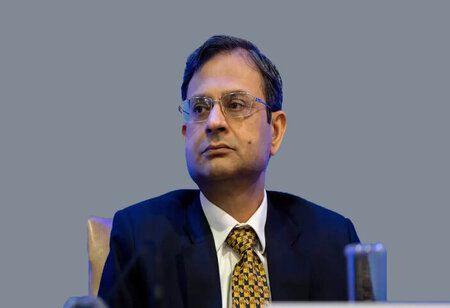
India's incoming central bank governor faces a difficult decision on how to manage the rupee's currency rate: focus on reducing volatility, as his predecessor did, or listen to pleas for more flexibility as the dollar continues to rise. Former Reserve Bank of India Governor Shaktikanta Das' time was highlighted by efforts to control currency fluctuations, as he aimed to provide predictability to both foreign investors and domestic importers and exporters.
A shift in leadership has fueled conjecture regarding the RBI's exchange rate strategy. While efficient at dampening volatility, opponents argue that Das' firm grasp on the rupee essentially anchored the currency to a crawling peg against the dollar. This has harmed India's export competitiveness amid a period of declining growth, they claim.
Sanjay Malhotra, the new governor, has not stated his policy position on the rupee. However, there are indications that he may allow the currency to float more spontaneously. The rupee's volatility has increased, reaching its highest level in almost a year in December, as the dollar continues to strengthen.
"With persistent dollar strength and fluctuations in capital flows, pressure was building even before the new governor took charge," said Abhay Gupta, a strategist at Bank of America Corp. in Singapore. "A change in FX management was warranted with room for more flexibility, and a change in guard may have just provided justification to that."
Former Chief Economic Advisor Arvind Subramanian has urged the RBI to return to a more flexible currency rate. In a series of newspaper pieces, Subramanian and others argued that keeping the rupee under control had harmed India's average export competitiveness. They also warned of potential consequences, such as tighter monetary conditions and a speculative attack on the currency. In November, a measure of the rupee's inflation-adjusted trade competitiveness, known as the real effective exchange rate, reached a historic high of 108.14, indicating an 8% overvaluation.
"The rupee therefore needs to depreciate by about 2-3 percent on average to align with its fundamentals on a long-term basis," said Kanika Pasricha, top economic adviser at Union Bank of India. The rupee is approaching 86, having touched a series of record lows in recent days, as a strong dollar and a widening trade imbalance put pressure on the currency.
"India's external account has shifted from comfort to caution, with the main reason being a sharp slowdown in net FDI due to a combination of reduced fresh inflow and a sharp increase in repatriation," said Namrata Mittal, chief economist at SBI Mutual Fund.
The RBI's foreign-exchange reserves fell to an eight-month low of $640 billion on December 27, after reaching a record high of $705 billion in September. The erosion essentially coincides with Donald Trump's most recent presidential election victory. The authority's forwards book also showed a $60 billion shortage as of November. This means it will have to buy an equal amount to settle maturing contracts or risk depleting its reserves even more. "No matter what your reserves are, losing a large amount of reserves in a short period of time does not send a good signal to the market," said Viral Acharya, former deputy governor of the RBI.
A spokeswoman for the central bank did not immediately respond to emailed questions about its FX strategy. Some businesses, such as MUFG Bank Ltd., are lowering their expectations downward. It now forecasts the rupee to fall to 88.50 by December from 86 previously. "The Reserve Bank of India's FX policy may become less interventionist, allowing the INR to adjust weaker, but it is unlikely to completely devalue the INR," senior currency strategist Michael Wan wrote in a note.