
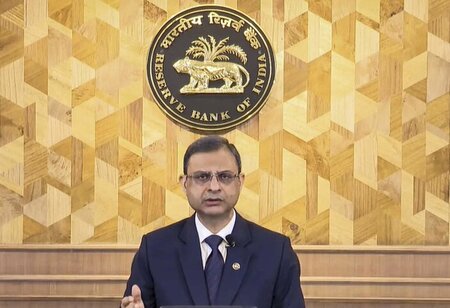
The Reserve Bank of India said on Wednesday, August 5, that it has retained the repo rate at 5.25% for the fourth meeting in a row, while keeping its monetary policy stance 'neutral'. The MPC's third-ever bi-monthly policy meeting for FY27 took place on 3 to 5 August and the decision to keep rates unchanged was unanimous.
Key Highlights
- The RBI has kept the repo rate unchanged at 5.25% for the fourth straight meeting and has remained neutral.
- The RBI has raised GDP growth and core inflation estimates for FY27 to 6.7% and 4.3%, respectively.
In addition to the repo rate, the RBI also maintained the Standing Deposit Facility (SDF) rate at 5%, and the Marginal Standing Facility (MSF) rate and the bank rate at 5.5% respectively. The call was eagerly awaited and so was the verdict – most economists and market makers were expecting a “no change” as the world faced greater uncertainty.
Growth Projected at 6.7%, Inflation Outlook Discussed
The MPC also revised up its real GDP growth estimate for FY27 to 6.7% from 6.6%, with core inflation estimated at 4.3% for the year. The Indian economy did better than anticipated in the first quarter, despite the headwinds in the global economy, thanks to positive initial corporate results in manufacturing and strong discretionary consumer spending, Governor Malhotra added.
On inflation, Malhotra said headline CPI inflation had edged up above target, largely on account of food and fuel prices, while core inflation remained benign. He added that headline inflation is expected to peak in the third quarter of the financial year before moderating thereafter. Realised inflation in the first quarter came in marginally lower than earlier projections, reflecting limited pass-through of cost pressures to consumers.
Global Uncertainty and Crude Oil Volatility in Focus
The Governor acknowledged that the re-escalation of the US-Iran conflict since early July had amplified volatility in global energy prices, adding a layer of complexity to the inflation outlook. He said growth, while resilient, is expected to be somewhat lower this financial year, with the overall outlook remaining hazy due to ongoing uncertainty around global trade policy. Sanjay Malhotra emphasised the need for greater clarity on the inflation trajectory and its composition before the central bank considers any further policy action.
Also Read: RBI Keeps Repo Rate at 5.25%, Predicts India GDP Growth at 6.9%
Markets React Positively Ahead of Policy Announcement
Indian equity markets opened higher on Wednesday ahead of the policy announcement, with the Nifty up 0.22% at 24,669.2 and the BSE Sensex gaining 0.8% to 79,055.38 by 9:15 am. Twelve of the 16 major sectors logged gains at the open, while broader mid-cap and small-cap indices advanced 0.6% and 0.5%, respectively.
The Indian rupee also strengthened ahead of the policy decision, appreciating 46 paise to open above the 95-per-dollar mark, supported by a sharp correction in Brent crude prices from a recent high of around $102 a barrel to $78.80, alongside sustained Reserve Bank of India intervention and strong capital inflows.
Analysts Expected Continuity over Change
Commenting ahead of the policy outcome, VK Vijayakumar, Chief Investment Strategist at Geojit Investments said, "The sharp dip in Brent crude below $80 and record closes on US markets augured well for Indian markets, adding that growth resilience, improving corporate earnings and sustained FII buying were positive signals for equities."
Prachi Kele, Lead Economist at PL Capital said, "The MPC was expected to adopt a cautious tone amid ongoing war-related uncertainties while reiterating a data-dependent approach, citing favourable responses to FCNR(B) measures and improving food inflation prospects as supportive of a policy pause."
Seema Srivastava, Senior Research Analyst at SMC Global Securities noted, "Markets would focus more on the RBI Governor's commentary than the decision itself, with investors closely tracking the central bank's assessment of inflation risks, liquidity conditions and future policy direction."
Liquidity Management to Remain a Key Focus
According to brokerage Emkay, liquidity management is expected to remain a priority area for the RBI going forward, with the central bank likely to manage surplus liquidity through temporary absorption measures rather than tightening policy. Core liquidity was estimated at around Rs 5.4 trillion, with average banking system liquidity at approximately Rs 1.1 trillion in July, expected to peak in the second quarter of FY27 before moderating in the latter half of the year.
Industry Reactions on RBI's Stable Policy Stance
Parimal Kumar Shivendu, Executive Director & Group Head, Easebuzz noted, "The RBI's decision to maintain the repo rate while retaining a neutral stance reflects a balanced approach in an environment where global uncertainties continue to persist, even as domestic growth remains resilient. The upward revision in the GDP growth forecast reinforces confidence in India’s underlying economic momentum, which is encouraging for businesses across sectors. For the digital payments ecosystem, sustained economic activity, rising formalisation and continued digital adoption will remain the key growth drivers. As more enterprises and MSMEs invest in technology-led financial operations, the focus will increasingly shift towards building scalable, secure and efficient payment infrastructure that supports long-term business growth."
Shams Tabrej, Co-founder & CEO, Ezeepay (MJ Digital Services) stated, "The RBI’s call to keep the repo rate at 5.25% shows a balanced direction right now since inflation is calming, but those global economic uncertainties still need a bit of extra caution. When the interest rate atmosphere stays steady, it gives more visibility to banks, fintechs and also businesses so they can map out lending and investment plans with more confidence and less guesswork.
"For the fintech ecosystem, it’s not just easing or cutting rates that matters. Policy stability itself is almost as important, because it helps maintain a consistent pace of credit growth. This especially benefits MSMEs, merchants and customers who are still underserved, many of whom lean on digital finance services for day-to-day needs and working-capital-type support. And as digital lending keeps maturing, the attention should move away from only expanding credit reach and toward making sure credit delivery stays responsible, affordable and sustainable at the same time. India’s digital financial ecosystem has moved into a stage where innovation, thoughtful regulation and monetary stability have to work together, not separately. The present stance underlines confidence in the financial system and creates a supportive space for fintech companies to push deeper financial inclusion while keeping credit discipline intact", he added.
Dharmendra Raichura, VP & Head of Finance, Ashar Group said, "The RBI's decision to maintain the repo rate at 5.25% reinforces confidence in an already resilient residential real estate market by providing certainty around borrowing costs and creating a stable environment for homebuying decisions. The broad consensus among economists that the repo rate is likely to remain at 5.25% through the remainder of 2026 further supports homebuyer sentiment, financing decisions, and healthy residential demand over the next 6–12 months. For homebuyers, predictable EMIs improve purchase planning and affordability, while developers benefit from greater visibility in project execution, financing, and long-term capital allocation. The most supportive RBI policy signal for the housing sector would be a continued commitment to price stability, a predictable interest rate trajectory, faster transmission of policy rates into home loan pricing by banks, and adequate systemic liquidity to ensure efficient credit flow.
He added, "Together, these measures would improve housing affordability, make home loans more accessible, strengthen end-user demand, and enable developers to plan investments, financing and project execution with greater confidence. A stable and well-transmitted monetary policy environment will play a pivotal role in sustaining long-term growth across India's residential real estate sector."
Umesh Gowda H A, Chairman and Founder of Sanjeevini Group said, "The RBI’s decision to keep repo rate unchanged is on expected lines considering the fact that the Indian economy is grappling with heightened geopolitical tensions, supply chain disruptions and renewed inflationary pressures, particularly due to rising energy prices. Prioritizing macroeconomic stability over monetary easing is a prudent move. A stable interest rates will help provide certainty to both developers and homebuyers, allowing investment and purchase decisions to continue without disruption. India's housing market has demonstrated resilience over the past few years, and policy stability will help sustain this momentum despite global uncertainties."
Mukesh Choudhary, Managing Director, Accuspace stated, "Keeping the repo rate unchanged with a view of balancing economic growth with inflation management is a judicious approach that the RBI has taken amid an increasingly volatile global environment. Adopting a wait-and-watch approach is the right move considering the fact that inflation is inching up and may surpass RBI’s comfort level. Policy consistency will reassure both domestic and foreign investors as predictable interest rates are often more valuable than abrupt policy shifts. A stable monetary environment supports long-term capital deployment, strengthens financing conditions and reinforces India's position as an attractive real estate investment destination."
Ankur Jalan, CEO, Golden Growth Fund (GGF) noted, "The RBI’s decision to keep the repo rate unchanged reflects a measured and prudent approach amid escalating geopolitical tensions, volatile crude oil prices and persistent inflationary risks. Macroeconomic stability and policy predictability are more critical than short-term rate movements. A stable interest rate environment sustains investor confidence and enables developers to execute projects without facing abrupt changes in financing costs. India’s real estate sector continues to benefit from strong structural demand, rapid urbanisation and increasing institutional participation. With inflationary pressures being closely monitored and financial conditions remaining stable, the sector remains well-positioned to attract long-term domestic and global capital. We believe the RBI’s calibrated policy stance will reinforce investor confidence and further strengthen the investment climate in India’s ever-evolving real estate sector."
Lalit Parihar, managing director, Aaiji Group said, "Escalating geopolitical conflicts have increased the risk of imported inflation through higher crude oil and commodity prices. Against this backdrop, the RBI’s decision to maintain the repo rate unchanged reflects a cautious and measured approach, with a clear focus on anchoring inflation expectations while preserving macroeconomic stability. While the real estate sector always welcomes lower borrowing costs, maintaining economic stability remains a larger priority. A stable policy stance will reinforce investor confidence and ensure that financing costs remain predictable. The housing sector today is resilient enough to sustain momentum even amid a pause in monetary easing. As global uncertainties ease and inflation remain contained, the RBI will have greater flexibility to support growth through calibrated policy measures."
Kaushal Agarwal, Chairman, The Guardians Real Estate Advisory stated, "The RBI's decision to keep the repo rate unchanged brings continuity and predictability to the market at a time when global geopolitical developments and inflationary pressures continue to create uncertainty. Stable interest rates ensure that home loan EMIs remain broadly unchanged, allowing prospective buyers to make informed purchasing decisions without concerns over rising borrowing costs. The Indian housing market has demonstrated remarkable resilience over the past few years, supported by strong end-user demand, rising incomes, and growing confidence in the economy. With GDP growth projected at 6.7%, we expect housing demand to remain healthy across key micro-markets."
Shilpin Tater, Managing Director, Superb Realty said, "The RBI's decision to maintain the repo rate is a balanced move considering the current global economic environment and domestic inflation outlook. Policy stability is particularly important for the real estate sector as it enables developers to plan projects with greater financial certainty while allowing buyers to benefit from stable lending rates. Demand for quality residential & commercial developments, especially in well-connected urban locations, is expected to remain robust. We remain optimistic that supportive monetary measures in the future could further strengthen investment activity."
Shraddha Kedia-Agarwal, Director, Transcon Developers said, "The RBI has adopted a measured and responsible approach by maintaining the repo rate while closely monitoring inflationary trends and global developments. Although a rate cut would have enhanced affordability for homebuyers, the decision to maintain stability provides confidence to both consumers and developers in an uncertain macroeconomic environment. The premium and luxury housing segments continue to witness healthy demand driven by aspirational buyers and strong wealth creation, while the broader residential market remains supported by genuine end-user demand. Stable financing costs, coupled with India's improving growth outlook, should sustain market momentum."
Dhruman Shah, Promoter, Ariha Group stated, "The RBI's decision to keep the repo rate unchanged reflects its focus on balancing growth with inflation management amidst ongoing global uncertainties. For the real estate sector, policy continuity is a positive outcome as it preserves financial stability and ensures that financing conditions remain predictable for both developers and homebuyers. Stable interest rates, combined with sustained infrastructure investments and urbanization, will continue to support residential sales."
Sharad Mittal, Founder & CEO of Arnya Real Estates Fund Advisors noted, "The RBI's measures are a positive step towards ensuring that liquidity reaches the real economy without compromising financial discipline. A stable interest-rate environment, coupled with continued liquidity support, creates a conducive backdrop for credit expansion. For the residential real estate sector, easier availability of construction finance is as important as home loan affordability. As capital becomes more accessible, developers with strong balance sheets, sound governance and proven execution should be better positioned to accelerate project delivery, supporting both housing supply and broader economic growth. Affordable home loan will help in sustaining the residential demand and support project level liquidity for developers. We believe these measures will improve credit confidence across the ecosystem and sustain momentum in India's housing market."
Anupam Rastogi, Co-Founder & CBO, Square Yards stated, “The residential real estate industry benefits from the RBI's decision to keep the repo rate at 5.25% since it promotes a steady and predictable borrowing environment. For creditworthy homeowners, financing conditions remain appealing because some lenders offer home loans at rates as low as about 7.25%. Stable borrowing prices, developer incentives, flexible payment plans, and competitive pricing could boost buyer sentiment and promote purchasing decisions as the holiday season draws near. Because ready-to-move-in and near-completion properties offer more assurance regarding delivery and the possibility of long-term value appreciation, the atmosphere is especially favorable for individuals contemplating such properties."
Amit Prakash Singh, Co-Founder and CBO, Urban Money said, “The RBI’s decision to maintain the repo rate at 5.25% reinforces a stable and predictable borrowing environment, which is positive for the residential real estate sector. With select lenders offering home loans at rates starting at approximately 7.25%, financing conditions remain attractive for creditworthy homebuyers. As the festive season approaches, stable borrowing costs, combined with developer incentives, flexible payment plans and competitive pricing, could strengthen buyer sentiment and encourage purchase decisions. The environment is particularly favourable for those considering ready-to-move-in and near-completion properties, which offer greater certainty around delivery and the potential for long-term value appreciation.”