
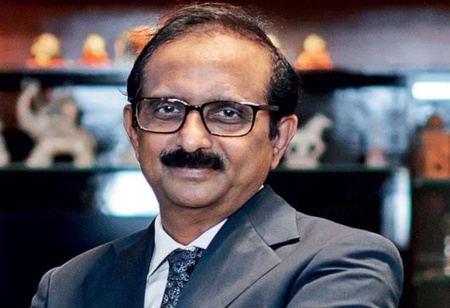
Artificial intelligence in Indian banking must move beyond improving retail services and help expand credit access for farmers and MSMEs, SBI Chairman CS Setty said at a Ficci-IBA event.
Highlights:
- SBI Chairman CS Setty says AI’s next big role in banking should be expanding credit access for farmers, small businesses and underserved customers.
- Banks must strengthen cybersecurity and oversight alongside AI adoption, as more autonomous systems could create new risks and vulnerabilities.
Banks have already started using AI to understand customers, improve services, manage risks and speed up credit decisions, but much of this adoption has focused on retail banking because of the availability of large volumes of customer and transaction data.
Setty said the bigger opportunity lies in taking AI deeper into India's economy, particularly rural areas and small businesses where conventional credit models may not fully capture financial potential. He also stressed that banks must build stronger safeguards as AI systems become more advanced and autonomous.
Can AI Help Banks Reach More Farmers and Small Businesses?
Setty identified agriculture as a major opportunity for AI-led banking, particularly in improving credit assessment and access to finance.
AI can combine farm-level information, digital records, satellite imagery and other data to help banks make more informed lending decisions. These tools could allow lenders to assess risks more accurately and understand customers whose financial histories may not fit traditional credit models.
Some banks are already using such technologies in farm lending, but Setty said the bigger challenge is taking these initiatives beyond pilot projects. The technology needs to become affordable, practical and accessible at the last mile if it is to make a meaningful difference to rural borrowers.
The same opportunity extends to MSMEs and other small businesses. Many such enterprises have limited formal financial histories, which can make conventional credit assessment difficult. AI could help banks evaluate a broader range of data and potentially widen access to formal finance.
This becomes particularly important as India targets its ambition of becoming a developed economy by 2047. For Setty, AI-led banking will have a larger economic impact only when it reaches customers beyond the traditional retail banking base.
Also Read: How Today's CFOs Navigate Risk Beyond the Balance Sheet
AI Growth Also Raises Cybersecurity and Trust Concerns
While AI can improve banking efficiency and financial inclusion, Setty warned that greater adoption will also create new cybersecurity and fraud risks.
More sophisticated AI systems could allow fraudsters to develop more advanced methods at a pace that conventional security systems may struggle to match. Banks will therefore need to strengthen their defences while expanding their use of AI.
Setty also highlighted the importance of trust, oversight, transparency and model risk management as banks increasingly adopt autonomous AI systems. As these systems take on more decision-making responsibilities, banks will need clear accountability over how AI operates and how its decisions affect customers.
The challenge for India's banking sector, therefore, is no longer simply about adopting AI. It is about making the technology useful beyond retail banking while ensuring that credit expansion, cybersecurity and human oversight develop together.