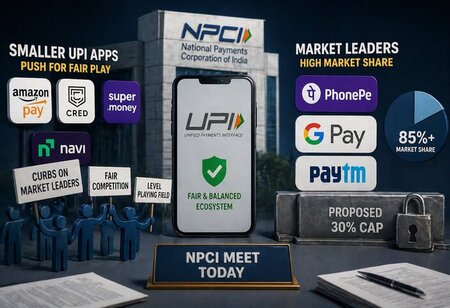
A group of smaller UPI players, including Amazon Pay, CRED, Navi, and Super Money, are set to seek fresh regulatory curbs on dominant platforms at a key meeting with the National Payments Corporation of India (NPCI) today. The move comes as the industry continues to grapple with the long-pending issue of implementing a market share cap.
Key Highlights
- Small UPI players push curbs on dominant apps to address rising market concentration risks.
- NPCI meeting to discuss fair competition, monetisation rules, and delayed 30% market cap implementation.
According to reports, the meeting will see participation from a broader set of ecosystem players beyond PhonePe, Google Pay, and Paytm, with smaller firms expected to jointly push proposals aimed at limiting the continued dominance of the top three apps.
Among the key measures under discussion are restrictions on user acquisition practices, including limiting the use of UPI ID mappers and banning app download targeting through users’ contact book data.
In addition, smaller players are advocating tighter monetization norms. These include preventing payment aggregators and gateways from charging fees on tokenised UPI checkouts at both the app and instrument level.
Push for fairer transaction ecosystem
Other proposals being considered include curbs on “collect” payment requests unless accompanied by broader merchant-side democratisation, as well as restrictions on autopay mandates to avoid concentration of recurring transactions among a few dominant apps.
Smaller third-party app providers (TPAPs) are also seeking preferential incentives, interoperability of transaction history and biller data across platforms, and early or exclusive access to new UPI features to accelerate adoption.
Also Read: PhonePe Becomes First UPI App to Cross 10 Billion Monthly Transactions
Market share cap debate intensifies
The push comes amid delays in implementing the proposed 30% market share cap, first introduced in 2020 and now deferred until the end of 2026 due to concerns over potential disruption to user experience and transaction flows.
Currently, the UPI ecosystem remains highly concentrated, with PhonePe, Google Pay, and Paytm collectively accounting for over 85% of transaction volumes. PhonePe alone commands nearly half the market, followed by Google Pay and Paytm.
Rapid growth, rising concentration concerns
India’s UPI network has scaled rapidly, processing over 22 billion transactions monthly, making it one of the largest real-time payment systems globally. However, the dominance of a few players has raised concerns around systemic risk and fair competition within the ecosystem.