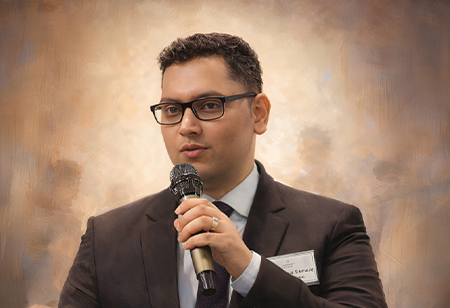
In an interaction with Finance Outlook India, Atharva Samant, Founding Partner at RGAS & Associates, shares his perspective on the emerging CFO–COO hybrid role and how finance leaders are increasingly stepping into operational leadership. Drawing from his experience as a Chartered Accountant, fractional CFO, and tax advisor, Atharva explains how the modern CFO is moving beyond reporting and compliance to become a strategic execution partner to the CEO.
With expertise spanning corporate finance, tax advisory across India, the US, the Middle East, and Singapore, forensic accounting, and sustainability reporting, Atharva works closely with founders, promoters, and boards during critical phases such as growth, restructuring, and regulatory scrutiny. His work focuses on building financial clarity, strengthening controls, and designing scalable, future-ready finance systems that align financial discipline with long-term business outcomes.
How is the CFO role evolving into operational leadership today?
Let’s first understand what a Chief Operating Officer (COO) does. COO runs the company’s day-to-day business. The COO turns the CEO’s vision into action by setting clear plans, managing teams, improving processes, and making sure execution happens across the organization. In many companies, the COO becomes the CEO’s closest partner because they own how the business actually runs.
What is changing now is that many CFOs are stepping into that same “right-hand” role. This shift is especially visible in global companies where finance and execution can no longer be separated.
In the US, this is showing up through hybrid roles. At Salesforce, Robin Washington holds the title of Chief Operating and Financial Officer (COFO). This role combines finance with core business operations. Her responsibilities span strategy, operations, global finance, employee success, key customers and partners, marketing, communications, and even workplace and real estate. It shows how one leader can align money, people, and execution under a single view. Many tech companies in USA and in other countries are doing the same thing.
India is seeing a similar evolution. Akriti Chopra at Zomato is a strong example. A Chartered Accountant by training, she joined Zomato early in her career and gradually took on roles that blended finance and operations. Over time, she moved from finance leadership into broader responsibilities, eventually becoming CFO and Chief People Officer as part of the founding leadership team.
This reflects a bigger shift in what the CFO role means today. CFOs are no longer limited to reporting, compliance, budgeting, and risk control. Many are now strategic partners to the CEO, helping drive revenue growth, improve efficiency, support digital transformation, optimize talent, and build long-term value.
Technology is a key enabler of this change. CFOs are using automation to reduce manual work and improve speed and accuracy. AI is helping move finance from looking backward to predicting what comes next. Cloud-based ERP systems are connecting finance with operations, HR, and supply chain. As a result, CFOs are freeing up time to focus on better decisions and stronger execution, not just better reports.
Which skills help CFOs manage both finance and operations effectively?
To succeed as a modern CFO who also operates like a COO, you need strong mental discipline. You are constantly balancing two valid but opposing ways of thinking. The CFO mindset focuses on control, risk, and returns. The COO mindset focuses on execution, efficiency, and speed.
Both are right. And that is exactly where the tension comes from. You may want to approve an operational upgrade because it improves performance, while at the same time wanting to stretch assets longer to protect cash flow and returns. Living with this tension, without defaulting to one side, is the real skill.
This is also why CFOs increasingly work very closely with the CEO. The CFO sees the entire business through numbers, constraints, and trade-offs. They often understand how decisions ripple across the organization better than most functional leaders. That makes the CFO a natural strategic partner, not just a finance head.
But operating like a COFO requires much more than financial skills. Traditional CFO skills are necessary but not sufficient. Accounting, reporting, budgeting, treasury, tax, capital allocation, M&A, compliance, and risk management are table stakes.
The real shift happens when a CFO steps into operational ownership. This means understanding how the business actually runs day to day. It means improving processes, removing friction, and being accountable for outcomes, not just reviewing results after the fact.
Technology is another gap that CFOs must close. AI and automation are no longer optional tools. They are core to speed and decision quality. Finance is moving from reporting the past to predicting the future. For a CFO taking on a broader role, this means using data and technology to improve forecasting, automate routine work, streamline operations, and help the business respond faster.
Risk management also becomes more complex. Indian businesses operate under heavy regulatory requirements from SEBI, RBI, the Companies Act, and ESG frameworks like BRSR. At the same time, cyber risk and supply chain uncertainty are rising. The answer cannot be hiring more people for every problem. It has to be better systems, cleaner processes, and smarter controls that scale.
This is where operational exposure matters. CFOs who have worked on M&A integration, large programs, or finance roles tied closely to supply chain, IT, or customer operations tend to adapt faster. That experience builds the ability to connect revenue, costs, cash, and long-term value in one view.
In the end, a CFO becomes an effective COFO only by widening their leadership scope. Financial discipline must be combined with operational excellence, technology fluency, and the ability to lead across functions like operations, IT, sales, HR, and workplace management.
The best CFOs today are execution leaders. They help translate strategy into action and enable the CEO to move faster, make better trade-offs, and build a stronger business over time.
Where does CFO–COO role overlap drive the most business value?
The overlap between the CFO and COO roles creates real value because it improves how quickly and how well a company makes decisions. When finance and operations are led together, financial discipline meets day-to-day execution. Forecasting, risk control, and capital planning sit directly next to operations, technology rollout, and resource deployment.
This reduces silos. Fewer handoffs mean fewer delays. Plans no longer live in spreadsheets while execution happens somewhere else. Capital flows through the business faster and more cleanly, improving cash flow, return on capital, and execution speed.
i. Better capital allocation and working capital control
The biggest advantage of this model is stronger capital allocation. When one leader sees both money and operations, decisions on capex, hiring, inventory, and supplier terms become faster and more grounded in reality.
Every operational decision is naturally tested against cash impact, funding cost, and business priorities. This often shortens the cash conversion cycle and frees up liquidity. That cash can then be reinvested in growth or used to reduce debt. It also removes the usual friction between finance, treasury, and operations, where decisions get stuck because teams approach the same problem from different angles.
ii. Higher efficiency and less waste
A combined finance and operations lens makes it easier to spot inefficiencies that cut across departments. Costs that look small in isolation but add up across the system become visible.
Performance can be tracked using both financial and operational metrics together, not in isolation. This leads to better cost control without hurting momentum, cleaner execution, and more reliable forecasts because plans are built on operational reality, not assumptions.
iii. Faster and more disciplined digital and AI investment
Technology spending only creates value when it improves execution and pays back financially. When finance and operations are aligned under one leader, automation, data platforms, and AI initiatives are more likely to deliver both.
Projects get prioritized based on business impact, not just technical ambition. Data becomes more unified across teams, which improves real-time visibility and decision quality. This is why many companies are blending financial leadership with operations and technology oversight as they scale AI and digital transformation.
iv. Faster decisions and stronger execution alignment
Decision speed improves when one leader understands both strategy and on-ground financial constraints. Fewer approvals are needed. Fewer debates happen between functions.
This is especially valuable during high-pressure situations like mergers, restructurings, rapid growth, or large transformation programs. Coordination improves because the same person is accountable for both the plan and the outcome.
v. Stronger forecasting, reporting, and risk management
With an integrated view, reporting becomes more accurate and timely. Forecasts reflect what is actually happening on the ground. Risks are identified earlier because operational disruptions are immediately linked to financial impact.
This gives the CEO, board, and investors greater confidence. Accountability is clearer, and performance management becomes more effective.
Where this model works best?
This structure creates the most value in fast-changing industries such as tech, SaaS, and manufacturing, especially in companies that are growing, transforming, or operating under capital pressure. This also is more suitable for startups and mid-sized companies and not top Large-cap listed companies.
Like any powerful role, success depends on the individual and alignment with the CEO. When done well, the benefits compound over time. The business becomes more efficient in the short term, more agile in competitive cycles, and more productive with capital over the long term.
Also Read: How CFOs Boost Real Estate Profitability via Budgeting & MIS
What risks emerge when CFOs take on core operational duties?
When a CFO also takes on core COO responsibilities, the risks are real. If not designed carefully, the role can weaken performance instead of improving it. The promise of speed and integration breaks down when one person is stretched too thin, lacks the right experience, or operates without proper checks and balances.
i. Overload, burnout, and split focus
Finance and operations are both full-time jobs. Finance demands precision, compliance, and external accountability. Operations demand daily decisions, firefighting, and cross-team coordination. When one person owns both, attention gets divided.
This often shows up as delayed decisions, missed details in reporting or compliance, and constant context switching. Large spans of control make it worse. Too many direct reports turn the leader into a bottleneck. Over time, performance drops or burnout sets in, sometimes quietly, until something breaks.
ii. Gaps in operational depth
Many CFOs are excellent at numbers but have limited hands-on experience in operations. Supply chains, manufacturing, sales execution, IT rollouts, and people management work very differently from finance.
Without deep operational exposure, decisions can look good on paper but fail in reality. Costs may be cut in the wrong places. Timelines may be underestimated. A finance-first mindset can accidentally slow growth or damage customer experience.
iii. Bias and conflicting priorities
The dual role can create tension between short-term financial results and long-term operational investment. Employees may feel that every decision is driven by cost control rather than capability building.
This perception matters. It can hurt morale and reduce trust. Conflicting goals, such as profitability versus speed or flexibility, can confuse teams. When finance dominates the narrative, operations teams may disengage or resist change.
iv. Weaker governance and too much power in one role
Combining roles reduces natural checks and balances. When one executive controls money, operations, and execution, risks become concentrated. Errors are harder to catch. Escalations slow down because everything routes to one person.
Boards often need to step in with safeguards. Clear decision rights, independent audit reporting, and defined escalation paths become critical. Without this structure, compliance risks rise and succession planning becomes difficult.
v. Change, culture, and scaling problems
Merging finance and operations is not just a structural change. It is a cultural one. Teams used to working in silos may resist. If change management is weak, integration stalls and old behaviors persist.
As the company grows, the model can also stop scaling. The business becomes too dependent on one leader. Decision speed slows instead of improving. In large or complex organizations, this risk increases sharply.
When the risks are highest? These issues are more likely in large or mature companies, operations-heavy businesses, and highly regulated environments. They also increase when the CFO has limited operational or leadership exposure beyond finance. Smaller and growth-stage companies tend to handle this model better. Their structures are simpler, cultures more flexible, and speed matters more than formal separation.
How to reduce the risk? The role works best when the leader has real operational experience, not just financial expertise. Strong support teams are essential, such as a capable controller, senior operations leaders, and clear second lines of accountability. Governance must be explicit, not assumed. Boards should stay actively involved. Change management cannot be optional.
In large-cap listed companies or complex group structures, separate CFO and COO roles usually make more sense. Independence and specialization matter more at that scale.
In startups and mid-sized companies, a well-designed CFO–COO hybrid can work and often works better. The key is not the title, but whether the organization is honest about the risks and builds the structure to support it.
Integration creates value only when the role is designed for humans, not superhumans.
How will the CFO–COO hybrid role evolve over the next decade?
Over the next decade, the CFO–COO hybrid role will move from a rare efficiency experiment to a core leadership role in many fast-moving organizations. This will be most visible in tech, manufacturing, and growth companies where speed, capital discipline, and execution matter more than rigid role boundaries. The main reason is simple: AI, volatility, and regulation are forcing finance and operations to work as one system, not as separate functions.
i. AI will fundamentally change what the role exists to do
By 2035, much of today’s finance and operations work will be automated. Closing books, reconciliations, forecasting, basic controls, and routine operational decisions will increasingly be handled by AI systems. The CFO–COO hybrid will not “do” these tasks but will oversee them.
The real job becomes deciding what AI is allowed to decide, checking whether its outputs make sense, and owning accountability. This role will act as the final human filter for AI-driven decisions across finance, operations, and performance. Leaders will also be responsible for scaling a mixed workforce of people and AI tools, ensuring data quality, security, and trust. As more employees manage AI systems directly, someone must own reskilling, guardrails, and coordination. That responsibility naturally sits at the intersection of finance and operations.
ii. The scope will widen beyond finance and operations
This role will steadily absorb responsibility for areas that cut across the enterprise. Sustainability and ESG reporting, regulatory compliance, cyber risk, supply chain resilience, and long-range scenario planning are already moving into the CFO and COO agendas. The hybrid role makes this easier because these issues cannot be solved in silos.
In many organizations, this leader will either closely partner with or partially absorb responsibilities traditionally owned by IT and data teams. The goal is not to become a technologist, but to ensure that data, systems, and processes actually support business decisions. As companies add more executive titles, this hybrid role becomes a stabilizer that connects strategy to execution.
iii. From execution manager to enterprise architect
As AI reduces the burden of daily oversight, the role shifts upward. The CFO–COO hybrid becomes less of an operator and more of an enterprise architect. This means shaping how resources move across the company, deciding which initiatives get funded, and ensuring that strategy turns into results.
The leader spends more time aligning teams, removing friction between functions, and helping the CEO navigate uncertainty. Financial insight becomes a real-time story about where the business is going, not a backward-looking report. Influence, judgment, and the ability to lead change become more important than technical perfection.
iv. Adoption will vary, but CEO pathways will favor it
This hybrid role will become common in companies facing constant disruption. It will be slower to appear in stable, regulated, or very large organizations where separation of powers still matters. The risk of overload is real, so not every company or leader will be suited to it.
That said, experience across both finance and operations is increasingly seen as preparation for the CEO role. Many new CEOs already come from COO or president backgrounds. Leaders who can integrate capital, execution, and technology into one view of the business will have a clear advantage.
v. Skills, structure, and governance will decide success
The role will demand comfort with AI, strong business judgment, and the ability to lead people through change. No one can do this alone. Companies that succeed will build support layers, clear decision rights, and strong governance around ethics, risk, and accountability.
Over time, some organizations may rename this role entirely, focusing less on titles and more on enterprise ownership. The core idea remains the same: one leader responsible for turning strategy, data, finance, and execution into durable value.
The bottom line
The CFO–COO hybrid will not become universal, but it will become normal where speed, integration, and capital efficiency drive advantage. AI makes this role possible by taking work off the leader’s plate. Organizational design makes it sustainable. And leadership quality determines whether it becomes a force multiplier or a burnout risk.
In a world with fewer silos and faster decisions, the value of leaders who can see the whole system will only increase.