India's Creator Economy Vanguard
Ranveer Allahbadia (BeerBiceps) turned long-form podcasts into a multi-vertical media company. His evolution from fitness vlogs to entrepreneurial interviews, and now The Ranveer Show, one of the most-popular podcasts in India, shows how owning content in one vertical - and being seen as the expert - opens the door to brand collaborations, events and courses.
Technical Guruji (Gaurav Chaudhary) demonstrated that vernacular content could go global. By connecting with people in Hindi, when tech content in India was mostly available just in English, he set the blueprint that thousands of creators adopt today: connect with the audience, own the trust, then expand into related niches.
CarryMinati (Ajey Nagar) is the gaming and roast content archetype - a creator who established such cultural relevance that he is now a mainstream entertainment phenomenon. His journey from uncensored commentary to an entertainment conglomerate illustrates the value of IP.
Sharan Hegde (Finance with Sharan) is perhaps the most textbook example of the 2026 solopreneur model. Starting with financial literacy content on Instagram and YouTube, he rapidly built a multi-crore business encompassing online courses, a finance app partnership, a newsletter, and a community - all centred on a core intellectual brand.
Tanmay Bhat represents a rare hybrid: comedian turned media operator and early-stage investor. His evolution from AIB co-founder to solo content creator to active investor in the Indian creator economy illustrates what Pillar 2 (IP and Equity) looks like at its most sophisticated.
India’s Top Solopreneurs
Ankur Warikoo is the definitive case study for the content-to-education solopreneur pipeline. A former CEO of Groupon India, Warikoo rebuilt his career as a personal brand - publishing books, building online courses, and mentoring through content - operating what is effectively a one-person educational empire. His disciplined content calendar, consistent publishing cadence, and systemised product launches are studied by aspiring solopreneurs across South Asia.
CA Rachana Ranade converted domain expertise into a financial education platform that rivals institutional offerings. Starting with YouTube videos explaining complex financial concepts in accessible language, she built a multi-crore business anchored on professional credibility. Her model is a direct answer to the question every expert-creator asks: Can my knowledge become a scalable business without diluting its integrity? The answer, in her case, is a yes.
Kanika Tekriwal (JetSetGo) demonstrates that solopreneurship is not limited to digital content. Beginning as a solo entrepreneur who identified a structural gap in India's private aviation market, she built the country's first private jet marketplace from scratch - without a co-founder, without inherited capital, and in an industry that had no existing playbook for disruption at that scale.
Divya Jaitly (GetMyTea OPC Pvt. Ltd.) is one of India's most instructive examples of the One-Person Company structure applied to global commerce. Operating as a sole owner, she manages the entire supply chain of sourcing and exporting premium Indian teas internationally - a business that combines deep product knowledge, international trade expertise, and personal brand storytelling in a way that no large corporation could replicate with the same authenticity.
Nikhil Rathi (Aarna Software OPC Pvt. Ltd.) represents the B2B solopreneur - a model often overlooked in creator economy conversations dominated by consumer-facing content. Operating from Nagpur, Rathi built a retail tech software company as a One-Person Company, serving local SMEs with digital adoption solutions. His story is proof that the solopreneur revolution is not confined to influencers, YouTubers, or course creators. It belongs equally to founders, consultants, and specialists who choose to own their work entirely.
These ten individuals across media, finance, aviation, trade, and software collectively map the full terrain of what the creator economy looks like when taken seriously as a business model rather than a side hustle.
Also Read: Best Instant Personal Loan Apps in India Without a Salary Slip (2026)
Conclusion
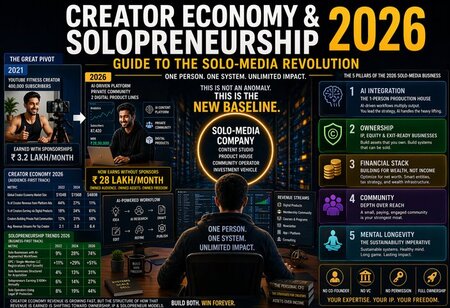
The Solo-Media Revolution Is Not a Trend. It Is Infrastructure. The Creator Economy gives you distribution. Solopreneurship gives you the structure that makes distribution permanent. One without the other is incomplete - reach without ownership is rented, and ownership without reach is invisible.
The five pillars in this guide - AI Integration, Ownership, Financial Stack, Community, and Mental Longevity - are not tactics. They are the load-bearing walls of a Solo-Media Company. Build all five and you have something rare in 2026: a one-person business that is scalable without hiring, sellable without a co-founder, and sustainable without burning out its founder.