
Finance outlook india logo
Home News Exclusive Expert's Viewpoint Corporate Startup Fintech Personal Magazine About Us Budget'24
  • Budget'26 Budget'25 Budget'24
    • Home
    • Exclusive
    Gen Z and Money Debit First Generation Rewriting the Rules of Credit

    Gen Z & Money: Debit-First Generation Rewriting the Rules of Credit


    Shiwani Pradhan, Assistant Editor, Finance Outlook India

    As Buy Now, Pay Later reshapes how young consumers spend, a generation raised on transparency, digital access, and debt aversion is navigating a complex new financial landscape - with real stakes for their futures.

    Born into the wreckage of the 2008 financial crisis, raised through a pandemic, and financially literate in ways their parents never were at 22, Gen Z has a complicated relationship with money. They are the first generation to come of age entirely in the smartphone era - yet they are also the most debt-averse cohort in decades. Sixty-nine percent prefer debit cards over credit cards, a deliberate rejection of interest structures they find opaque and predatory. And yet, a new form of debt - dressed in the language of empowerment, flexibility, and zero interest - has captured their wallets: Buy Now, Pay Later.

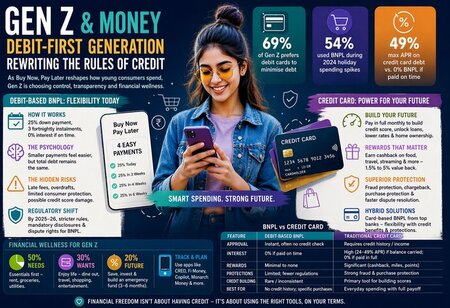
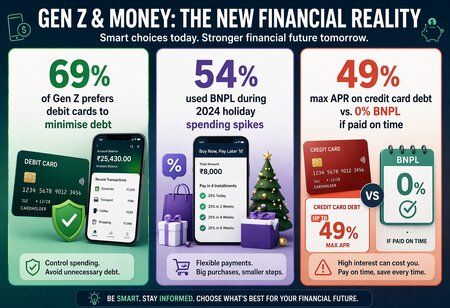
    • 69% of Gen Z prefers debit cards to minimise debt
    • 54% used BNPL during 2024 holiday spending spikes
    • 49% max APR on credit card debt vs. 0% BNPL if paid on time


    Core Pillar

    The Gen Z Financial Identity

    Gen Z's financial identity rests on three tensions: the desire for immediacy (instant digital access to anything), the need for sustainability (building actual long-term wealth), and an instinct toward ethics (choosing institutions that reflect their values).

    This generation banks with apps rather than branches. They comparison-shop interest rates at 23. They call out predatory fee structures on TikTok. They are also, paradoxically, more likely than any generation before them to miss a BNPL repayment - because the very design of instalment payments makes debt feel invisible.

    Gen Z is 27% more likely to choose a financial institution based on its environmental or social commitments. ESG-aligned neobanks and credit unions are growing disproportionately in this demographic.

    Decoding Debit-Based BNPL

    Buy Now, Pay Later sounds simple: you split a purchase into four equal instalments, the first due immediately (typically 25% of the total), the rest fortnightly. Pay on time? Zero interest. Retailers love it - conversion rates jump when the total price disappears behind a smaller number. Consumers love it - until they don't.

    How it works

    25% down at checkout, three fortnightly payments. Typically no hard credit check at approval- instant access, frictionless design.

    The psychology

    Splitting a Rs 8,000 purchase into four Rs 2,000 payments reduces perceived cost but the total obligation doesn't change.

    Hidden risks

    Late fees, debit account overdrafts, and minimal consumer protections. BNPL loans often fall outside traditional lending regulation.

    Regulatory shift

    By 2025–26, the CFPB and global equivalents are treating BNPL products as credit, introducing mandatory disclosures and dispute rights.

    The danger is what economists call invisible debt. A Gen Z consumer with four simultaneous BNPL plans - each individually manageable - may be carrying Rs 30,000-Rs 50,000 in obligations they cannot see aggregated anywhere. No single provider shows them the full picture. And when a linked debit account runs low, missed payments cascade into overdraft fees and credit score damage.

    The Hidden Cost 

    BNPL providers are not legally required (in most jurisdictions) to report on-time payments to credit bureaus - but they can report defaults. You get none of the upside and all of the downside risk on your -redit score.

    The regulatory landscape is shifting. In 2025, the Consumer Financial Protection Bureau in the United States issued guidance classifying many BNPL products as credit cards under federal law - extending Truth in Lending Act protections to consumers and requiring clearer fee disclosures. The UK's Financial Conduct Authority introduced similar requirements, with India's RBI tightening rules on lending app partnerships. Gen Z's preferred payment method is growing up fast - and getting watched.
    Also Read: The Rise of Parallel Careers: How Gen Z Is Redefining Work in India

    Modern Credit Strategy for Gen Z

    "A credit score is not a number about the past. It is a number about who you can become - it determines whether you can rent the flat, get the mortgage, or qualify for the car loan."

    Here's the uncomfortable truth that BNPL marketing does not mention: credit cards, used strategically, remain the single most powerful financial tool available to a young person building their future. The key word is strategically.

    Paying your balance in full each month costs you exactly zero in interest while building a credit history that unlocks homeownership, better insurance premiums, and lower borrowing costs for life. The 24-49% APR figure that terrifies Gen Z applies only to revolving balances - money you have not paid back. If you treat a credit card exactly like a debit card (only spend what you have) and pay in full, the APR is irrelevant. What remains are: rewards, fraud protection, and credit building.

    Rewards optimisation matters more than many Gen Z consumers realise. Cards aligned with this generation's lifestyle - high cashback on food delivery, streaming, travel, and rideshares - effectively reduce the cost of everyday spending by 1.5-5%. Over a year of ordinary purchases, this compounds meaningfully.

    Fraud and purchase protection remains the most underappreciated credit card benefit. Disputed a fraudulent BNPL charge lately? It can take weeks. Disputing a credit card charge? Federal law requires a response within 30 days and often results in immediate provisional credit. If you buy a laptop that arrives broken, your credit card's purchase protection can reimburse you. BNPL offers no equivalent.

    Major banks are paying attention. American Express, JPMorgan Chase, and Citi have all launched card-based BNPL instalment plans embedded within credit accounts. These hybrid products offer the flexibility Gen Z wants while preserving the consumer protections and credit-building benefits of traditional credit. It is, in many ways, the best of both worlds.

    Lifestyle Integration & Financial Wellness


    Social media has collapsed the distance between aspiration and consumption. When everyone you follow is wearing the same trainer drop, attending the same festival, or staying at the same boutique hotel, spending becomes performance. BNPL makes it cheaper to perform or appears to. The FOMO tax is real, and instalment plans are its preferred currency.

    The antidote is not austerity. It is a framework that makes intentional spending sustainable.

    50% Needs

    Rent, groceries, transport, utilities - the non-negotiables. If this category exceeds 50% of take-home pay, the priority is income growth or cost reduction, not BNPL plans for discretionary items.

    30% Wants

    Dining out, travel, entertainment, new clothes. This is where BNPL and credit card rewards both operate — fund this category from the budget first, then consider how you pay for it.

    20% Future

    Emergency fund, investments, debt repayment. A 3-6 month emergency fund (3–6 months of essential expenses in liquid savings) is a prerequisite before any discretionary credit use - BNPL or otherwise.

    Top-rated tools for Gen Z financial management in 2026 include: CRED (credit card management, India), Fi Money (smart banking with spending analytics), Copilot (US, AI-powered budgeting), and Mint alternatives like Monarch Money for comprehensive net worth tracking. For BNPL users specifically, apps that aggregate all active instalment plans into a single view - showing true total obligations - are increasingly essential.

    Comparative Analytics: Making the Decision

    Context determines which tool wins. During the 2024 holiday season, 54% of Gen Z used BNPL - even those who owned credit cards. The reason was often psychological: BNPL felt lighter, less like "real" debt, and more controllable. The 0% interest framing won against credit card APR fears, even when those fears were misplaced for consumers who pay in full.

    The total cost comparison, however, is clear: 0% BNPL (paid on time) costs nothing extra. A credit card balance carried at 24-49% APR costs enormously. But a credit card paid in full costs nothing and builds credit. The middle option - BNPL missed payments - can also cost enormously, in fees and credit damage.

    Debit-Based BNPL vs Traditional Credit Card

    Feature

    Debit BNPL

    Credit Card

    Approval

    Instant, often no credit check

    Requires credit history / income

    Interest

    0% if paid on time

    High (24–49% APR) if balance carried; 0% if paid in full

    Rewards

    Minimal to none

    Significant (cashback, miles, points)

    Protections

    Limited; fewer regulations

    Strong fraud & purchase protection

    Credit Building

    Rare / inconsistent

    Primary tool for building scores

    Best For

    No credit history; specific planned purchases

    Everyday spending with full monthly payoff


    On credit scores: the nuance matters. Most BNPL providers run only a "soft" pull - invisible to bureaus - at approval. Your score is unaffected. But if you default, many providers will now report that, and the damage can be severe. You get no credit benefit from paying on time, but you absorb the full cost of paying late. This asymmetry is the clearest argument for including a traditional credit card in your financial toolkit, even if you primarily use BNPL.

    The Verdict: Not Either/Or

    The smartest Gen Z financial strategy is not "BNPL over credit" or "credit over BNPL." It is intentional tool selection. Use BNPL for specific, planned purchases where you have the cash available and simply want to spread timing - never to buy something you cannot currently afford. Use a credit card for everyday spending, paying in full monthly, to build the credit score that will matter enormously at 28, 32, and beyond.

    Build your emergency fund first. Follow the 50-30-20 framework. Track your obligations in one place. And recognise that the "debit-first" instinct - the desire to avoid debt - is genuinely healthy. The goal is to apply that same rigour to all forms of spending commitment, including the ones with "zero interest" in the name.

    Financial freedom, for Gen Z, is not the absence of credit. It is the ability to use every financial tool on your own terms - with full awareness of the actual costs.


    Read More:

    Branded Residences Go Mainstream as Buyers Seek Trust & Value

    Best Instant Personal Loan Apps in India Without a Salary Slip (2026)

    KNOWLEDGE DECK

    Most Viewed

    • The Economic Impact of India-Pakistan War: A Detailed Analysis

    • Why Financial Literacy Matters More Than Ever for Today's Youth

    • Prominent Financial Advisors in India to Partner With

    • Rags to Riches: The Top 6 Indian Entrepreneurs' Motivational Tales of Success

    • Navigating Financial Disruption With Future Proof Financial Service Deliverability

    • India's Rs 31 Lakh Cr Green Push: Building the Foundation of a Net-Zero Future

    • Wakhariya & Wakhariya: Facilitating International Legal Processes across Diverse Domains

    • Aligning Financial Strategies with Sustainable Business Goals

    • The Top 5 Highest-paid Actors in India - 2024

    • Central Government Proposes Tax on Agricultural Water Usage

    • Carpediem Capital Invests INR 100 Crore, CorporatEdge to Deploy INR 350 Crore in the next 3 Years

    • EPFO Registers All-Time High Member Addition of 20.06 Lakh in May 2025

    • Unearthing Intricacies of Today and Beyond in the Indian Insurance Sector

    • Expected Correction in Housing Prices to Revive Sales in Coming Quarters

    • How to Choose the Right Mutual Fund for your Financial Goals?

    • Future of Corporate Finance: Emerging Trends in Treasury Solutions and Cash Management for MNCs

    • ElasticRun Announces FY24 Financial Results: Key Details

    • Financial Inclusion in Viksit Bharat

    • Abans Financial Services Advises Vaishali Pharma on Strategic Acquisition of Kesar Pharma


    🍪 Do you like Cookies?

    We use cookies to ensure you get the best experience on our website. Read more...

    Copyright © 2026 Finance Outlook India. All rights reserved.   Privacy Policy Terms of Use Blogs Conferences Subscribe WRAPUP’25