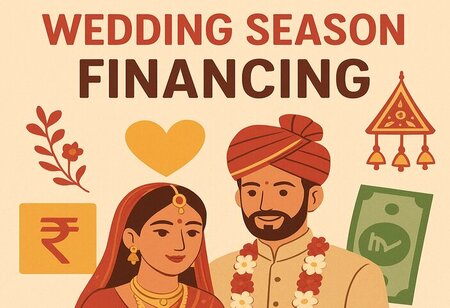
Indian wedding season is not only the season of love and tradition, but also a great financial investment that could drain the finances of families and change the financial planning in years to come. Due to the increased elaboration of weddings, it has become imperative to know the financial environment and the available funding sources to the families in the nation.
The Increasing Price of the Indian Weddings
Through the years, the cost of Indian weddings has continued to increase. Estimates in the industry show that average cost of an Indian wedding is 10-20 lakh but this figure may escalate to a few crores among the rich families. The cost of a wedding in a city is generally high as compared to the rural parts, and in metropolitan cities such as Mumbai, Delhi, and Bangalore the cost is considerably high. The multi-day celebration format, the increasing demands and social pressure to conform and even surpass community standards are input factors that help increase the costs.
Estimating the Costs of a Wedding
The expenses of wedding are spread into a large number of categories and they require big investments. The costs of venue booking and decoration normally take up 15-20 percent of the overall budget of the event, and higher the rank of the banquet halls and destination venues, the higher their price is during season. Another significant cost is catering which usually consumes 25-30 percent of the costs, and per plate costs are in the range of 800-5000 rupees or even higher on the basis of the elaborateness of the menus. The price of photography and videography services has gone up to 50,000 to several lakhs of money due to demand of cinematic wedding movies and drone shots.
A very big chunk of money is devoted to bridal dance and jewelry, where designer lehengas are sold between 50,000 and a few lakhs and jewelry purchase, may it be in the form of gold or diamond or precious stones can be the biggest single cost expense. The costs become increasingly high with the wedding cards, return gifts, guest transportation, entertainers in the form of DJs and live musicians, makeup artists, and decorators. Such functions as mehendi, sangeet, and engagement parties must be budgeted separately.
Traditional Financing Methods
Traditionally, Indian families have been using their traditional savings in order to finance weddings. Some parents start saving to have funds ready to arrange the weddings of their children since they are born, by putting their money in fixed deposits, recurrent deposits and gold investments. The joint family system tended to imply that wedding costs were shared with several family members sharing the financial burden among the uncles, aunts, and grandparents.
Gold jewels which are a symbol of investment as well as an ornament in the Indian culture have been used as a cushion to protect finances. Families would sell or vow accumulated gold to fund weddings. Also, the chit funds system, an informal savings system that would be suitable in South India, gave a systematic means of families saving up wedding money.
Modern Financing Options
The modern financial world provides various alternatives to the funding of weddings. Personal loans that are specifically promoted as wedding loans have become very popular and banks and NBFCs provide loans in the range of 50,000 to 25 lakhs or more. These loans are normally charged at an interest rate of 10-18 percent per annum with a loan repayment period of a maximum of five years. They are also appealing to families that require urgent funds as the approval process is comparatively fast and only requires a few forms.
The use of credit cards in wedding purchases has been growing particularly in booking of vendors and advance payments. Most high-end credit cards have reward points, cashback and EMI conversion features that can be used to control expenses. Yet, it is important to have a credit card debt repayment plan because of its high interest rates.
Loan against property or gold loan plans are less costly than unsecured loans because they attract low interests, and thus become viable options when the family has assets. Gold loans, especially in wedding season, mean that the family can borrow their gold without selling it permanently with interest rates normally in the range of 8-12% per year.
Monetary Planning Strategies
Financial advisors suggest that one should begin saving towards wedding early as a matter of fact several years before. It is essential to develop a practical budget, which is grounded on the real financial possibility, and not social demands. This is because cost control includes prioritizing expenses as must-haves and nice-to-haves. Most couples now prefer small and intimate events as opposed to huge events that accommodate thousands of people.
By negotiating with vendors, making service reservations at low seasons and combining services with one vendor, one can save a lot of money. Other families are adopting the spread cost cover-over-various financing options instead of taking a single and expensive loan and maximizing their interest expenses.
New Trends and Conscious Purchasing
An increasing number of Indian couples are adopting simple weddings that are more about the events than the fancy. This trend can be seen as a response to a changing perception of wedding costs, mainly younger and economically conscious couples who are interested in investing their future in a house, a business, or in a retirement plan as opposed to spending it on one occasion.
Crowdfunding websites have become alternative sources of funds with couples establishing registries not only to receive gifts but also to receive certain wedding costs so that guests can chip in to receive a specific service or experience. Couples too are choosing to marry in court and have small wedding celebrations, defying the conventional rules but being financially wise.
Also Read: Matrimony.com Develops WeddingLoan.com to Make Wedding Finance Easier
The Financial Wellness and Debt Trap
Financial experts caution on excessive leveraging of weddings despite the available financing sources. The debt on marriage may weigh down families over years and cause them to fail to achieve other financial ambitions. The social status has also been stressed and families have fallen into the traps of debt where they have borrowed many loans in different manners without proper plans of repayment.
There is a slow change in the financial literacy regarding the costs of a wedding and more families realize that a one-day celebration should not come at the cost of long-term financial well-being. Banking and other financial institutions are also doing better lending practices whereby they undertake strict evaluations of repayment ability.
The issue of Indian wedding financing is the intricate combination of tradition, social norms, and the financial aspects of modernity. Although the celebrations are culturally a great thing, how it is going to be financed should be planned well and realistically budgeted and smart decisions made to make the wedding day happiness not turn into a nightmare of years of struggling with the budget balance sheet.