
.jpg "GST on UPI MDR NPCI Guidelines and Small Merchant Exemptions Explained")
How Could the Proposed MDR Affect Merchant Margins?
The financial impact will depend on a merchant's transaction mix, average payment size, eligibility for exemptions and ability to claim ITC.
Chandan P. Bhagat, an Independent Financial and Mutual Fund Advisor, emphasized the importance of balancing the sustainability of India's digital payments infrastructure with the need to protect small traders from additional financial pressure. He highlighted the need for a structured funding model that can support essential infrastructure, including payment security and server operations, without disproportionately burdening smaller businesses.
Consider a merchant processing Rs 50 lakh in eligible monthly UPI transactions, with an average payment of Rs 8,000. If the entire amount falls within the proposed standard MDR category:
- Estimated monthly transactions: 625
- MDR per Rs 8,000 transaction: Rs 32
- Estimated monthly MDR: Rs 20,000
- GST at 18% on MDR: Rs 3,600
- Potential annual MDR cost: Rs 2.4 lakh, excluding the GST component
For a GST-registered merchant eligible for full ITC, the GST component may be offset against output tax liability. The MDR itself would remain a cost. An unregistered merchant may not be able to recover the GST component.
These calculations are illustrative and assume all transactions qualify for the standard rate. Actual charges, if and when implemented, will depend on the final rules, eligible transaction volumes and merchant classification.
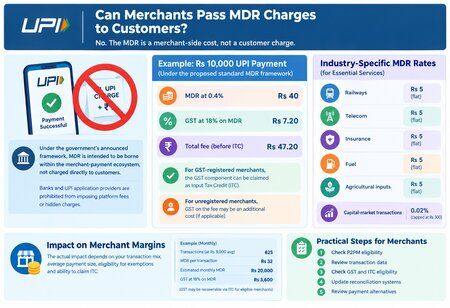
Practical Steps for Merchants
- Check P2PM eligibility: Confirm monthly inward UPI QR receipts and merchant classification with the acquiring bank or payment service provider.
- Review transaction data: Identify the share of payments above Rs 2,000 and the categories that may qualify for special rates.
- Check GST and ITC eligibility: Keep payment-processing invoices and confirm the eligibility of GST credits with a tax professional.
- Update reconciliation systems: Ensure accounting software can distinguish payment-processing fees and GST from the underlying sale value.
- Review payment alternatives: For suitable high-value business transactions, compare UPI with bank transfers and other payment methods based on cost, speed and customer convenience.
Merchants should not split transactions artificially or misclassify payments to avoid charges. They should follow the final NPCI instructions and their payment provider's operational guidance once a new implementation date is announced.