
Finance outlook india logo
Home News Exclusive Expert's Viewpoint Corporate Startup Fintech Personal Magazine About Us Budget'24
  • Budget'26 Budget'25 Budget'24
    • Home
    • Exclusive
    How to Invest Before 18 in India Teen Micro Investing Guide

    How to Invest Before 18 in India: Teen Micro-Investing Guide


    Shiwani Pradhan, Assistant Editor, Finance Outlook India

    Let’s start by answering the core question here: Can you invest before 18 in India? The answer is Yes. A minor can own certain investments in India, but generally cannot independently operate the investment account. A parent or legal guardian must act on the minor's behalf until the child becomes a major.

    Depending on the product and applicable rules, minors can hold mutual funds, participate in SIPs, PPF accounts, use eligible minor demat structures and benefit from schemes such as Sukanya Samriddhi Yojana (SSY). The investment is held for the minor, while the guardian manages the account during the minority period.

    For teenagers and parents, starting early is less about investing a large amount and more about creating a long investment horizon and developing financial discipline.

    A Rs. 500 monthly SIP may look small. But, when contributions continue for years and returns are reinvested, the time can become a significant contributor to the eventual corpus. Remember, the actual return, however, is never guaranteed, particularly for market-linked investments.

    This guide explains how to invest before 18 in India, what minors can invest in, how a minor SIP works, how minor demat accounts operate, what documents are required, how minor investments are taxed, what Rs. 500, Rs. 1,000 or Rs. 2,000 a month could potentially become, and what happens when the investor turns 18.

    Please Note: This is an educational guide, not personalised investment, tax or legal advice. Rules, tax rates, interest rates and platform eligibility can change. Verify current requirements with the relevant regulator, AMC, bank, broker or qualified professional before investing.

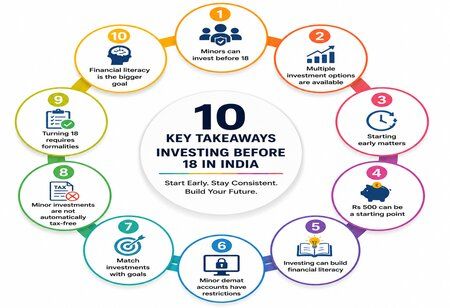
    10 Key Takeaways

    1. Minors can invest in India before turning 18, but a parent or legal guardian generally manages the investment account on their behalf.

    2. Multiple investment avenues are available to minors, including mutual funds and SIPs, eligible demat structures, PPF, and Sukanya Samriddhi Yojana for eligible girl children.

    3. Starting early matters more than starting with a large amount. A small, consistent SIP can benefit from a longer investment horizon and the potential effects of compounding.

    4. A Rs. 500 monthly SIP can be a meaningful starting point, provided it is sustainable. The article emphasizes consistency rather than investing an amount that strains the family budget.

    5. Mutual funds can serve both investment and financial-education purposes, helping teenagers understand diversification, volatility, risk, returns, compounding, expenses and taxation.

    6. Minor demat accounts are not the same as adult trading accounts. Minors may hold eligible securities, but trading permissions and products such as intraday and F&O are restricted, with rules varying by broker.

    7. The investment should match the financial goal and time horizon. Equity-oriented investments may suit longer-term goals, while money required within a short period may need more stable options.

    8. Minor investments are not automatically tax-free. Minor income can be subject to clubbing provisions, while capital gains, interest and dividends may have different tax treatments under prevailing rules.

    9. Turning 18 is an important financial transition. The young investor generally needs to complete applicable KYC, bank-detail and minor-to-major formalities before independently operating the investments.

    10. The ultimate goal of investing before 18 is financial literacy—not simply building a corpus. Teenagers should learn about saving, investing, risk, taxation, inflation, diversification and the difference between investing and speculation.

    Can a Minor Invest in India?

    Yes. A minor below 18 can hold permitted investments in their own name, but a parent or legal guardian generally operates the account until the minor becomes a major. SEBI's framework specifically permits mutual fund investments in the name of a minor through a natural or court-appointed legal guardian. The minor is the sole and first holder of the mutual fund folio.

    Can a 16-Year-Old or 17-Year-Old Invest in India?

    Yes, but not in exactly the same way as an adult. A 16-year-old or 17-year-old can be the beneficial holder of permitted investments, while the parent or legal guardian carries out transactions on the minor's behalf.

    The important distinction is:

    Ownership is Different from Operation.

    The investment may be held in the minor's name, but the minor does not acquire unrestricted authority to buy, sell, redeem or otherwise operate the investment merely because the investment belongs to them.

    This distinction becomes especially important with:

    • mutual funds

    • SIPs

    • demat accounts

    • shares and ETFs

    • PPF

    • tax reporting

    • the transition from minor to major at age 18

    Hence, parents should therefore always avoid thinking of a minor account as simply an adult investment account with a different name. Each product has its own rules.

    What Investment Options Are Available for Minors in India?

    The most relevant options for families include:

    1. Mutual funds and SIPs

    2. Minor demat accounts and permitted securities

    3. Public Provident Fund (PPF)

    4. Sukanya Samriddhi Yojana (SSY) for eligible girl children

    5. Existing Sovereign Gold Bond (SGB) holdings, subject to applicable rules

    Among these array of investment avenues, the right choice depends on some of the important parameters which encompasses the goal, time horizon, risk tolerance, liquidity requirement and the family's financial situation.

    PLEASE NOTE: This table should be treated as a framework rather than a recommendation to choose one product over another.

    Mutual Funds and SIPs for Minors

    For families seeking a simple way to introduce long-term investing, a mutual fund folio in the minor's name can be one option to consider.

    SEBI's framework allows investment in mutual fund units in the name of a minor through a guardian. The minor must be the first and sole holder, while the guardian acts on the minor's behalf.

    How does a minor SIP work?

    A SIP is simply a method of investing a fixed amount periodically into a mutual fund. For example, a family could decide to invest Rs. 500, Rs. 1,000 or Rs. 2,000 per month in a mutual fund portfolio held in the minor's name, subject to the AMC's current minimum investment and SIP rules.

    Given this, the important point is that the SIP amount does not determine whether an investment is suitable. The family should always first consider the purpose and time horizon.

    For a long-term goal such as higher education 8–12 years away, market-linked investments may be considered differently from money needed within one or two years.

    Why mutual funds can be useful for financial education

    A mutual fund can also help parents introduce teenagers to concepts such as:

    • diversification

    • market volatility

    • asset allocation

    • long-term investing

    • expense ratios

    • compounding

    • risk and return

    • taxation

    Always remember, the educational benefit can be as important as the financial contribution.

    What Is the Minimum SIP for a Minor?

    There is no single universal minimum SIP amount applicable to every mutual fund.

    Many mutual funds and platforms may offer SIPs at relatively low amounts. However, the minimum can vary by scheme and platform. Therefore, instead of assuming that every minor SIP can be started at exactly ₹500, parents should check the current minimum SIP amount for the selected scheme.

    The more important principle here is “Start with an amount that can be maintained consistently rather than choosing an amount that puts pressure on the family budget."

    How Much Can Rs 500, Rs 1,000 or Rs 2,000 a Month Become?

    If we have to answer this, this is where the mathematics of long-term investing becomes useful.

    Let’s consider a hypothetical teenager who starts investing at age 14 and continues until age 28.

    The following illustration assumes a hypothetical 12% annualised return with monthly compounding and contributions made at the end of each month.

    Note: It is not a forecast.

    What does this demonstrate?

    A Rs 2,000 monthly SIP over 14 years involves total contributions of Rs 3.36 lakh. Under the hypothetical 12% assumption, the illustration grows to approximately Rs 8.64 lakh.

    The difference is the effect of investment returns and compounding.

    But this is not guaranteed wealth creation. Equity mutual funds can experience substantial fluctuations, and actual returns may be considerably higher or lower than 12%.

    What about a single Rs 500 investment?

    A single ₹500 contribution invested for 14 years at a hypothetical 12% annualised return would grow to roughly Rs. 2,500–Rs. 2,700 depending on the compounding convention used.

    That is very different from investing Rs. 500 every month.

    This distinction is important: Rs 500 once is a small investment. But Rs 500 every month for a certain stipulated year is where we can see an actual difference. 

    Why Starting Early Matters More Than Starting Big

    Teen investing is not primarily about finding the perfect stock or the highest-return fund. But rather, it is about giving money more time to work.

    Let’s create a scenario. Consider two teenagers:

    Teenager A: Starts investing Rs. 1,000 per month at 14.

    Teenager B: Waits until 18 to start investing Rs. 1,000 per month.

    Teenager A has already accumulated four years of contributions and investment experience by the time Teenager B starts.

    The advantage of starting early therefore comes from two sources:

    1. More time for contributions

    More months mean more invested capital.

    2. More time for returns to compound

    Returns that remain invested can themselves generate further returns.

    Neither mechanism guarantees a particular final corpus, but both explain why time can be a powerful variable in long-term investing. 

    Minor Demat Account: Can a Minor Buy Stocks?

    A minor can have a demat account through a parent or legal guardian, subject to the broker's current rules.

    However, a minor demat account should not be confused with an adult trading account. Transaction and trading permissions are restricted.

    For example, current broker-specific rules can permit certain securities to be held or sold while restricting fresh purchases or speculative products. Groww's current minor-demat documentation, for example, states that its minor account is available for children below 16 and places restrictions on secondary-market stock purchases, intraday, F&O and margin-related products.

    This illustrates why parents should verify the current broker-specific rules before opening an account.

    What can a minor demat account potentially be used for?

    Depending on the broker and applicable regulations, a minor demat structure may allow ownership of securities such as:

    • Equity Shares

    • ETFs

    • IPO Allocations

    • Certain other permitted securities

    However, a minor cannot simply begin independent stock trading at 15, 16 or 17.

    Minor Demat Account vs Adult Trading Account

    Feature

    Minor demat structure

    Adult account

    Account holder

    Minor

    Adult

    Guardian

    Required

    Not Normally Required

    Independent Operation

    No

    Yes, Subject to KYC

    Stock Trading

    Restricted/Prohibited

    Permitted Subject to Eligibility

    Control at 18

    Transfers to adult investors after formalities.

    Already Independent

    Platform rules can change, so this table should always be checked against the broker's current documentation.

    Public Provident Fund (PPF) for Minors

    PPF is a government-backed long-term savings scheme that can be used for a minor's long-term financial planning, subject to the scheme rules.

    For the July–September 2026 quarter, the PPF interest rate is 7.1% per annum. Small-savings rates are reviewed periodically by the government, so the rate should not be treated as permanently fixed.

    PPF has a 15-year base tenure, with extension provisions under the applicable rules.

    Why parents may consider PPF

    PPF can provide:

    • government-backed savings

    • long-term discipline

    • relatively predictable interest compared with market-linked assets

    • tax advantages subject to prevailing law

    • a structured savings vehicle for long-term goals

    However, PPF is not designed to provide the liquidity of a normal savings account or equity mutual fund.

    Important PPF point for parents

    Do not assume that a minor's PPF account simply matures 15 years after the child's birthday.

    PPF maturity is governed by the scheme's financial-year-based rules. Parents should therefore calculate the actual maturity date from the account's opening rules rather than simply adding 15 years to the child's age.

    The current PPF rate is also subject to quarterly government review.

    Sukanya Samriddhi Yojana for Eligible Girl Children

    Sukanya Samriddhi Yojana is a government-backed savings scheme designed specifically for eligible girl children.

    For the July–September 2026 quarter, the interest rate is 8.2% per annum. The rate is government-notified and can change in future quarters.

    The scheme is subject to specific eligibility, contribution, withdrawal and maturity rules.

    Who can consider SSY?

    Families with an eligible girl child below the prescribed age can consider SSY for long-term goals such as education.

    SSY can be particularly relevant where the family wants:

    • a government-backed savings structure

    • long-term discipline

    • a dedicated girl-child financial goal

    • tax-efficient treatment under applicable rules

    It should not automatically be considered the "best" investment for every family. The appropriate choice depends on the family's overall financial plan and objectives. 

    Sovereign Gold Bonds: What Minors Need to Know in 2026

    Sovereign Gold Bonds require special treatment in a current 2026 guide.

    The RBI's official SGB website continues to publish information on outstanding bonds and redemption schedules, including 2026 premature-redemption notices.

    However, parents should not treat SGBs as a routinely available fresh-issue investment option in the same way as a mutual fund SIP or PPF.

    For a child-focused portfolio, gold exposure can also be obtained through other permitted routes, but each has different costs, risks, liquidity and taxation.

    The important point is:

    Check whether a fresh SGB tranche is actually available before presenting SGBs as an option for a new investment.

    For existing SGB holdings, applicable transfer, holding and redemption rules should be checked with the bank, broker or relevant authority.

    Which Investment Is Better for a Minor?

    There is no universal "best investment for a minor."

    The right question is:

    What is the goal, when will the money be needed, and how much risk can the family accept?

    For example:

    Goal: Money needed in 1–2 years

    Market-linked equity investments may be inappropriate because the value could fall when the money is required.

    Goal: Education in 8–10 years

    The family may have more scope to consider a combination of long-term market-linked and stable savings products, depending on risk tolerance.

    Goal: Very long-term wealth creation

    A diversified equity-oriented approach may be considered by families comfortable with market volatility and long holding periods.

    Goal: Government-backed long-term savings

    PPF or SSY may be relevant where the eligibility and liquidity characteristics fit the goal.

    The investment should therefore follow the goal, rather than the other way around.

    Investing Before 18: A Simple Age-Based Framework

    Teenagers at different ages require different approaches.

    Age 8–10: Build the Financial Foundation

    The emphasis should be on:

    • saving pocket money

    • understanding needs versus wants

    • learning what interest means

    • introducing compounding

    • explaining what an investment actually owns

    The parent can manage the account while involving the child in age-appropriate discussions.

    Age 11–13: Introduce Investment Concepts

    At this stage, parents can explain:

    • SIPs

    • mutual funds

    • shares

    • diversification

    • risk

    • inflation

    • long-term goals

    The child does not need to make investment decisions independently.

    Age 14–15: Start Learning Through Real Investments

    This can be an appropriate stage to show the teenager:

    • how a SIP works

    • how NAV changes

    • why markets rise and fall

    • how an investment statement looks

    • how returns differ from contributions

    The objective should be education rather than chasing returns.

    Age 16–17: Prepare for Financial Independence

    This is the stage to teach:

    • PAN and KYC

    • bank accounts

    • taxation

    • capital gains

    • nomination

    • demat accounts

    • mutual fund statements

    • investment risk

    • the Minor-to-Major transition

    By 18, the teenager should understand not only how much money they have, but why it is invested and how it is managed. 

    How to Open a Minor Mutual Fund Folio

    The exact onboarding process varies by AMC and platform, but the broad process is straightforward.

    Step 1: Identify the Guardian

    The guardian may generally be a natural parent or a court-appointed legal guardian under the applicable framework. SEBI's mutual fund framework requires the minor to be the first and sole holder, with the guardian acting on the minor's behalf.

    Step 2: Prepare the Documents

    Depending on the AMC and KYC requirements, documents may include:

    • minor's date-of-birth proof

    • minor's PAN, where required

    • guardian's PAN

    • guardian KYC

    • proof of relationship

    • bank account details

    • guardian documentation where applicable

    The exact document list should be verified with the AMC before submission.

    Step 3: Open the Folio in the Minor's Name

    The minor is the investor/first and sole holder. The parent or legal guardian is recorded in the guardian capacity.

    Step 4: Select the Investment

    Parents should select the investment according to:

    • goal

    • time horizon

    • risk

    • liquidity needs

    • diversification

    • costs

    Step 5: Set Up Contributions

    A SIP can then be established if permitted by the selected scheme and platform.

    SEBI's framework allows payments for minor mutual fund investments from the minor's bank account, the parent's/legal guardian's account, or a joint account of the minor with the parent/legal guardian, subject to the applicable requirements. Redemption proceeds are required to be credited to the verified bank account of the minor.

    Step 6: Review, Don't Constantly Trade

    An annual review is generally more useful than reacting to every market movement.

    The portfolio should be checked against the original goal and time horizon.

    What Documents Does a Minor Need to Invest?

    The exact documentation depends on the investment product.

    Common requirements can include:

    Minor

    • birth certificate/passport or other accepted age proof

    • PAN, where applicable

    • bank account details

    • KYC information where required

    Parent/Guardian

    • PAN

    • KYC documentation

    • identity/address proof where required

    • relationship proof

    • guardianship documentation in cases involving a court-appointed guardian

    Parents should not rely on a generic checklist because AMC, broker and bank requirements can change.

    What Happens When a Minor Turns 18?

    This is one of the most important parts of minor investing.

    Turning 18 changes the legal status of the investor.

    The guardian no longer continues to operate the investment simply because they previously managed it.

    For mutual funds, SEBI's framework requires the now-major investor to provide updated KYC information and bank details before the account can be operated in the investor's own right. The guardian cannot continue transacting merely because they were the previous operator.

    Minor-to-Major Transition Checklist

    Before the 18th birthday

    • Confirm the exact account status.

    • Check the AMC/broker's conversion procedure.

    • Ensure PAN information is updated where required.

    • Prepare the adult bank account.

    • Complete applicable KYC requirements.

    • Review nomination details.

    At/after 18

    The investor may need to:

    1. Submit the relevant minor-to-major application.

    2. Complete adult KYC.

    3. Provide updated PAN/KYC information.

    4. Submit new bank-account details.

    5. Update signature/authentication details.

    6. Update nomination information.

    7. Complete any broker-specific demat conversion or reactivation requirements.

    The exact procedure and processing time vary by institution.

    Why should parents prepare early?

    Because an account that was convenient at age 16 can become operationally restricted once the investor becomes a major.

    The family should therefore treat the 18th birthday as a financial transition date, not merely a legal birthday.

    Minor Mutual Fund vs Minor Demat Account: Which Comes First?

    For families deciding between the two, the comparison is useful.

    FEATURE

    MINOR MUTUAL FUND PORTFOLIO

    MINOR DEMAT ACCOUNT

    Main Investment

    Mutual Fund Units

    Securities, subject to rules

    Diversification

    Built into the fund

    Parent/investor must construct it

    Guardian

    Required

    Required

    Independent Operation before 18

    No

    No

    Investment Selection

    Fund-level

    Security-level

    Complexity

    Lower

    Higher

    Market Knowledge

    Moderate

    Higher

    Suitable for 

    Families seeking a simpler diversified route

    Families comfortable understanding securities

    A mutual fund folio may be simpler for families who want diversified market exposure without selecting individual stocks.

    A minor demat account can provide greater exposure to individual securities, but it also requires greater understanding of the restrictions and risks.

    Neither should be automatically labelled the "best" option.

    How Are Minor Investments Taxed in India?

    Taxation is one of the most important considerations for parents.

    Under the income-tax rules, income of a minor child is generally clubbed with the income of a parent under the applicable provisions, subject to specified exceptions.

    The Income Tax Department currently states that under Section 64(1A), minor income may be clubbed with the parent's income and that Section 10(32) provides an exemption of up to ₹1,500 per minor child, subject to the applicable conditions.

    What types of income can be relevant?

    Depending on the investment, the tax treatment can involve:

    • interest

    • dividends

    • capital gains

    • other investment income

    The tax treatment depends on the nature of the investment and the applicable provisions.

    Exceptions to minor-income clubbing

    The clubbing rule is not absolute.

    There are statutory exceptions, including certain income arising from the minor's own manual work or from the application of the child's skill, talent or specialised knowledge, subject to the applicable conditions.

    Parents should consult a qualified tax professional where the minor's investment income is significant or the family's tax structure is complex.

    Tax on Equity Mutual Funds and Shares

    For specified equity investments, current tax rules provide for special capital-gains treatment.

    The Income Tax Department states that short-term capital gains covered under Section 111A on specified securities, including equity shares and equity-oriented mutual funds, are currently taxed at 20%, subject to the applicable conditions.

    For specified listed securities, long-term capital gains are currently taxed at 12.5% on gains exceeding ₹1.25 lakh, subject to the relevant provisions and conditions.

    The fact that the investment is held by a minor does not mean that market-linked investment income is automatically tax-free.

    Because tax rules can change and the final tax liability depends on the parent's circumstances and the type of income, families should verify the applicable provisions for the relevant financial year.

    Is a Minor's SIP Tax-Free?

    No.

    A minor SIP does not automatically become tax-free simply because the investor is under 18.

    The tax treatment depends on the income generated and the applicable clubbing provisions.

    For example, capital gains from an equity mutual fund can be taxable under the applicable capital-gains rules. The minor's investment income may also be clubbed with the parent's income, subject to the law and exemptions.

    Therefore, minor status does not mean zero tax. [$$$$]

    Can Parents Invest in Their Child's Name?

    Yes, where the investment product permits it.

    There is an important difference between:

    Investing in the minor's name

    The minor is the investor/holder and the guardian operates the account.

    Investing in the parent's name for the child

    The parent remains the legal investor.

    These structures can have different consequences for ownership, taxation, succession and control.

    If the objective is genuinely to create an investment corpus for the child, families should understand the ownership structure before investing.

    Common Mistakes Parents Should Avoid

    1. Starting too late

    Waiting for the "perfect" investment amount can waste valuable time.

    Starting early with an affordable contribution can be more practical than waiting several years to invest a larger amount.

    2. Chasing high returns

    A teenager's investment portfolio should not become a laboratory for speculative trading.

    The goal is long-term financial development, not short-term market excitement.

    3. Treating 12% as a guaranteed return

    It is not.

    The SIP illustrations in this article use 12% purely as a mathematical assumption.

    Actual returns can be substantially different.

    4. Choosing equity for a short-term goal

    If the money is needed soon, market volatility can become a major problem.

    The investment should match the time horizon.

    5. Investing secretly

    A parent may legally manage the account, but hiding the investment from the teenager removes an important opportunity to build financial literacy.

    6. Ignoring taxation

    Minor investments can create tax consequences through the clubbing provisions.

    7. Ignoring the 18th birthday

    The Minor-to-Major transition should be planned before the child reaches adulthood.

    8. Choosing a platform without checking current rules

    Broker and AMC policies change.

    Age limits, product availability, documentation and transaction permissions should be checked directly with the institution.

    9. Investing in the parent's name without understanding the consequences

    Ownership and tax treatment can differ significantly from an investment held in the child's name.

    10. Over-diversifying a small portfolio

    A teenager does not necessarily need five or ten different funds.

    A small number of well-understood investments may be easier to monitor and explain.

    A Practical Rs. 500 Teen Investing Framework

    A teenager does not need ₹10,000 a month to start learning about money.

    A simple ₹500 framework could be:

    ₹500/month

    Month 1: Understand what the investment owns.

    Month 2: Learn what NAV, units and returns mean.

    Month 3: Understand why the value moves.

    Month 4: Learn diversification.

    Month 5: Learn inflation.

    Month 6: Learn taxation.

    Month 7 onward: Track contributions versus market value.

    The objective is not to check the portfolio every day.

    The objective is to understand how money behaves over time.

    What Should a Teenager Learn Before Turning 18?

    By age 18, a financially aware young investor should ideally understand:

    • what a bank account is

    • what a mutual fund is

    • what a SIP is

    • what a stock is

    • why diversification matters

    • why markets fluctuate

    • what inflation does

    • what capital gains are

    • what PAN and KYC mean

    • why tax matters

    • how nominations work

    • how to read an account statement

    • how to identify investment scams

    • how to avoid excessive leverage

    • how to distinguish investing from speculation

    That education may ultimately be more valuable than the first ₹1 lakh of investment corpus.

    Answering FAQs About Investing Before 18 in India

    Can a 16-year-old invest in India?

    Yes. A 16-year-old can hold permitted investments through a parent or legal guardian, but cannot generally operate the account independently. The exact rules depend on the investment product.

    Can a 17-year-old invest in mutual funds?

    Yes. A mutual fund investment can be made in the minor's name through a guardian, subject to the AMC's procedures and SEBI's applicable framework.

    Can a minor start an SIP?

    Yes, a SIP can be established in a minor's mutual fund folio where the selected scheme and platform support it. The guardian manages the account.

    Can a minor buy stocks in India?

    A minor can hold securities through an eligible guardian-operated demat structure, but cannot independently trade like an adult. Broker-specific restrictions apply.

    Can a minor have a demat account?

    Yes, a minor demat account can be opened through a parent or legal guardian, subject to broker and regulatory requirements.

    Can a minor have a PPF account?

    Yes, a PPF account can be maintained for a minor under the applicable PPF rules.

    What is the PPF interest rate in 2026?

    For July–September 2026, the PPF interest rate is 7.1% per annum. The government reviews small-savings rates periodically.

    What is the Sukanya Samriddhi interest rate in 2026?

    For July–September 2026, the SSY interest rate is 8.2% per annum. It applies subject to the scheme's eligibility and rules.

    Does a minor's investment become tax-free?

    No. Minor investments can generate taxable income, and the applicable clubbing provisions may cause the income to be included in the parent's taxable income. Section 10(32) provides an exemption of up to ₹1,500 per minor child, subject to applicable conditions.

    Can parents pay a minor's SIP from their own bank account?

    For mutual fund investments in a minor's name, SEBI's framework permits payment from the minor's bank account, parent/legal guardian's bank account or certain joint accounts, subject to the applicable requirements. Redemption proceeds are required to go to the verified bank account of the minor.

    What happens when a minor turns 18?

    The investor becomes a major and must complete the applicable minor-to-major conversion/KYC and bank-detail requirements before independently operating the investment. The guardian's authority does not continue simply because they previously managed the account.

    Can a parent invest in a child's name?

    Yes, where permitted by the product. The minor is the holder/investor while the parent or legal guardian operates the account.

    Is ₹500 enough to start investing?

    ₹500 can be enough to begin a supported SIP or savings habit, but the minimum depends on the selected product and platform. The amount should be sustainable rather than financially stressful.

    Is investing before 18 better than investing after 18?

    Starting early can provide more time for contributions and potential compounding, but there is no guaranteed return. The benefit comes primarily from the longer investment horizon and financial habits developed early.

    A Parent's Checklist Before Starting a Minor Investment

    • Define the financial goal.

    • Decide when the money may be needed.

    • Determine how much the family can invest comfortably.

    • Understand the investment product.

    • Check the current AMC/broker rules.

    • Verify the guardian and minor documentation.

    • Complete applicable KYC.

    • Understand the tax treatment.

    • Avoid assuming market returns.

    • Involve the teenager in financial education.

    • Review the investment periodically.

    • Prepare for the Minor-to-Major transition before age 18.

    The Bottom Line: Start Early, Start Small and Teach Along the Way

    Investing before 18 in India is possible, but it is not simply about opening an account and putting money into a fund.

    The real opportunity is to combine time, disciplined investing and financial education.

    A minor can hold permitted investments through a parent or legal guardian, while products such as mutual funds, SIPs, PPF, SSY and eligible demat structures serve different purposes. SEBI's mutual fund framework provides a formal structure for investments made in a minor's name through a guardian, including rules around payments, redemption and the transition to majority.

    For parents, the most important lesson is not to search for the investment that promises the highest return.

    It is to ask:

    What is the goal? When will the money be needed? How much risk can we accept? And what will the child understand about money by the time they turn 18?

    For teenagers, the lesson is even simpler:

    You do not need to start big. You need to start learning early.

    A ₹500 contribution is small. A ₹500 monthly habit sustained for years can become meaningful. The investment return is uncertain, but the financial knowledge gained from understanding saving, investing, risk, taxation and compounding can remain valuable for decades.

    The best outcome of teen micro-investing is therefore not merely a larger corpus at 18.

    It is a young adult who understands how money works.

    Editorial & Regulatory Note

    This article is intended for financial education and general information. Investment products involve different levels of risk, liquidity, taxation and regulatory requirements. Market-linked investments do not offer guaranteed returns. Interest rates for government small-savings schemes can change periodically. Broker, AMC and platform eligibility requirements may also change.

    Before investing, readers should verify current information with the relevant SEBI, RBI, Ministry of Finance, Income Tax Department, AMC, bank or broker and seek professional advice where appropriate.

    Content reviewed for: regulatory framework, taxation, investment terminology, minor-account structure and 2026 updates.

    Written by: Shiwani Pradhan, Assistant Editor at Finance Outlook India
    About the Author: Shiwani Pradhan brings more than 5 years of experience in the media industry with expertise in building editorial excellence. Over the years, she has curated numerous business editorials and has written 50+ cover stories.
    Last Updated: August 26, 2026


    Read More:

    PM Internship Scheme 2026: Eligibility, Rs 9,000 Stipend & More

    The Next Unicorns: Indian Startups Transforming Finance in 2026

    KNOWLEDGE DECK

    Most Viewed

    • The Economic Impact of India-Pakistan War: A Detailed Analysis

    • Why Financial Literacy Matters More Than Ever for Today's Youth

    • Prominent Financial Advisors in India to Partner With

    • Rags to Riches: The Top 6 Indian Entrepreneurs' Motivational Tales of Success

    • Navigating Financial Disruption With Future Proof Financial Service Deliverability

    • India's Rs 31 Lakh Cr Green Push: Building the Foundation of a Net-Zero Future

    • Wakhariya & Wakhariya: Facilitating International Legal Processes across Diverse Domains

    • Aligning Financial Strategies with Sustainable Business Goals

    • The Top 5 Highest-paid Actors in India - 2024

    • Central Government Proposes Tax on Agricultural Water Usage

    • Carpediem Capital Invests INR 100 Crore, CorporatEdge to Deploy INR 350 Crore in the next 3 Years

    • EPFO Registers All-Time High Member Addition of 20.06 Lakh in May 2025

    • Unearthing Intricacies of Today and Beyond in the Indian Insurance Sector

    • Expected Correction in Housing Prices to Revive Sales in Coming Quarters

    • How to Choose the Right Mutual Fund for your Financial Goals?

    • Future of Corporate Finance: Emerging Trends in Treasury Solutions and Cash Management for MNCs

    • ElasticRun Announces FY24 Financial Results: Key Details

    • Financial Inclusion in Viksit Bharat

    • Abans Financial Services Advises Vaishali Pharma on Strategic Acquisition of Kesar Pharma


    🍪 Do you like Cookies?

    We use cookies to ensure you get the best experience on our website. Read more...

    Copyright © 2026 Finance Outlook India. All rights reserved.   Privacy Policy Terms of Use Blogs Conferences Subscribe WRAPUP’25