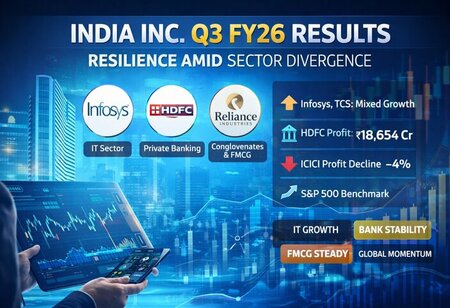
The third quarter of fiscal year 2026 (Q3 FY26) painted a nuanced picture of India Inc.'s corporate health. The information technology segment in India marked the Q3 FY26 earnings season in January of 2026, and the numbers were widely optimistic, with several significant exceptions. The second largest IT exporter of the country Infosys posted consolidated revenue of Rs 45,479 crore in the country with high growth of 8.9 percent per annum. Another significant deal to note in the company was the deal wins of 4.8 billion total contract value with 57% of it classified as a net new business which is a good indicator of future revenue visibility. Infosys also revised its full-year revenue forecast indicating its confidence in the demand of the digital and technology services.
IT Sector: Growth Intact, Margins Under Scrutiny
The Infosys story was however accompanied with a major asterisk; operating margins dropped to 18.4% compared to 21.3% last year due to increased employee expenses and operational costs. The net profit declined 2.2% on year basis to Rs 6,654 crore which is an indication that the top-line growth will not necessarily be a motivating factor to the investors in an environment where cost discipline is the key.
The industry leader, TCS, generated revenue of Rs 670,870 million in Q3 FY26, which was an increase of 4.9% year-on-year and 2.0% quarter-to-quarter. The company also had a very healthy operating margin of 25.2% which strengthened the company as a stable and efficient performer. In the meantime, HCL Technologies and Wipro were also on the earnings calendar, and the IT segment as an aggregate was in the spotlight of the investors as an indicator of technology spending in the world.
Banking: Private Lenders Demonstrate Strength
The performance of the Indian private banking industry in Q3 FY26 was widely stable. The largest private lender based on market capitalisation in the country is HDFC bank which has standalone profit after tax of Rs 18,654 crore which is a fantastic growth of 11.5% every year. Standalone revenue improved by 8.9 to Rs 45,870 crore and net interest income (NII) has increased by 6.4 to Rs 32,620 crore. The asset quality of the bank also did not vary significantly, since gross NPAs did not change and have been maintained at 1.24% sequentially and provisions fell 10 percent per annum, a combination of which is indicative of disciplined credit management.
There was also a high capital adequacy ratio of 19.9% in HDFC Bank based on Basel III requirements of 11.9% which is well above the required capital adequacy of 11.9% an indicator of financial strength. Geographic penetration continued with the number of branches and ATMs in the bank increasing to 9,616 and 21,176 respectively in over 4,170 cities.
ICICI bank, the second biggest privately owned lender in the country, had a less impressive performance. Net interest income rose by 7.7 year-on-year to Rs 21,932 crore, and the net interest margin remained steady at 4.3% but, on the other hand, consolidated net profit declined by 4% year-on-year to Rs 11,318 crore, in part because of high provisions. Gross NPAs improved slightly to 1.53% compared to one year ago and this indicates that asset quality was still improving though short-term profitability was taking a greater buffer.
Conglomerates and FMCG: Muted but Stable
The net profit of Q3 FY26 reported by Reliance Industries was nearly equal to Rs 18,645 crore, a slight improvement over Rs 18,540 crore reported one year before. As its revenue through operations increased significantly to Rs 2.69 lakh crore as compared to Rs 2.43 lakh crore, strength in its retail business which was partly caused by the GST rate rationalisation were countered by positive gains in its energy and digital businesses. The show highlighted the fact that such giant conglomerates are susceptible to the sector-related shocks despite the general excellence of other business divisions.
There was mixed performance across the middle of the capital and industry-specific firms. The IT service company Coforage was no exception, as it recorded an increment of 39 percent in its consolidated income and a growth of 91 percent in net profit which made it one of the brightest companies in the quarter. Wealth management activity was high with Nuvama Wealth and Investment Limited registering 24% growth in total income and 58% growth in net profit per year. However, the opposite was the case in some of the sectors like textiles and agrochemicals where firms such as Mirc Electronics and Aimco Pesticides made losses.
Also Read: Finance Outlook 2026: Markets, Policy and the Road Ahead
Global Benchmark: S&P 500 Sustains Momentum
On the global stage, S&P 500 companies are tracking a blended earnings growth rate of approximately 13.3% for CY2025, above both 5-year and 10-year historical averages. Notably, 74% of S&P 500 companies have reported earnings above estimates for Q4 CY2025, with Information Technology, Communication Services, and Financials leading revenue growth. For CY2026, analysts project earnings growth of 14.4% and revenue growth of 7.5%, suggesting that global corporate momentum remains intact.
Salesforce provided a standout global highlight in Q3 FY26. The AI CRM giant reported revenue of $10.3 billion, up 9% year-on-year, and raised its full-year FY26 revenue guidance to $41.45–41.55 billion. Its Agentforce AI platform surpassed half a billion in annual recurring revenue, up 330% year-on-year, and the company processed over 3.2 trillion tokens — signalling that enterprise AI adoption is accelerating at a rapid pace.
Key Takeaways and Outlook
Q3 FY26 confirmed a number of significant trends: the IT sector is a primary growth driver in India but is becoming more price sensitive; the private banking segment is also proving to be resilient but is exposed to short-term earnings volatility in its provisioning dynamics; and large conglomerates have the challenge of managing performance across a myriad of business lines in a highly dynamic regulatory and macroeconomic environment.
As the analysts look ahead, there is a significant pick-up of earnings in the coming quarter Q4 FY26 and beyond, especially as the effects of interest rate normalisation, Artificial Intelligence investment cycles and domestic consumption recovery are more evident. The theme of the quarters ahead will be whether Corporate India can translate the best-line growth into the bottom-line growth. As of today, Q3 FY26 is a quarter of perceived optimism, one in which the roots of long-term growth are still in place, although immediate implementation requires more accuracy.