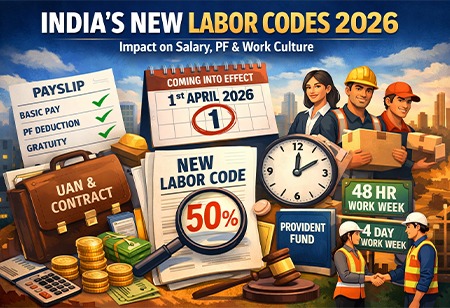
When will the New Labor Codes be implemented? The answer is likely 01-04-2026. It is evident that a major chunk of the country's (India) economy is run by salaried employees. Hence, it is important to give these sections of people the needed buying power. The New Labor Codes for employment will likely be in effect from 1st April, 2026. This update will have a direct impact on salary, and the structure on it works as the New Labor Codes come to the force. This will revamp how your basic pay is calculated to what will be credited in your bank account every month.
It is not a mere reform about corporate compliance, but rather, it encompasses employees' payslip structure, PF deductions, gratuity eligibility, and long-term savings. 29 existing labor laws were incorporated in the Labor Codes in India. With the update, these 29 laws will be sub-divided into four simplified laws, encompassing wages, industrial relations, social security, and workplace safety. If we look at the financial changes, the most important change would be with respect to the wage code that is said to redefine how salary components are calculated.
Minimum Wage benchmark will be drawn with a national "floor wage" to ensure a baseline income across all states. Furthermore, employers must offer settlement of all wages within two working days of an employee's exit; be it a resignation, termination, or retrenchment. The New Labor Codes also states that the basic pay must now be at least 50 percent of the total CTC. While this may reduce take-home pay, it will increase long-term savings in Provident Fund (PF) and Gratuity.
Another important parameter would be the eligibility for gratuity; reducing it from five years to just one year of service. The standard remains 8 hours per day (48 hours per week). However, the codes allow for a 4-day work week with 12-hour shifts. Overtime must be paid at double the regular wage rate. Social Security for Gig Workers: For the first time, gig and platform workers are recognized and will receive social security benefits like insurance and Provident Fund.