
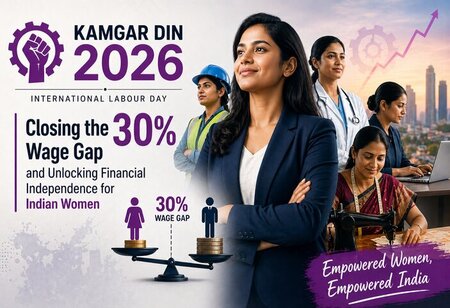
A century after the International Labour Organization first advocated for workers’ rights, the issue of labour equity is more pertinent today than ever before. Specifically, in India, Karma Din traces its origins back to 1923 when the Labour Kisan Party of Hindustan organized the first official May-Day celebrations in Madras, an act of radical solidarity that laid the groundwork for the contemporary workers’ rights movement.
Yet, over a hundred years later, one of the most persistent injustices of the Indian labour market is the gender wage gap. Over a hundred years since then, some of the most rife injustice in the Indian labour market is the gender wage gap. This is an invisible economy that subsidizes businesses, families, and GDP growth, yet receives no formal compensation.
On the formal side, the picture is complex: Wages of women in salaried roles did grow by 7.2% in 2025, meaningfully outpacing 5.4% growth in wages of their male counterparts. This is an advancement and must be acknowledged. However, that number comprises only a fraction of the story, given the drastically lower baseline from which women begin growing, while in all other sectors and categories, from casual agricultural labour to urban construction, the gender wage disparity stands stubbornly between 24 and 30 percent in India as of 2026.
Closing the gender pay gap in Indian tech, manufacturing, and care work is not just a gender issue, but a macroeconomic imperative. Closing the gender pay gap in Indian tech, manufacturing, and care work is not merely a gender issue, rather, it is a macroeconomic imperative.
Why the 30% Gap Persists: From "Sticky Floors" to Unpaid Care
Dissecting why the gender wage gap in India remains stuck at 24-30% in 2026 entails looking beyond simple discrimination to the structural labour market architecture in India. Three interlocking forces keep the gap in place.
Occupational Segregation
The most apparent force is occupational segregation, or the tendency for women to be clustered in particular low-income industries. Teaching, assisting healthcare, textile-related work, and domestic services account for an overwhelming majority of female employees in India. These sectors are grossly undervalued for the skill levels and amount of emotional labour they entail. Therefore, even if women are paid fairly within their sector, the sectors themselves are paying less.
The "Sticky Floor" Phenomenon
The sticky floor phenomenon in India is defined by a more insidious glass ceiling wherein wage gaps are not most apparent at the top but the bottom of the wage scale, while policy statements abound with the need for women to break into boardrooms. The real crisis is at the grassroots in Rajasthan in which a female casual labourer earns nearly 30 percent less pay than a male peer for undertaking exactly similar work in agriculture. This suppression at entry levels gets compounded over a period of time, thus making it structurally difficult for women to accumulate savings and the credit track record necessary to move into formal, better paying jobs. The result is a self-reinforcement of occupational segregation and the gender gap.
The Weight of Unpaid Labour
One of the most powerful and structural barriers maybe time poverty. Perhaps most powerful structural barrier is time poverty. This enormous time burden robs women the chances of taking overtime opportunities, skill development, getting promotions, or migrating to better-paying job markets. The unpaid economy is in a very real sense, financed by the sacrificed wages of women.
Wage Gap Comparison: Salaried vs. Casual Labour in India (2026)
|
Worker Category |
Avg. Male Wage (Rs/day) |
Avg. Female Wage (Rs/day) |
Wage Gap (%) |
|---|---|---|---|
|
Salaried (Urban) |
Rs 35,000/mo |
Rs 24,500/mo |
30% |
|
Casual Labour (Rural) |
Rs 385 |
Rs 271 |
29.6% |
|
Construction Workers |
Rs 420 |
Rs 290 |
31% |
|
Agriculture |
Rs 310 |
Rs 218 |
29.7% |
|
IT/Tech (Entry Level) |
Rs 52,000/mo |
Rs 44,200/mo |
15% |