
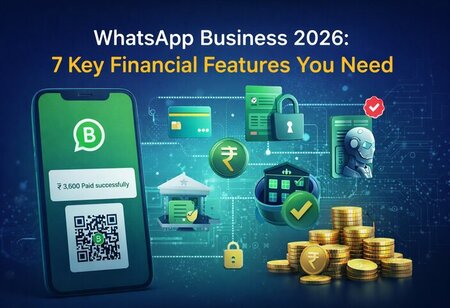
WhatsApp has developed to be much more than a messaging application, being a full-fledged financial and commerce ecosystem in 2026. The platform has over 3 billion users around the world and over 50 million businesses are actively using the WhatsApp Business which is fast becoming the foundation of conversational commerce. It offers powerful updates like in-chat payments, AI-driven flows, and direct INR billing that can help businesses boost ROI by up to 60%.
India, its largest market with 535+ million users, is leading this transformation. WhatsApp business alone attained Rs 35,000 crore value in transactions in 2025 and is expected to shoot almost threefold in the next few years.
So, what's driving this shift? We can gain an understanding of the business opportunities presented by 7 major financial characteristics influencing WhatsApp Business in 2026- and how can you capitalize on them.
1. In-Chat Payments: The New Checkout Experience
In-chat payments can be considered one of the most potent updates that enables users to make a transaction without leaving a conversation. Through integrations such as UPI in India, now companies are able to receive payments in real-time in WhatsApp.
It is also much more efficient than web checkouts because, according to industry statistics, in-chat payment flows are able to decrease cart abandonment by up to 30%.
How to collect payments on WhatsApp 2026:
- Share product catalog
- Add payment link or UPI request
- Customer pays within chat
- Instant confirmation
This seamless experience is transforming WhatsApp into a full funnel—from discovery to payment.
2. WhatsApp Pay for Business
The rise of WhatsApp Pay for business is another game changer. In India alone, 100+ million users have activated WhatsApp Pay, with transactions growing over 40% year-on-year.
Businesses can now accept:
- UPI payments
- Cards and net banking (via gateways)
- QR code payments
As one industry report notes, “your customer’s next purchase is simply the next message”, highlighting how commerce is becoming conversational.
3. WhatsApp Business API Pricing 2026: The Economics Shift
One of the biggest changes in 2026 is the transition to transparent and conversation-based pricing model. Companies pay per category of messages:
- Marketing messages (promotions)
- Utility messages (alerts, reminders)
- Authentication messages (OTP, KYC)
Direct INR billing is increasingly emerging in India, which is assisting businesses to save 12-20% margin mark goods through the middleman.
This is particularly important to BFSI enterprises that need to minimize the expenditure of messaging on WhatsApp and increasing customer interaction.
4. WhatsApp Flows for Banking and Financial Services
The introduction of WhatsApp Flows is redefining financial interactions. These are interactive, in-chat forms that allow users to:
- Apply for loans
- Complete KYC
- Renew insurance
- Open accounts
This eliminates friction by replacing multi-step apps with single-thread conversations.
For financial institutions, this means faster onboarding and improved conversion rates.
5. AI-Powered Financial Support
Conversational commerce trends in 2026 focus on AI. New chatbots have become advanced and can deal with:
- Balance inquiries
- EMI calculations
- Loan eligibility checks
- Interest rate queries
Meta research indicates that 67.7% of consumers consider the ai chat answers to be helpful, and 73.3% of consumers favor messaging to its conventional counterparts.
This is making it possible to provide 24/7 financial support at scale, which lowers the cost of operation and increases customer satisfaction.
6. Automated Billing and Payment Reminders
Integration with platforms like Zoho and CRMs allows businesses to automate:
- Invoice generation
- Payment reminders
- Subscription renewals
To illustrate this, lenders and fintech firms can now send automated EMI notifications through WhatsApp which is more effective to collect and diminish defaults.
Considering that WhatsApp has an open message rate of 98%, as opposed to a 20% email open rate, this would greatly increase the rate of engagement and payment compliance.
Also Read: UPI 2026 Revamp: New KYC, Transaction Checks & Faster Refunds
7. Compliance, Security & Trust Infrastructure
As financial transactions grow, compliance and security have become critical. WhatsApp Business 2026 addresses this through:
- End-to-end encryption for financial data
- Meta Verified badges for business authenticity
- Compliance with India’s DPDPA and TRAI guidelines
Trust is a key driver—74.6% of consumers trust businesses more when they can message them, according to Meta’s global study.
For BFSI companies, this ensures secure handling of sensitive data like KYC documents and loan approvals.
The Bigger Picture: Conversational Commerce is the Future
WhatsApp is no longer a communication tool anymore, it is a layer of commerce infrastructure.
A recent industry insight puts it best: “WhatsApp commerce in India is not a trend—it’s infrastructure.”
As UPI has been processing 16.7 billion transactions monthly and WhatsApp is brought straight into this system, the platform will be in a unique position to take over digital payments and financial services.
Conclusion: Why Businesses Must Act Now
The WhatsApp Business 2026 improvements are redefining the dynamics of business interaction, selling, and transacting. From in-chat payments and AI-powered support to INR billing and compliance frameworks, the platform is enabling companies to:
- Increase conversions by up to 30–40%
- Reduce operational costs
- Deliver seamless financial experiences
In the case of businesses, particularly the fintech, banking, and e-commerce, it is no longer a matter of whether to integrate WhatsApp, but how rapidly they will be able to scale on the platform.