
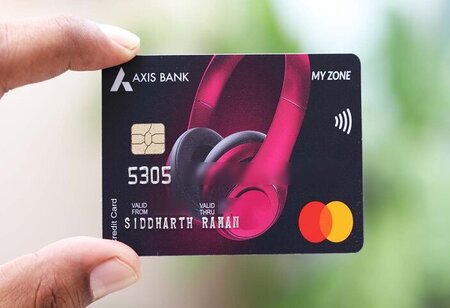
Axis Bank credit card users will pay a higher cost on certain overseas transactions from August 28, with the lender raising the dynamic currency conversion (DCC) markup on several cards from 1.5% to 3.5%. The bank is also increasing the top late-payment fee to Rs 1,300 and withdrawing rewards or cashback on bridge fees, road fees and toll transactions.
Key Highlights
- Axis Bankcredit card raises DCC markup on overseas transactions to 3.5% from 1.5%, effective August 28.
- Bank withdraws rewards on toll, road and bridge fee payments, and raises top late fee to Rs 1,300.
The changes, detailed in revised Axis Bank credit card terms, will vary depending on the card variant. For instance, the DCC markup for Magnus and Magnus for Burgundy cards is being revised to 2%, while Olympus cards will carry a separate rate of 1.8%.
For customers, the key concern isn't simply the rise in charges - some of the changes could also reduce the value of credit card rewards and make certain spending strategies less effective.
Overseas Spending Could Get More Expensive
DCC is offered when an overseas merchant, website or ATM gives a customer the option of paying in Indian rupees rather than the local currency. Under the revised terms, the DCC markup for most affected cards will rise to 3.5% from 1.5%.
For example, on an eligible transaction equivalent to Rs 1 lakh, a customer opting for DCC would now pay a markup of Rs 3,500 before applicable taxes, compared with Rs 1,500 under the earlier 1.5% rate.
This is distinct from a standard foreign-currency transaction charge. In a regular foreign-currency transaction, the purchase is made in the local currency and converted into rupees through the card network. With DCC, the merchant converts the transaction into rupees at the point of sale itself. When given a choice while transacting overseas, paying in the local currency is generally the more cost-effective option compared to accepting DCC, since the card's normal foreign-currency charges would still apply either way.
Late-Payment Fee Rises for Larger Outstanding Balances
Axis Bank is also revising its late-payment fee structure. According to the bank, fees for outstanding balances below Rs 50,000 will remain largely unchanged, though the revised slabs show some adjustment at higher tiers.
The revised late-payment fee slabs are as follows:
- Below Rs 500: Nil
- Rs 501–Rs 5,000: Rs 500
- Rs 5,001–Rs 10,000: Rs 750
- Rs 10,001–Rs 50,000: Rs 1,200
- Above Rs 50,000: Rs 1,300
This means customers carrying a larger unpaid bill could face an additional Rs 100 compared with the earlier top fee. However, for credit card users, the bigger financial risk continues to be the interest charged on unpaid dues - avoiding the late fee alone should not be the only reason to pay the full bill on time.
Also Read: Axis Bank Cuts 3,000 Employees in FY26 as Tech Boosts Productivity
Rewards to Disappear on Toll and Road Payments
Axis Bank is also tightening reward eligibility criteria. From August 28, no rewards will be earned on spending classified as bridge fees, road fees and tolls. Gift card purchases will continue to be excluded from rewards and will also not count towards spending-based fee waivers or milestone benefits. The bank is additionally moving gift card transactions from the broader 'Wallet' category into a separate 'Gift Card' category.
This shift is particularly relevant for customers who strategically use card to reach their annual credit card spending thresholds. For instance, cardholders who previously relied on toll payments or eligible gift-card purchases to build toward a milestone will no longer be able to count on these transactions to help them reach the required spending level. The key takeaway for cardholders is to calculate a card's value based on eligible spending, rather than total spending.
How Partial Payments Will Be Adjusted
Axis Bank has also clarified the order in which payments will be adjusted when a customer does not clear the full outstanding amount. Under the revised terms, payments will first be adjusted toward applicable fees and charges, including taxes, followed by EMIs, interest charges, purchase transactions, and finally cash advances.
This makes partial repayment particularly important for customers already carrying multiple types of outstanding dues, since paying only part of the bill does not guarantee that the payment will reduce the specific component the customer expects it to.
What Should Axis Bank Cardholders Do?
The changes do not affect every Axis Bank card equally - the exact impact depends on the card variant and how it is used. Customers are advised to:
- Check the revised terms applicable to their specific card
- Choose the local currency rather than rupees when offered DCC abroad
- Pay the full credit card bill by the due date wherever possible
- Stop assuming toll, road or bridge payments will help earn rewards
- Exclude gift-card purchases when calculating milestones or fee-waiver spending
- Review whether the card's annual fee is justified by the benefits actually used
For frequent international travellers, the DCC revision is likely to be the most immediate change to watch. For other users, the reduction in reward-earning opportunities may prove more significant over the course of the year.
Revised terms of Axis Bank take effect from August 28, though card-specific changes may differ. Customers are advised to rely on the notice applicable to their particular card rather than assuming that every revision applies uniformly across the bank's entire credit card portfolio.