
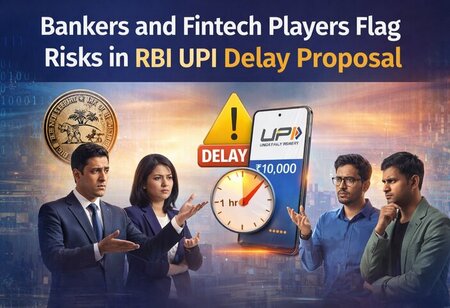
The Reserve Bank of India’s (RBI) proposal to introduce a one-hour delay on digital transactions above Rs 10,000 for new payees has triggered strong concerns among bankers and fintech players, who warn that the move could disrupt India’s real-time digital payments ecosystem.
The proposal, outlined in a recent discussion paper, aims to curb rising digital fraud by introducing a “cooling-off” period for high-value transfers, particularly impacting Unified Payments Interface (UPI) transactions.
Key Highlights
- RBI proposes one-hour delay on UPI payments above ₹10,000 to curb rising digital fraud risks.
- Bankers warn delay may disrupt real-time payments, increase friction, and impact UPI adoption nationwide.
The RBI’s proposal comes amid a sharp rise in digital frauds, which have surged significantly in recent years. Data indicates that transactions above Rs 10,000 account for nearly 98–99 percent of total fraud value, making them a key focus area for regulators.
The central bank believes that introducing a delay could act as a safeguard by giving users time to reconsider transactions and cancel suspicious payments, especially in cases of authorised push payment (APP) frauds driven by social engineering and coercion.
However, industry stakeholders have expressed scepticism about the effectiveness of this approach. A senior banker heading digital payments operations remarked, “This is similar to the idiom ‘the cure is worse than the disease’… this measure could kill real-time payments in the country.” Bankers argue that India’s digital payments success, particularly UPI, is built on speed and seamless user experience, and any delay could introduce friction and reduce adoption.
The proposed framework includes certain safeguards and exemptions. Transactions involving registered merchants or previously added beneficiaries will not face delays, and users will have the option to whitelist trusted payees to bypass restrictions. Despite these provisions, experts say the measure will disproportionately impact UPI, which thrives on instant, high-value person-to-person transactions. Around 37–38 percent of UPI transactions are peer-to-peer, accounting for nearly 60 percent of total transaction value, highlighting the potential scale of impact.
Industry leaders also caution that such friction could push users back toward cash. A senior executive from a UPI platform said, “This will create unnecessary friction and move people back to cash. UPI has gotten people used to speed.” Experts like Raj P Narayanam, founder of Zaggle noted, "The key reasons for UPI’s success has been its simplicity and ability to enable instant high-value payments without the complexities associated with traditional systems like NEFT or IMPS."
Another major concern raised by industry experts is that the proposal does not address the root cause of fraud- mule bank accounts and weak enforcement mechanisms. Nitesh Singhal, founder of Aryaa Advisors, pointed out that fraud detection systems already exist, stating, “The signals exist. But not enough happens. Most digital frauds ultimately end in KYC-compliant bank accounts and that stronger monitoring and accountability are needed rather than blanket transaction delays."
Also Read: RBI Proposes One Hour Delay on Digital Payments Above Rs 10,000
Experts also question whether a one-hour delay would effectively prevent fraud, noting that many scams- such as fake investment schemes or “digital arrest” frauds- unfold over several hours or even days. One banker observed that these are behavioural crimes where victims are manipulated over time, suggesting that “the time lag does not help much.”
However, some industry participants support the RBI’s proposal as a behavioural safeguard. Abhinav Parashar, CEO of Digio, said, “The proposed one-hour lag acts like a circuit breaker, a ‘golden hour’ to realise they are being manipulated.” Proponents argue that this buffer period could be particularly useful in preventing panic-driven frauds targeting vulnerable users, including senior citizens and low-income groups.
The RBI has also proposed additional measures such as enhanced authentication, transaction caps on suspicious accounts, and a “kill switch” to disable digital payments instantly. While the discussion paper is currently open for stakeholder feedback, the debate underscores a broader challenge- balancing security and convenience in one of the world’s fastest-growing digital payments markets.