India’s Grade A and A+ retail real estate market is entering a phase of historic supply tightening, with top destination malls in Delhi-NCR and Mumbai Metropolitan Region (MMR) reaching near-full occupancy. According to the latest report, Leasing Trends in Malls Across Top Metropolitan Cities in India, released by ANAROCK and IMAGES Group at the Phygital Retail Convention in Mumbai, vacancy rates in Delhi-NCR’s premium retail assets have dropped to 0-2%, effectively translating into full occupancy. Meanwhile, Mumbai has recorded the sharpest rental growth in the country, with premium mall rents rising 15–20% year-on-year.
Key Highlights
- Delhi-NCR’s premium Grade A/A+ malls have reached near-full occupancy, with vacancy rates falling sharply to 0–2%.
- Mumbai recorded the highest rental appreciation nationwide, with premium mall rents rising 15–20% year-on-year.
- India’s top seven cities will add over 45 million sq. ft. retail supply by 2031.
Delhi-NCR Leads Rental Growth
Anuj Kejriwal, CEO - Retail and CEO - EMEA, ANAROCK Group, said: "On a year-on-year basis, Delhi-NCR’s Grade A+ malls have witnessed rental appreciation of approximately 8–12%, outperforming Grade A assets at 6–8%. This widening gap reflects stronger footfalls, better tenant productivity, and superior asset positioning. It reinforces the ongoing flight-to-quality trend among retailers."
Delhi-NCR currently has nearly 19 million sq. ft. of upcoming retail supply scheduled for completion by 2031, underscoring developer confidence and sustained retailer demand. The pipeline includes both established Grade A developments and emerging institutional-grade projects across key micro-markets.
International Brands Fuel Demand
Kejriwal noted that aggressive expansion by global retailers and entertainment-led anchors is driving the surge in leasing activity.
Recent notable transactions include:
- Zara and Levi’s at Pacific Mall, Tagore Garden
- Foot Locker’s entry at DLF Mall of India, Noida
In Mumbai, premium retail assets such as Phoenix Palladium and Jio World Drive continue to set industry benchmarks, with rents touching Rs 777 per sq. ft. per month in select locations.
"The 19 million sq. ft. supply planned for Delhi-NCR reflects long-term developer confidence in India’s growing consumer appetite for organised retail," Kejriwal added.
Mumbai Retail Pipeline Remains Measured
Mumbai Metropolitan Region is expected to see 4 million sq. ft. of fresh retail supply between 2026 and 2031, with phased additions concentrated in:
- 2028: 1.8 million sq. ft.
- 2027 & 2030: 1.2 million sq. ft. each
- 2026: 0.25 million sq. ft.
Post-2030, supply is expected to moderate, indicating a disciplined development strategy.
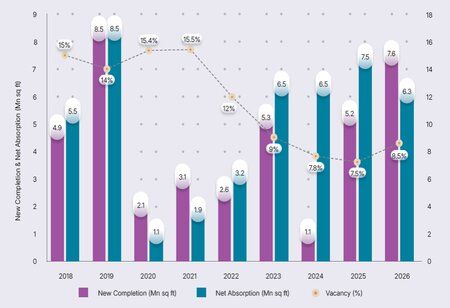
Supply-Demand Dynamics & Vacancy Trend (Last 8 Years)
Other Key City Highlights
Bengaluru
The city remains a resilient mid-range market with 5-8% vacancy and a healthy expansion focus in the East and South corridors, led by anchors like Lifestyle and Westside. The city is poised to witness a decent retail supply pipeline of 5.03 Mn sq. ft. by 2031. The average mall rental in Bengaluru stands at Rs 200-250 per sq ft (chargeable, vanilla stores) across Grade A/A+, indicating a relatively stable and mid-range rental market compared to other Tier I cities. The market is further supported by healthy occupancy levels, with vacancy rates in Grade A and above malls remaining low at ~5–8%, reflecting strong leasing traction and sustained demand from retailers.
Hyderabad
Emerging as a supply powerhouse, Hyderabad anticipates 7.1 million sq. ft. by 2031. Hyderabad’s Grade A mall ecosystem reflects a moderate rental environment, with the city average for vanilla stores at Rs 200- 250/sq.ft. Asset-level performance indicates a wide dispersion, with top-performing malls achieving Rs 300-400/sq.ft. (up 54% above city average), while underperforming assets remain in the range of Rs 168-Rs 176/sq.ft. (down 25–30%).
Pune
Pune is seeing massive activity with IKEA and Uniqlo driving headline deals. The city’s organized retail market reflects stable rental benchmarks for vanilla stores, with city-level averages indicating a mature yet steadily evolving consumption landscape. As per the analysis, vanilla store rentals in Grade A developments average Rs 175-225 psf, with asset-level variations ranging from Rs 170 psf to Rs 300 psf. This spread highlights the impact of mall positioning, catchment affluence, and brand mix on rental performance, with premium centres commanding significantly higher trading values.
Chennai
Chennai’s organized retail market reflects stable but relatively moderate rental performance, with average vanilla store rentals at Rs 175–225 psf (chargeable) across select Grade A developments. The limited sample size indicates a concentrated, asset-driven market with minimal variance in rental positioning.
Kolkata
The city’s limited upcoming supply of 1.85 Mn sq. ft. is expected to protect current rental values despite a more conservative leasing pace.
Suburban Growth Emerging as the Next Retail Frontier
The report highlights a clear shift toward suburban retail expansion.
- Mumbai: Growth concentrated in Thane, Borivali, and Panvel
- Bengaluru: Expansion accelerating along Sarjapur Road
These residential catchment-driven corridors are expected to power the next phase of organised retail growth as city centres approach saturation.
Retail Real Estate Attracts Institutional Capital
India’s Grade A/A+ retail assets are increasingly emerging as one of the country’s most attractive commercial real estate investment classes.
Key trends include:
- Historically low vacancy levels of 0-2%
- Sustained rental growth of 6-10% annually
- 74% of leases adopting hybrid revenue-linked models
- Nearly 75% of lease tenures locked between 3-7 years
With an estimated USD 25-30 billion core investment opportunity, alongside 40–50 million sq. ft. redevelopment potential, the sector is expected to attract stronger participation from:
- REITs
- Private equity investors
- Sovereign wealth funds
- Institutional developers
The report concludes that India’s organised retail real estate market is poised to remain one of the strongest consumption-led growth stories through 2030.
Recent Report
India’s real estate capital markets staged a strong comeback in FY2025-26, with total deal value rising to $4.3 billion, according to ANAROCK Capital’s FLUX FY26 Annual Edition. Marking a 13% year-on-year increase, the sector recorded its highest activity in seven years with 60 transactions, reflecting broader investor participation and stronger market depth.
Also Read: India Real Estate Capital Markets Hit $4.3 Bn Deals in FY26
Commercial office assets led with $1.6 billion across 14 deals, while retail real estate regained momentum through marquee institutional investments such as Blackstone’s $377 million South City Mall acquisition. A notable trend was the growing dominance of domestic capital, which surged to $1.64 billion, as foreign investor share declined. ANAROCK noted that this shift highlights rising local confidence, improved transparency, and India’s strengthening position as a mature and diversified real estate investment destination.