
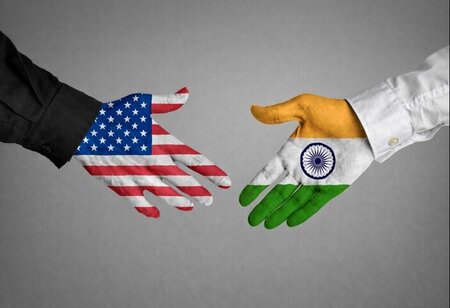
In a swift reversal of events, the long-awaited Indo-US trade deal has been announced, with the US agreeing to lower the reciprocal tariff on Indian imports from 25% to 18% and completely removing the 25% punitive tariff related to Indo-Russian oil trade. This resulted in a 32 percentage point reduction in the applicable tariff, not only making Indian exports more competitive in the US markets but also triggering a chain reaction of positive developments that could enhance the performance of Indian markets. This is a high-impact development and will have a multi-layered positive effect on the Indian economy, prevailing market sentiments, and sectors exporting to the US, which will benefit from better competitiveness. Key sectoral beneficiaries include Auto Ancillaries, Defense, Consumer, Textiles, EMS, Consumer Durables, IT Services, Financials (second-order beneficiary), and Utility companies (for detailed information and specific stocks, refer to Exhibit 1).
Multi-layered benefits to accrue for the Indian markets and economy
The Indo-US deal has been in abeyance for several months now and was a key reason for negative sentiments surrounding India in the past one year or so. With the fog of uncertainty now being lifted, we believe that multiple positives will accrue in the form of 1) reversal of FII outflows, 2) INR recovering its lost ground, 3) general improvement in sentiments towards Indian equities, 4) return of confidence for FDI, and 5) retracement of India’s underperformance vs. EM peers, etc. Most of the market participants are likely to be surprised by the timing of the deal announcement. In most of our recent investor interactions, we sensed that the majority expected the deal discussions to be protracted, with completion around 2HCY26, ahead of the US midterm elections.
The event carries a positive allocation effect over a long time horizon
Not only will the market respond very positively to the deal announcement in the near term, but this deal will also reset the base for India’s strong performance over a longer time horizon, as we see this event imbued with a structurally “positive allocation effect”. The Indo-US trade relations have been strained since Apr’24, which has soured the FIIs’ outlook, as India was seen to have limited leverage with the US. Consequently, India has significantly underperformed its peers by ~40% over the past year, as FIIs withdrew USD22b from the Indian equities since Jan’25. Additionally, the INR depreciated by ~6% against the USD, especially as the dollar index slid. We believe many of these adverse trends are now likely to reverse.
India’s exports to the US get their competitiveness back
This one announcement has singularly swung attractiveness of India’s goods US market appreciably from being the most tariffed imports to among the lowest tariffed ones as the composite tariff on India reduces from 50% to 18%. Among key economies, Switzerland, the EU, the UK, Japan, and South Korea will have lower tariffs compared to India. However, competition from these economies will be limited, given the different stages of the value chain these economies occupy leading to lower overlap. Importantly, most of the nations that India competes with in the US market will have higher tariffs ranging from 19% to 40%, with large emerging market exporters such as China, Vietnam, Brazil, Thailand, and South Africa – all now being levied higher tariffs than India.
Also Read: US and India Seal Trade Deal; Tariffs on Indian Goods Cut to 18%
Indo-US deal crowns the recent trade deal overdrive of India
The Indo-US trade announcement comes on top of the Indo-EU FTA, which was inked last week, and together they will help assuage the growing concerns over India’s geopolitical seclusion. Before these two, India had struck trade agreements with several other countries and regions, such as the UK, EFTA, Oman and NZL and underscores India’s growing importance in a world marked by bilateral/plurilateral cooperation, given India’s size, growth promise, and strategic relevance.
India’s positives should receive due weightage now
With this deal announcement, we believe that the market will now begin to accord correct weightage to the improving trajectory of corporate earnings growth, which has shown successive improvement over the quarters with an improving earnings revision trend. We had expected a 16% YoY growth in MOFSL PAT at the start of 3QFY26, and the results to date have been in line with our estimates. We expect ~12% earnings growth for Nifty over FY25-27E. Valuations for Nifty at 20.4x remain palatable (below the 10-year average of 20.8x), and with the latest turn of events, it has the potential to expand appreciably. This expansion will be duly supported by earnings expectations of 12% for Nifty and 15% for the MOFSL universe.
Source : Press Release