
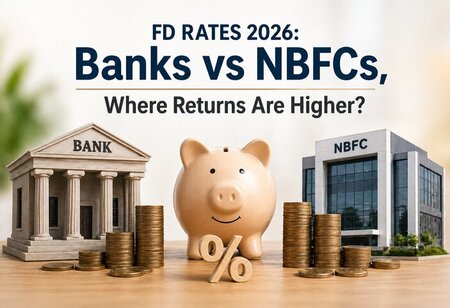
Fixed deposits (FDs) continue to remain a preferred investment avenue for risk-averse investors, but the interest rate landscape in April–May 2026 highlights a widening gap between traditional bank FDs and higher-yielding non-banking financial company (NBFC) deposits.
Key Highlights
- Bank FD rates remain stable at 6.25-6.50%, while NBFCs offer higher returns up to 8.5%.
- Investors balancing safety and returns increasingly diversify between banks, NBFCs, and small finance banks.
Bank FD rates remain stable but moderate
Interest rates offered by major banks currently range between 2.5% and 7.9% per annum, depending on tenure and institution . For the popular 1-3 year tenure, large lenders such as SBI, HDFC Bank, ICICI Bank, and Axis Bank are offering returns in the 6.25%-6.50% range .
Private banks and select lenders like IDFC FIRST Bank, Bandhan Bank, and RBL Bank offer relatively higher rates, going up to 7.25%-7.40%, while senior citizens can earn close to 7.75%-7.90%.
For longer tenures of 5–10 years, most banks provide slightly lower returns of around 6.00%-6.75%, reflecting a stable interest rate cycle influenced by RBI policy decisions .
Despite lower yields, bank FDs remain attractive due to capital safety and DICGC insurance coverage of up to ₹5 lakh, making them a reliable option for conservative investors.
NBFC FDs offer higher returns but with added risk
In contrast, NBFC fixed deposits are offering significantly higher returns, typically ranging between 6.15% and 8.50%, depending on tenure and issuer . Some NBFCs and financial institutions are even offering rates above 8%, particularly for medium- to long-term deposits .
These higher rates are driven by NBFCs’ reliance on public deposits to fund lending across sectors such as housing finance, vehicle loans, and MSME credit.
For instance, leading NBFCs like Bajaj Finance have recently revised FD rates upward, offering up to 7.40% for general investors and 7.75% for senior citizens in select tenures, making them competitive in the long-term segment.
However, unlike bank deposits, NBFC FDs do not carry DICGC insurance, which means investors must carefully evaluate credit ratings and financial strength before investing.
Also Read: NBFCs Gain Consumer Loan Share Over Private Banks; RBI Curbs NBFC Norm
Small finance banks emerge as high-yield alternatives
Small finance banks (SFBs) are currently offering some of the highest FD rates in the market, with returns going up to 8.10% or higher for select tenures .
Players such as Suryoday, ESAF, and Jana SFB are particularly competitive in the 1.5 to 3-year segment, offering better yields than traditional banks. However, investors should weigh these returns against the relative risk profile and deposit limits.
What should investors consider?
The evolving FD landscape in 2026 presents a clear trade-off:
- Bank FDs: Lower returns but high safety and guaranteed insurance
- NBFC FDs: Higher yields with moderate credit risk
- SFB FDs: Attractive returns with a balance of risk and reward
Financial experts recommend a diversified approach, allocating funds across banks and highly rated non-banking financial companies to optimise returns while maintaining capital protection.
As interest rates stabilise, fixed deposits continue to play a crucial role in investment portfolios. However, choosing the right tenure, institution, and credit quality remains essential to maximise returns in the current rate cycle.