
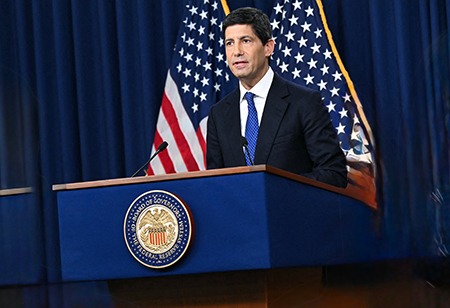
The US Federal Reserve has kept its benchmark interest rates unchanged at 3.75%-4% following its October 28, 2026, policy meeting, in a widely anticipated decision that leaves global investors assessing the outlook for inflation, bond yields and future monetary policy. For Indian stock markets, the US Fed decision keeps attention focused on crude oil prices, foreign portfolio investor (FPI) flows, geopolitical developments and corporate earnings.
Key Highlights
- The US Fed decision to keep rates at 3.75%-4% and the prevailing concerns of inflation and policy uncertainty in the global markets weighed on the market sentiment.
- Indian stock market remain vulnerable to commodity prices, capital flight, geopolitical risks and company profits.
The US central bank said inflation remains above its 2% target and that it needs more information to determine the appropriate policy path. Two members of the Federal Open Market Committee (FOMC) dissented from the decision, highlighting differences over the future direction of interest rates.
Markets are now mulling a rate hike in December. As the outlook for US monetary policy changes, it could affect global investment flows and sentiment towards emerging markets, such as India.
US Fed Interest Rate Decision Keeps Policy Uncertainty in Focus
The US Federal Reserve has continued to prioritize inflation on the 2% target with a focus on economic growth, and have kept rates at 3.75%-4% in accordance.
The ruling comes six days before U.S. midterm elections that saw cost of living and affordability issues continuing to be concerns for voters. Investors are also looking for hints in the Fed's statement on the interest rate outlook for the near future.
The decision was long anticipated, though there was division in the policy-making circles and on-going inflation concerns have kept uncertainty alive as to the future path of rates.
What Does the US Fed Rate Decision Mean for Indian Stock Markets?
Lakshmi Iyer, Group President (Investment) and CEO of Bajaj Alternate Investment Management, said that the Fed's move was in line with market sentiment. She pointed out that the crude oil prices, geopolitical developments and other factors are key drivers of Indian equities.
Crude oil stability is the most important factor for our markets, as sensitivity to oil prices is very high, Lakshmi Iyer said, noting that geopolitical uncertainty remains unresolved. She also pointed to continued foreign portfolio investor selling as a factor behind the underperformance of Indian equities compared with global peers.
However, Lakshmi Iyer sees an improvement in the earnings outlook. While FY26 witnessed earnings downgrades, FY27 has so far delivered good earnings growth. She added that FY28 could see limited earnings downgrades.
According to Lakshmi Iyer, valuations have corrected across stocks and sectors, making price-to-earnings multiples more reasonable. She also expects interest rates to remain broadly stable around current levels.
Also Read: RBI Repo Rate Hiked by 25 Bps; Shifts to Calibrated Tightening Stance
US Markets Extend Gains as Treasury Yields Remain Elevated
The US stocks posted three-day gain on Wednesday. The Dow Jones Industrial Average rose 97 points and the Nasdaq Composite had a 72-point increase.
The S&P 500, Nasdaq and the Russell 2000 all rallied to one-week highs, and the Russell 2000 hit a three-week high. The positive results occurred despite persistent worries over inflation and the path interest rates will take in the United States.
The US dollar index broke a three-day winning streak and was down on the close in the 102 level area.The US dollar index broke a three-day winning streak and ended below 102 on the day. At the same time, 10-year US Treasury yields were still above 5%, which meant that borrowing rates stayed higher.
The equity gains and high bond yields signal the need to watch inflation data and the next Fed policy signals for global investors.
Asia Stocks Fluctuate following US Fed Decision
The Asian stock index was mixed on Thursday, as traders looked for clues to the Fed's policy stance and how it will affect financial markets around the world.
Japan’s Nikkei 225 rose 1.09% to 64,651.14, gaining nearly 697 points. The Kospi, on the other hand, fell 0.61% to 5,975.79. Hong Kong’s Hang Seng edged down 0.08% to 23,076.92, while China’s Shanghai Composite fell 0.51% to 3,662.88.
Key Factors Indian Investors Should Watch After the Fed Decision
The Fed’s decision leaves several factors in focus for Indian equity investors.
-
Crude oil prices: Changes in oil prices remain important for India’s inflation outlook and market sentiment.
-
FPI flows: Continued foreign investor selling could influence demand for Indian equities.
-
Earnings by companies: The earnings growth path in FY27 and any revisions in FY28 will continue to be key for valuations.
-
Higher US bond yields: Higher bond yields in the U.S. could impact interest rates and investment patterns around the world.
-
Geopolitical developments: Uncertainty around global conflicts could affect energy prices and investor confidence.
The Fed rate decision is not enough to give direction to Indian stock market. Other factors that affect market performance include domestic earnings, valuations, oil prices and foreign investment flows.