
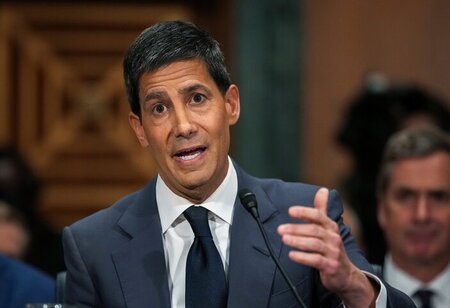
The US Federal Reserve kept the federal funds rate unchanged in the 3.50%-3.75% range for the fourth consecutive meeting, as policymakers continued to weigh slowing economic growth against persistent inflationary pressure. The decision, taken at the first policy meeting under new Fed Chair Kevin Warsh, was largely in line with market expectations.
Key Highlights
- US Federal Reserve kept rates unchanged at 3.50%-3.75% amid persistent inflation concerns.
- Fed's hawkish stance may impact rupee, FII flows and Indian markets.
Inflation Forecasts Revised Sharply Higher
The Fed increased its forecast of year-end Personal Consumption Expenditure (PCE) inflation to 3.6% from the 2.7% it had recorded in March in its revised Summary of Economic Projections (SEP). The volatile food and energy costs have been removed from the core PCE inflation figure and now projected to be 3.3%, up from the previous estimate of 2.7%.
The increase is due to rising prices, primarily due to high energy prices associated with the current Iran conflict. US inflation has now hit a three-year peak and is further away than ever from the Fed's 2% long-term goal.
In addition, the Fed made another change to its policy statement to eliminate forward-guidance language, marking another step toward a more data-driven policy stance under Fed Chairman Warsh, who has previously said he favors cutting back the Fed's usage of forward-guidance.
Also Read: RBI Keeps Repo Rate Unchanged at 5.25%, Maintains Neutral Stance
A Growing Number of Officials Expect a Rate Hike
The Fed's so-called "dot plot", however, suggests a more hawkish tone among the members of the committee this time, as rates were kept steady. The 18 members of the Fed's Open Market Committee who made projections of interest rates:
- Nine now expect at least one rate hike later this year
- Six of those nine - roughly a third of the committee - believe more than one 25-basis-point hike may be needed
- Eight expect rates to stay unchanged through the year
- Only one favours a rate cut
- One official did not submit a projection
With more than half the committee now leaning toward tightening, markets are bracing for the possibility that US interest rates could stay elevated for longer than previously anticipated.
What This Means for the Indian Stock Market
A potential US rate hike would be widely viewed as a headwind for Indian equities. Higher US yields make American assets more attractive relative to emerging markets, which could accelerate Foreign Portfolio Investor (FPI) outflows from India at a time when foreign investors have already pulled significant capital from domestic markets this year.
This comes against a backdrop of rich valuations, a weaker earnings outlook, and India's relatively limited exposure to the AI-led investment theme - all factors that have already dampened FPI sentiment toward Indian equities. So far in 2026, the Nifty has declined 8%, making it one of the worst-performing major emerging markets, while persistent selling has pushed Indian equities to seventh position globally by market capitalisation, slipping behind South Korea.
Commebting on Warsh’s Hawkish Debut, Amit Modani, Senior Manager, Lead – Fixed Income, Shriram AMC stated, “In his first major policy decision, Fed Chair Kevin Warsh left interest rates unchanged. He noted that economic activity continues to expand at a solid pace despite elevated uncertainty linked to the Middle East, while reiterating that the Fed remains “resolute” in bringing inflation back to its 2% target."
He noted, "The key shift was in communication, the Fed scrapped all forward guidance, signalling a more opaque, data-dependent approach going forward. Warsh struck a distinctly hawkish tone, prioritizing inflation control with limited emphasis on the employment side of the dual mandate. He also announced five internal task forces covering communications, the balance sheet, data sources, productivity & jobs, and the inflation framework. indicating a broad review of the Fed’s policy toolkit."
"For markets, a more hawkish Fed could temper risk-on sentiment from a potential U.S.–Iran deal. Still, Indian markets are responding positively to deal prospects, which have led to a sharp drop in crude oil prices, further aided by recent RBI measures to attract foreign flows, including easing of FPI norms. Together, these factors remain supportive for the INR, FPI flows, and the domestic bond market, keeping overall sentiments constructive", he added.
Pressure on the Rupee and Domestic Inflation
A stronger US dollar environment, driven by elevated yields, typically puts downward pressure on the Indian rupee - which has already touched multiple lows against the dollar in 2026. Sustained FPI outflows could intensify this pressure further.
Commenting on the decision Naval Kagalwala, COO & Head of Products, Shriram Wealth Ltd. stated, “In the first meeting under the new Fed Chair Kevin Warsh, for the fourth consecutive Fed meeting and in line with market expectations, the Fed decided to keep the interest rates unchanged at 3.50% - 3.75%. However, the commentary underscored a cautious approach, highlighting persistent inflation risks (Total Personal Consumption Expenditure {PCE} Inflation index was revised to 3.6% for this year, sharply higher from the 2.7% estimated in the March meeting) and a lower GDP growth (projected at 2.2% vs 2.4% in March) stemming from the geopolitical headwinds. With more than 50% of the dot plot projections indicating at least one rate hike this year, Interest rates could remain elevated longer than previously anticipated."
He further added, "For India & Indian investors - a higher US yield reduces the appeal for Indian debt for global investors and also puts pressure on the INR. Closer home, a below normal monsoon forecast by IMD (90% of long-period average with a 60% chance of drought like conditions) is likely to impact agriculture and hence a higher food inflation. These risks are currently offset with the oil price below US$80 based on expectations of stability in the US-Iran conflict.”
Domestic Factors Compound the Risk
Beyond global monetary policy, India faces its own inflationary headwinds. The India Meteorological Department (IMD) has forecast a below-normal monsoon this year - just 90% of the long-period average, with a 60% probability of drought-like conditions. A weaker monsoon typically hurts agricultural output and pushes up food inflation, adding a domestic dimension to the inflation risk that global rate decisions already pose.
For now, this risk is being partly offset by crude oil prices remaining below US$80 per barrel, supported by expectations of relative stability in the US-Iran conflict. However, any escalation on that front could quickly reverse this cushion.
Bottom Line
With the Fed signalling a longer runway for elevated rates and a meaningful share of policymakers now leaning toward a hike, Indian investors should watch FPI flow data, rupee movement, and crude oil prices closely in the coming weeks. The interplay between global rate trajectory and domestic factors like the monsoon outlook will likely shape market sentiment through the rest of 2026.