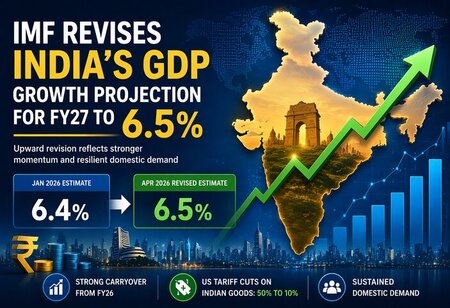
The International Monetary Fund (IMF) has revised India’s GDP growth projection for FY27 upward to 6.5%, a 0.1 percentage point increase from its January 2026 estimate of 6.4%, according to its April 2026 World Economic Outlook (WEO) report titled Global Economy in the Shadow of War.
Key Highlights
- IMF raises India’s FY27 GDP growth forecast to 6.5% amid global uncertainty.
- Strong domestic demand, tariff cuts help India outperform global slowdown pressures.
The IMF expects India to maintain this growth momentum at 6.5% in FY28 as well, positioning it among the few major economies to receive an upward revision in a report otherwise marked by widespread downgrades due to geopolitical tensions.
Key Drivers Behind the Upgrade
The IMF attributes the revised India’s GDP growth projection to strong economic fundamentals and favorable external developments. These include robust carryover momentum from FY26, a significant reduction in US tariffs on Indian goods—from 50% to 10%—and continued strength in domestic demand.
The report notes that growth for 2026 has been revised upward by 0.3 percentage points overall (including a 0.1 percentage point increase since January), supported by the strong performance in 2025 and easing trade restrictions. These positive factors are expected to outweigh the negative spillover effects of the ongoing Middle East conflict.
Also Read: World Bank Raises India's FY27 GDP Growth Forecast to 6.6%
Additionally, India’s growth estimate for FY26 has been raised to 7.6%, reflecting better-than-expected economic performance in the second and third quarters, along with sustained momentum in the fourth quarter.
On inflation, the IMF expects price pressures in India to stabilise after a period of food-driven softness in FY26, gradually aligning with the Reserve Bank of India’s 4% target over the medium term.
Global Economic Headwinds
While India’s GDP growth remains resilient, the global scenario has weakened significantly. The IMF warns that the ongoing Middle East conflict has disrupted around 13% of global oil supply and 20% of LNG flows through the Strait of Hormuz, impacting growth and fueling inflation worldwide.
Globally, inflation is projected to rise from 4.1% in 2025 to 4.4% in 2026 before easing to 3.7% in 2027, driven largely by higher energy and food prices.
Despite these challenges, India continues to stand out as one of the fastest-growing major economies, supported by strong domestic demand and improving external trade conditions.