
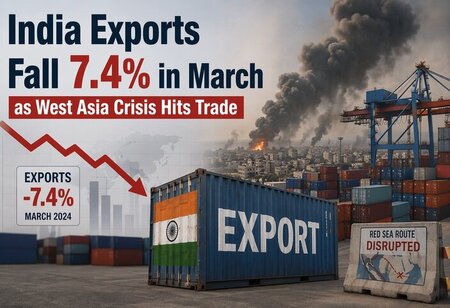
India’s merchandise exports declined sharply in March, signaling renewed pressure on the country’s external trade amid geopolitical disruptions and sectoral weakness. According to a report by Crisil, goods exports fell 7.4% year-on-year to $38.9 billion, marking a significant reversal from the relatively stable performance seen in the previous quarter.
The decline reflects a combination of a high base effect, weakening global demand, and supply chain disruptions linked to the ongoing West Asia conflict.
Key Highlights
- India exports decline reflects global demand weakness and geopolitical risks.
- Oil trade dynamics offer temporary relief through higher prices.
- Trade deficit and CAD risks remain elevated.
The slowdown was not limited to a single sector. Core exports contracted 7.5%, indicating widespread weakness across manufacturing and labour-intensive industries.
Key segments reported notable declines:
- Gems and jewellery exports plunged 29.3%, the steepest fall among major categories
- Textiles dropped 10.3%
- Readymade garments declined 19%
- Leather exports fell 14.4%
The downturn in gems and jewellery exports is particularly significant, as the UAE-India’s largest market for the segment-has witnessed demand volatility and trade disruptions.
Even the electronics sector, which had been a consistent growth driver, saw a 3.3% contraction, marking its first decline in 30 months.
Oil Trade Dynamics Offer Partial Relief
While non-oil exports weakened, petroleum shipments provided some support. Petroleum exports rose 5.7%, driven by higher global crude prices. Brent crude averaged $95.6 per barrel in March, compared to $70.7 a year ago.
There was also a noticeable shift in export destinations:
- Exports to Singapore surged 158.6%.
- Shipments to Malaysia increased 84.5%.
On the import side, crude oil purchases declined significantly, pulling total imports down 6.5% to $59.6 billion.
As a result, India’s oil trade deficit narrowed sharply to $7 billion, nearly half of the $14.1 billion recorded a year earlier.
West Asia Trade Corridors Disrupted
The impact of geopolitical tensions was most visible in trade flows with West Asia, a key region for India’s exports and energy imports.
- Exports to Saudi Arabia dropped 45.7%.
- Shipments to the UAE fell 61.9%.
- Imports from Qatar, Saudi Arabia, and the UAE also declined sharply.
These disruptions highlight the vulnerability of India’s trade routes to regional instability and logistics bottlenecks.
Agricultural exports were also affected, with rice shipments declining 15.4%, reflecting both logistical challenges and softer demand in key markets.
Also Read: Indian Trade Deficit Falls to $20.67 Billion in March 2026
Trade Deficit Widens Despite Modest Export Growth
For FY26 so far:
- Total exports rose marginally by 0.9% to $441.8 billion
- Imports increased 7.4% to $774.9 billion
- The trade deficit widened to $333.1 billion
The widening gap underscores persistent pressure on India’s external balance, despite resilience in certain sectors.
Rising Risks to Current Account Balance
According to Crisil, external risks remain elevated due to geopolitical uncertainty and energy price volatility.
The agency estimates that:
- India’s current account deficit (CAD) could widen to 1.5% of GDP in FY27
- It may rise further to 2% if crude oil prices remain elevated
While services exports continue to act as a buffer, the outlook for merchandise trade remains cautious.