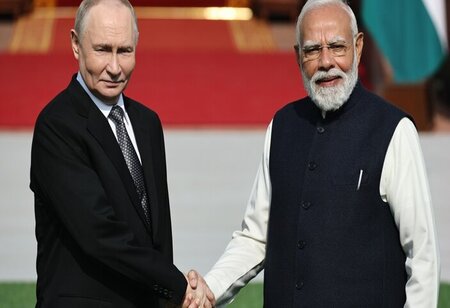
During his two-day state visit to India, Russian President Vladimir Putin and Indian Prime Minister Narendra Modi reaffirmed their long-standing strategic partnership, announcing an ambitious goal to raise bilateral trade to US$100 billion by 2030.
Key Highlights
- India and Russia set a 2030 goal to boost bilateral trade to $100 billion across sectors.
- Russia commits to uninterrupted crude supplies as both nations expand cooperation in energy, infrastructure, agriculture.
The leaders emphasized that the relationship between Russia and India remains underpinned by deep trust and mutual respect, describing it as “resilient” despite the complex global geopolitical situation. Modi noted that the target may in fact be achieved ahead of schedule, citing the “tremendous potential” in the partnership.
A key pillar of the new economic cooperation programme is to diversify the partnership beyond its traditional focus on oil and defence. Russia and India agreed to pursue expanded collaboration in areas such as energy (including nuclear), infrastructure, agriculture, digital economy, critical minerals, joint manufacturing and supply chains. One major element is the continued guarantee from Russia of “uninterrupted” fuel supplies to India, underscoring the energy security dimension of the relationship.
On the trade architecture front, both sides committed to practical measures: eliminating non-tariff and trade barriers; exploring settlement of trades in national currencies (rupee-ruble); strengthening newer transport corridors such as the North–South route and the Chennai-Vladivostok sea line; and accelerating work on an FTA (Free Trade Agreement) between India and the Eurasian Economic Union.
Also Read: US House Panel to Review India-US Strategic Partnership on Dec 10
Geopolitically, the timing is significant. India continues to simultaneously engage with the West, particularly the U.S., while deepening ties with Russia. The U.S. has expressed concern over India’s oil imports from Russia, and this partnership with Moscow highlights India’s balancing of its strategic and economic interests.
In summary, the announcement marks not just a numerical trade target, but a broadening of the India-Russia partnership into a multi-sectoral growth agenda — one that may reshape regional economic linkages and offer new industrial, infrastructural and strategic opportunities for both countries.