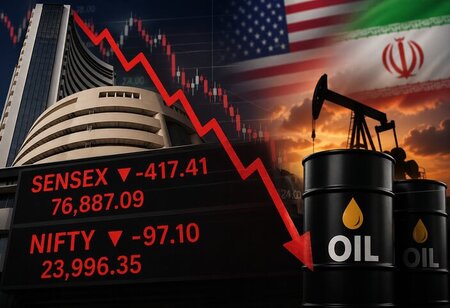
Indian equity markets ended lower on Tuesday, with the BSE Sensex declining over 417 points to close at 76,887 and the NSE Nifty 50 slipping 97 points to settle at 23,996, as rising crude oil prices and escalating geopolitical tensions dampened investor sentiment. The decline follows a strong rally in the previous session, indicating a phase of consolidation in the markets.
Key Highlights
- Sensex and Nifty decline amid rising oil prices and escalating Iran-US geopolitical tensions globally.
- Broader markets outperform benchmarks despite FII selling and volatility concerns in Indian equities.
Investor caution intensified after fading hopes of a quick resolution to the ongoing US-Iran conflict triggered a sharp rebound in global oil prices. Brent crude surged above $110 per barrel, raising concerns about inflation and economic stability, particularly for oil-importing nations like India.
Reports suggest that diplomatic efforts to ease tensions remain uncertain, with the US expressing dissatisfaction over Iran’s latest proposal to reopen the strategically critical Strait of Hormuz.
Despite weakness in benchmark indices, broader markets outperformed. The Nifty Midcap and Smallcap indices ended up to 0.4% higher, indicating continued investor interest in mid- and small-cap stocks. Meanwhile, the India VIX, a key measure of market volatility, declined around 2% to 18.05, suggesting relatively stable risk perception among investors.
On the sectoral front, the Nifty PSU Bank index fell over 2%, emerging as the top loser, while the Oil & Gas index gained more than 1% amid rising crude prices.
Among stocks, Maruti Suzuki dropped nearly 3% after reporting a 7% year-on-year decline in Q4 FY26 profit. Banking and financial stocks including Axis Bank and ICICI Bank also declined. On the positive side, Reliance Industries and Bharti Airtel gained up to 2%, providing some support to the indices.
Market breadth remained negative, with approximately 1,784 stocks declining compared to 1,490 advancing on the NSE.
Market experts indicated that the near-term trend may remain range-bound amid mixed signals. “Overall, markets are entering a consolidation phase, balancing strong earnings momentum against macro and geopolitical uncertainties, with near-term direction hinging on central bank commentary and incoming data,” Bajaj Broking said.
Also Read: Indian Equity Markets: Sensex Jumps 639 Points, Nifty Tops 24,000
Global markets remained mixed, with Asian indices showing divergent trends as investors tracked developments in the Middle East and central bank policy signals. Meanwhile, the Indian rupee weakened by 41 paise to 94.56 against the US dollar, reflecting pressure from rising oil prices and foreign fund outflows.
Foreign institutional investors (FIIs) continued to remain net sellers, offloading equities worth Rs 1,151 crore in the previous session. Analysts attribute this trend to stronger global market performance, particularly in AI-driven sectors abroad.
VK Vijayakumar, Chief Investment Strategist at Geojit Investments said, “It is important to understand the principal reason behind sustained FII selling in India… A few AI stocks are driving this AI trade globally. So long as this market momentum continues, FIIs are likely to continue selling.” He added that a potential correction in global AI stocks could reverse flows back into Indian equities, with fairly valued large-cap stocks likely to benefit.