
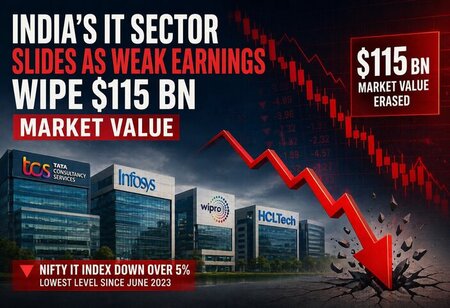
India’s IT sector is facing renewed pressure as disappointing earnings from major players have intensified investor concerns over near-term growth prospects. The latest earnings cycle has triggered a sharp market reaction, with IT stocks witnessing a significant selloff. A key sectoral index dropped over 5%, hitting its lowest level since June 2023, reflecting weakening sentiment among investors.
Key Highlights
- India’s IT sector declined sharply as weak earnings triggered selloff, wiping $115 billion market value.
- Infosys guidance miss and HCLTech profit decline deepened concerns over growth outlook and AI disruption.
Infosys, India’s second-largest IT services exporter, reported revenue of Rs 46,402 crore with 13.4% growth and an EBIT margin of 21%, but projected annual revenue growth below analyst expectations. Meanwhile, HCL Technologies posted revenue of Rs 33,981 crore with 12.3% growth, though profitability remained under pressure with a marginal decline in net profit and a sharp 146 bps drop in margins, triggering multiple analyst downgrades and steep stock corrections.
Across the sector, performance remained mixed- TCS delivered stable growth with Rs 70,698 crore in revenue and strong margins of 25.3%, while Tech Mahindra showed signs of a turnaround with improving profitability. Mid-tier players such as Persistent Systems and Oracle Financial Services Software outperformed, reporting robust earnings growth and margin expansion.
Despite pockets of resilience, the negative earnings momentum has weighed heavily on investor sentiment, with nearly $115 billion wiped off the IT sector’s market value over the past four months, underscoring the depth of the ongoing correction and broader concerns around growth visibility.
Twin Challenges: Global Slowdown and AI Disruption
India’s $315 billion IT industry is currently grappling with a dual challenge:
- Weak global macroeconomic environment, exacerbated by geopolitical tensions, which has reduced discretionary technology spending by global clients
- Rapid rise of artificial intelligence, which is disrupting traditional outsourcing models and reshaping demand dynamics
Recent reports also indicate that clients are delaying large technology investments due to uncertainty around returns on AI adoption, further impacting revenue visibility.
Sector Drag on Broader Markets
The prolonged decline in IT stocks has begun to weigh on the broader equity markets. Technology stocks account for nearly 10% weightage in the NSE Nifty 50, making the sector a key driver of overall market performance.
Since the earnings season began with Tata Consultancy Services, the IT index has remained under sustained pressure, emerging as one of the worst-performing sectoral indices in 2026.
Market experts remain cautious about the sector’s near-term outlook. “We continue to be cautious on the sector,” said Surendra Goyal, Managing Director & Head of India Research at Citigroup, citing high competitive intensity and the growing impact of AI on traditional business models."
Echoing similar concerns, Anurag Rana, Sector Head & Senior Analyst at Bloomberg Intelligence noted, "Discretionary and non-AI technology spending is under pressure, as clients are delaying large, multi-year projects due to economic uncertainty and unclear returns from AI.” He added that companies currently lack visibility beyond a single quarter, making medium-term guidance challenging.
AI: Threat and Opportunity
While artificial intelligence is creating near-term disruption, IT companies are actively repositioning themselves. Firms like Infosys are integrating AI into their service offerings to optimize costs and maintain client spending, while TCS is expanding AI infrastructure partnerships globally.
However, analysts highlight that AI-driven revenues still form a relatively small portion of total income, even as traditional services face pricing pressure.
Also Read: How Advancements in AI Will Topple the Indian IT Services Market?
Valuations Turn Attractive Amid Selloff
Despite the ongoing correction, some market participants see emerging value in the sector. The IT index is currently trading at below 17 times forward earnings, compared to nearly 30 times at the beginning of last year, indicating a sharp valuation reset.
“This is a sector with no price froth, little valuation excess, and a weak business cycle already reflected in prices,” said Sahil Kapoor, Investment Strategist. “At current prices, terminal-value risk appears limited, and we remain overweight.”
Outlook: Cautious Near-Term, Structural Shift Ahead
The India's IT sector is undergoing a structural transition as it navigates slowing global demand and AI-led disruption. While profitability remains stable, growth visibility has weakened significantly, with companies guiding for low single-digit expansion in FY27.
Going forward, the sector’s performance will hinge on how effectively companies adapt to AI, accelerate digital transformation offerings, and rebuild demand momentum in global markets.