
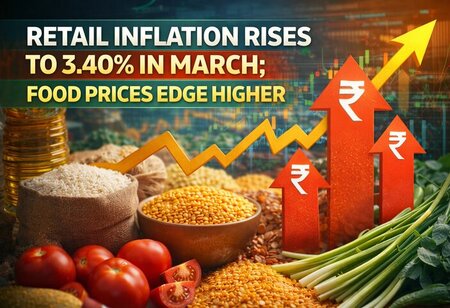
Retail inflation, measured by the Consumer Price Index (CPI), rose slightly to 3.40% in March 2026 from a revised 3.21% in February, according to data released by the Ministry of Statistics and Programme Implementation. The year-on-year inflation rate, based on the All India CPI with base year 2024, stood at 3.40% (provisional), indicating that overall price pressures remain moderate despite a marginal uptick.
Key Highlights
- Retail inflation rises to 3.40% in March, driven by food and energy pressures.
- RBI flags inflation risks as global uncertainties and rising oil prices impact outlook.
A closer look at the data shows a divergence between rural and urban inflation trends. Rural inflation was recorded at 3.63%, while urban inflation remained lower at 3.11%, suggesting relatively higher price pressures in non-urban areas.
Food inflation, measured by the Consumer Food Price Index (CFPI), stood at 3.87% during the month, with rural food inflation at 3.96% and urban food inflation at 3.71%. This indicates that essential commodities continue to exert pressure on household budgets, although some signs of stabilisation are emerging.
Housing inflation, on the other hand, remained subdued at 2.11% in March. Within this, rural housing inflation was estimated at 2.54%, while urban housing inflation stood at 1.95%, helping to keep overall inflation within manageable levels.
Despite this, the Reserve Bank of India has flagged potential upside risks to inflation in its latest Monetary Policy Committee (MPC) outcome. Sanjay Malhotra noted, "Rising energy prices and possible weather-related disruptions could push inflation higher in the coming months."
Echoing similar concerns, Radhika Rao, Senior Economist and Executive Director at DBS Bank said, "March inflation numbers reflect early signs of price pressures linked to global developments, including the Middle East crisis. She highlighted that while input costs are being selectively passed on to consumers and food prices are gradually normalising, the impact of higher energy prices is expected to intensify over time. She also noted that core inflation remains below 4%, reducing the immediate need for a hawkish monetary policy stance, although risks from rising fuel prices continue to be closely monitored."
Also Read: India Wholesale Inflation Hits 11-month High at 2.13% in February 2026
Robust Data Collection Accuracy
The data, compiled by the National Statistical Office, is based on extensive price collection across 1,407 urban markets and 1,465 villages, covering all states and Union Territories. With 100% market coverage and reporting efficiency of 99.93% in rural areas and 100% in urban centres, the estimates reflect a high degree of accuracy.
Overall, while India’s inflation remains under control, evolving global uncertainties, particularly energy prices and geopolitical tensions, could shape the inflation trajectory in the months ahead.