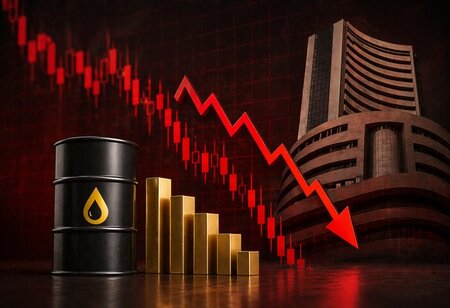
India’s benchmark equity indices - the BSE Sensex and NSE Nifty 50 - extended their losses for a second consecutive session on Thursday, weighed down by heavy selling in auto, banking, and consumer discretionary stocks amid rising global uncertainties.
Key Highlights
- Sensex and Nifty fall for second straight session amid rising crude oil prices and global uncertainty.
- Auto, banking, and PSU bank stocks lead losses, dragging benchmarks lower despite limited gains in select stocks.
The Sensex declined 852.49 points (1.09%) to close at 77,664, taking its two-day decline to over 1,600 points. Meanwhile, the Nifty 50 fell 205.05 points (0.84%) to settle at 24,173.05, reflecting broad-based weakness across sectors.
Investor sentiment remained fragile as crude oil prices surged above $100 per barrel due to ongoing tensions in the Middle East and disruptions in the Strait of Hormuz. The lack of clarity around a sustained US-Iran ceasefire further heightened volatility in global markets.
Rising oil prices have increased concerns around inflation and economic stability, particularly for oil-importing countries like India, adding pressure on equities.
Among Sensex constituents, Trent emerged as the biggest loser, falling over 4%, followed by declines in Bajaj Finserv, Tech Mahindra, Mahindra & Mahindra, Infosys, and HDFC Bank, each dropping up to nearly 3%.
On the positive side, select stocks such as Adani Ports, Larsen & Toubro, and Sun Pharma managed modest gains of up to nearly 1%. Heavyweights including Reliance Industries, Infosys, M&M, HDFC Bank and ICICI Bank were the primary contributors to the Sensex’s decline.
Sector-wise, the BSE Auto index fell sharply by over 2%, while the BSE PSU Bank index also declined more than 2%, indicating broad selling pressure in rate-sensitive and cyclical stocks.
Also Read: Bajaj Broking and MOFSL Daily Market Commentary for April 22nd
Analysts attribute the continued sell-off to a combination of global and domestic headwinds, including elevated crude prices, geopolitical uncertainty, weakening currency trends, and cautious investor sentiment. With volatility expected to persist, market direction will likely remain sensitive to developments in global energy markets and geopolitical negotiations.