
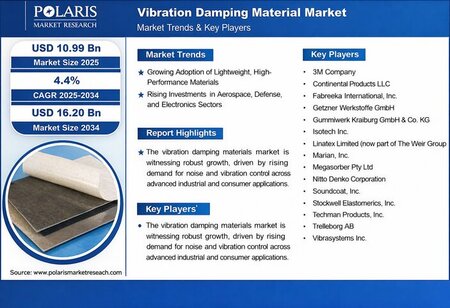
The vibration damping material market is gaining significant momentum as industries increasingly prioritize noise reduction, equipment longevity, and operational efficiency. These materials are widely used to absorb mechanical vibrations and dissipate energy in machines, structures, and electronic systems, helping reduce noise, prevent structural damage, and enhance product durability. Their applications span several industries, including automotive, aerospace, electronics, industrial machinery, and construction, making them a critical component in modern engineering and manufacturing systems.
According to industry analysis, the global vibration damping material market was valued at USD 10.54 billion in 2024 and is projected to reach USD 16.20 billion by 2034, expanding at a compound annual growth rate (CAGR) of 4.4% during the forecast period. This growth is primarily driven by increasing demand for advanced noise and vibration control solutions across transportation, manufacturing, and infrastructure sectors.
Market Overview
Vibration damping materials are engineered materials designed to reduce or eliminate unwanted vibrations in mechanical systems and structures. These materials convert vibrational energy into heat or other forms of energy, thereby minimizing vibration amplitude and improving system stability. Such capabilities are crucial in modern equipment where vibration can lead to reduced performance, noise pollution, and premature wear of components.
Industries are increasingly adopting advanced damping solutions as machinery becomes more complex and sensitive. Automotive manufacturers, for instance, integrate vibration damping materials into vehicles to improve passenger comfort, reduce cabin noise, and enhance driving performance. Similarly, in electronics and aerospace systems, vibration control ensures the reliability and longevity of sensitive components.
The growing emphasis on predictive maintenance and smart manufacturing has further amplified the demand for vibration damping solutions. Modern monitoring systems rely on vibration control technologies to detect anomalies and ensure stable operation, thereby strengthening the role of these materials in industrial applications.
Key Market Growth Drivers
Rising Automotive Production and Noise Reduction Requirements
One of the major drivers fueling the vibration damping material market is the rapid expansion of the global automotive industry. Vehicle manufacturers are continuously seeking materials that can reduce noise, vibration, and harshness (NVH) levels in vehicles. With the growing adoption of electric vehicles and hybrid powertrains, vibration control has become even more critical, as quieter engines make vibrations more noticeable.
Advanced polymer-based damping materials are increasingly used in engine mounts, door panels, dashboards, and suspension systems to enhance comfort and reduce mechanical stress. As automotive production increases worldwide, the demand for vibration control solutions is expected to rise steadily.
Growth in Industrial Machinery and Manufacturing
Industrial machinery and heavy equipment generate significant vibration during operation. Excessive vibration can lead to mechanical fatigue, reduced operational efficiency, and equipment failure. As a result, manufacturers are increasingly adopting damping materials in machinery components, foundations, and structural supports.
The rise of industrial automation and advanced manufacturing technologies is also contributing to market growth. Automated systems require precise vibration control to maintain operational accuracy and prevent equipment damage.
Increasing Use of Lightweight and High-Performance Materials
Another important trend driving the vibration damping material market is the growing demand for lightweight and high-performance materials. Industries such as aerospace, electronics, and automotive are actively pursuing weight reduction to improve efficiency and performance.
Advanced composites and polymer-based damping materials offer superior vibration control while maintaining low weight, making them ideal for modern engineering applications. These materials help improve energy efficiency, reduce structural stress, and extend product lifespan.
Market Challenges
Despite its promising growth trajectory, the vibration damping material market faces several challenges. One of the key barriers is the high cost associated with advanced damping materials and specialized manufacturing processes. High-performance composites and engineered polymers can significantly increase production costs, which may limit adoption among small and medium-sized manufacturers.
Another challenge is the complexity of integrating damping solutions into existing mechanical systems. In certain industries, retrofitting vibration control components into established equipment designs can be technically challenging and costly.
Additionally, fluctuations in raw material prices, particularly for polymers and specialized composites, can affect the overall profitability of manufacturers operating in the market.
Regional Analysis
From a geographical perspective, Asia Pacific dominates the vibration damping material market, driven by strong industrialization, rapid urbanization, and expanding automotive manufacturing across countries such as China, India, Japan, and South Korea. The region’s robust electronics manufacturing sector and increasing infrastructure development also contribute to strong market demand.
North America is expected to witness significant growth during the forecast period due to technological advancements and increasing demand for high-performance materials in aerospace, defense, and industrial applications. The presence of leading manufacturers and strong investment in research and development further strengthens the regional market.
Europe also represents a key market for vibration damping materials, particularly due to strict regulations regarding vehicle noise levels and industrial safety standards. Automotive manufacturers in countries such as Germany and France are investing heavily in advanced noise and vibration control technologies.
Meanwhile, emerging economies in Latin America and the Middle East & Africa are gradually adopting vibration damping solutions as industrialization and infrastructure projects expand in these regions.
Also Read: GST 2.0: Automotive Industry's Revamped Pricing Model
Market Segmentation
The vibration damping material market is segmented based on type, form, end-use industry, and region.
By type, the market includes polymers, metals, and composites. Among these, the polymer segment holds the largest share due to its cost-effectiveness, flexibility, and superior vibration absorption properties across various applications.
By form, the market is categorized into films & sheets, pads & tapes, foams & gaskets, and other forms. The pads and tapes segment is expected to grow rapidly because of its ease of application and adaptability to complex component designs.
Based on end-use industries, the market serves sectors such as automotive, industrial machinery, aerospace & defense, electronics, building & construction, and sports & leisure.
Conclusion
The vibration damping material market is poised for steady growth as industries continue to prioritize equipment reliability, noise reduction, and structural stability. Rapid industrialization, increasing automotive production, and the adoption of lightweight materials are key factors driving market expansion. As technological advancements and sustainable material innovations continue to evolve, vibration damping materials are expected to play an increasingly critical role in modern engineering and industrial applications worldwide.
Source : Press Release