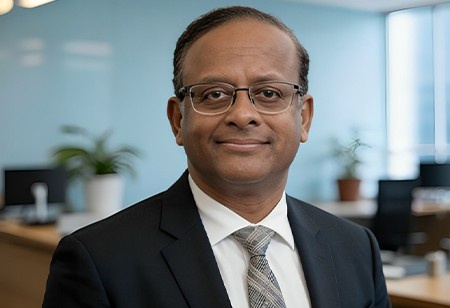
In an exclusive interaction with Adlin Pertishya Jebaraj, Correspondent at Finance Outlook, Senthil R Kumar, Managing Director & Chief Executive Officer, Nitstone Finserv Private Limited, has provided insightful commentary on the rapidly evolving Indian FinTech investment landscape. He further added that there has been a shift in the regulatory framework, which generally favours infrastructure-led FinTechs and B2B FinTech platforms primarily compared to super-apps that are consumer-focused.
Senthil R Kumar is a seasoned banking professional with over 25 years of experience in retail banking, inclusive finance, MSME lending, and asset-liability management, with a strong regional focus in South India. He has held leadership roles, including an extended tenure at ICICI Bank, where he managed large portfolios and led cross-functional teams to deliver consistent, high-performance results.
How would you characterise the current investment environment for Indian FinTech compared to the peak funding cycles of 2021–22, and what structural shifts are shaping capital deployment today?
The current investment environment of the Indian FinTech has become significantly more measured and picky than the fast-paced funding cycles witnessed in 2021-22. During that previous era, the amount of capital available was high and investors tended to focus on growth measures e.g. gross transaction volume, customer acquisition and market share more than profitability or unit economics. Currently, business models have become more sustainable.
The challenges of strong unit economics, efficiency, regulatory resilience and open access to long-term profitability are some of the fundamentals that investors are questioning. In terms of structure, the capital deployment has been shifting towards FinTech companies that offer the necessary financial infrastructure, exercise discipline in their execution, and have good governance practices, instead of pursuing scale fast at the cost of their financial sustainability or valuation-driven growth.
Also Read: Financial Planning for Product Engineering Startups
How is the cost of capital impacting FinTech business models, particularly for lending, BNPL (Buy now, pay later) and credit-led platforms that rely on leverage to scale profitably?
The increased cost of capital has been a major influence on credit-based FinTech models, especially in lending and Buy Now Pay Later (BNPL) businesses. Platforms which once enjoyed the advantages of low-cost leverage to grow faster are being forced to pursue balance-sheet management that is more prudent. This involves the enhancement of underwriting practices, customer acquisition strategies and reliance on cheap external funds.
In response, numerous FinTechs are seeking co-lending opportunities, off-balance-sheet opportunities, and fee-based or subscription revenue models. Such strategies enable companies to keep scaling and remain profitable in capital management, credit risk management, and adherence to the new and changing regulatory expectations, establishing a disciplined and more resilient growth structure.
In your view, does India’s regulatory posture now favour infrastructure-led FinTech platforms over consumer-facing super apps, and how is that influencing investor allocations?
The changing regulatory environment in India is becoming more favourable to infrastructure based FinTech systems, which focus on transparency, compliance and systemic stability. Regulatory bodies are promoting the innovations that enhance the financial ecosystem, including payment rails and data combination, compliance technology, and API-based services.
Consequently, investors are also investing in B2B and infrastructural FinTechs that are considered to be less risky and more strategic to regulatory priorities. Such infrastructure providers have predictable revenue flows, scalable technology offerings and can be long-term integrated with the overall financial ecosystem, unlike large, consumer-facing super app, which are more subjective to operation and regulatory risk.
Also Read: Purpose-Led Growth from a Financial Leadership Perspective
How are Indian FinTech firms positioning themselves for international expansion, and what capital structures best support cross-border scaling?
International expansion is being strategically done with the Indian FinTech companies achieving international expansion into markets with comparable regulations, emerging digital infrastructure, or gaps in financial inclusion.
Most companies are also taking partnership-based, asset-light strategies to avoid risk instead of aggressively building balance sheets abroad. The cross-border growth strategies are becoming more and more dependent on a mixture of strategic equity alliances, patient long-term capital, and region-specific alliances. Not only can these models facilitate sustainable growth, but also help firms to operate efficiently in complex regulatory and operating environments, as well as in capturing new customer segments, especially in markets where digital banking and payments ecosystems have not yet developed.
Over the next 3–5 years, which business models are most likely to dominate India’s FinTech landscape — infrastructure providers, embedded finance enablers, full-stack digital banks, or vertical SaaS-finance hybrids?
In future projections, in the next three to five years, the role of infrastructure providers, embedded finance enablers and vertical SaaS-finance hybrids will dominate the FinTech ecosystem in India. Such business models have the advantage of recurring revenue stream, increased level of integration in digital ecosystems and reduced cost of acquisition of customers in comparison to consumer centric platforms.
Although full-stack digital banks will keep evolving and growing, their scalability could be constrained by increasing regulatory and capital needs compared to platforms that are more capital efficient. Investors will prefer to invest in businesses that use technology to create effective distribution relationships, operational efficiency and provide long-term sustainable returns, which is an indication of a mature stage in the FinTech investment environment in India.