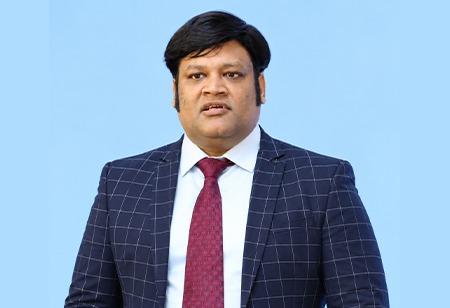
In an exclusive interaction with Finance Outlook India, Gopal Agarwal, Chief Financial Officer at Universal Cables, shares insights on managing working capital in a capital-intensive, cyclical industry, drawing on a finance career shaped by diverse corporate and banking experiences. He also offers a hands-on perspective on how cable manufacturing can turn aggressive growth into sustainable cash generation.
Gopal Agarwal completed his Chartered Accountancy and undertook industrial training at Tata Metallics and HSBC, gaining early exposure to both the corporate and corporate banking sides of finance. During his training, he developed a strong interest in finance as a core domain and recognised its potential to shape his career as a finance leader. After completing his CA, he was selected through Tata Sons Group HR's recruitment of Chartered Accountants and joined Tata Capital. Moving from Calcutta to Bombay marked an important transition in his professional journey, giving him an opportunity to work within one of India's prominent business groups.
At Tata Capital, Gopal Agarwal underwent induction and internship training at TMTC, Pune, before spending close to a year working on challenging projects alongside experienced colleagues and leaders. These early experiences helped strengthen his understanding of finance in a corporate environment and laid the foundation for the senior finance roles he would take on subsequently.
How can cable manufacturers reduce the cash conversion cycle without compromising production continuity, inventory availability, or customer service?
There are multiple ways of doing it. I will tell you operational ways and financial ways.
Operationally, in order to reduce the entire cycle, you will have to ensure minimum inventory holding. For example, the day your raw material procurement is there, the raw material should be fed to the plant on the very day you procure it. We should not have a lag where a lot of inventory is lying and then gets fed into the machines at a later point of time. If you have a time lag of 15, 20 or 30 days, it should be reduced as much as possible. I understand that because of logistics issues in India, it's not practically possible to make it zero - that would really be out of the world. But yes, you can reduce it to as good as three to five days, which is operationally possible. You align your logistics and procurement in such a manner that your plants are fed with raw material three to five days prior. That's a very amicable way of doing it.
Second, the same cycle applies to work-in-progress (WIP). There should not be a time lag in holding WIP at each stage, right from wire drawing to the final testing stage. Each stage should move at its optimum speed - you should keep the ball rolling and avoid idle plant usage. Then comes your final dispatch to the customer, which again comes back to strong supply chain management and very strong planning for customer delivery. If you make your product on time and ensure delivery is done on time with no lag, inventory holding period can easily be reduced from 60 days to as good as 15-20 days. That itself is a big operational lever, and it is possible in the cable industry.
Inventory holding period can be substantially reduced in the cable industry through better procurement plans, supply chain management, and delivery execution - this can be reduced to as good as near a minimum of 45 days. If a company is lethargic, it will take longer. In India, we are still not practising just-in-time inventory the way Japan does - we tend to hold inventory 15-20 days in advance through excessive advance planning, which is actually not required, and that creates this time lag. This can be substantially reduced.
The second operational lever is customer credit - companies giving 90, 180 days of credit terms because they want the customer to buy from them and not from a competitor. This competition is actually a hindrance to getting higher order volumes. Companies in the cable industry chasing growth need to really check whether they can reduce their debtor days - this may require incurring some cash discounts to remain price competitive in the market. But a time lag in receiving funds can definitely dampen the working capital side. In the entire working capital equation, you essentially only have two elements - inventories or receivables. Apart from that, there is nothing else.
On the financial side, nowadays there are a lot of supply chain management solutions that give you credit which is off-balance-sheet and which you can use for growth capital, apart from the banking norms. Whatever the bank gives you is based on an assessment of your working capital, whereas this is growth capital, beyond normal working capital, which lets you do additional business or turnover by extending the cycle. That is the financing way of doing it. These are the two mechanisms I have seen live in this industry, and I can help any company apply them.
How should cable manufacturers manage working capital when copper prices rise sharply but customer contracts do not allow immediate price revisions?
In the entire business, there are two types of contracts - fixed price and variable price. In variable price contracts, the higher metal price is naturally passed on to the customer. But in fixed price contracts, because customers have become cost-conscious and want to lock the price in advance, there is no other mechanism for the manufacturer apart from having a proper hedging strategy on metals. You have to hedge the metal on the day of the order, and by the time you finally procure the material, the price movement impact is neutralised.
The best practice, in cases where metal price movements are very volatile - say copper is at 14,800 today and the company feels it could go up to 15,600 or come down to 14,000 - is that dynamic hedging is possible through options. There are call and put options, and a proper call-put option strategy enables a dynamic hedging policy that manages price volatility with no impact on the business's profit and loss.
When cable companies pursue aggressive revenue growth, which working-capital metrics should CFOs monitor to prevent growth from consuming cash?
CFOs are supposed to monitor basically the cash flow, and daily cash flow is the most important element in the cable industry. If you are able to get your receivables on time and make all your payments and interest obligations on time, your debt should be serviced, and for that it's very important that your sales revenue is realised on time.
Those cable manufacturers on a dealership model - B2C rather than B2B - find it easier to get credit limits for dealers and don't face this challenge as much. This challenge is mainly faced when there is a large amount of EPC orders, executable over 3 to 5 years, because you have to underline the cables and the entire project takes significant time - you need government authority approvals and, to achieve COD, proper planning aligned with execution strategy. If execution stays in line with the planning, this doesn't become an issue.
I definitely understand that the CFO's role is not to operate the business - he's supposed to take care of the finances of the company - but in this business, he has to have a hand-hold on the operational side too, otherwise it's not possible to drive the entire sector. Cash flows are very important, so are liquidity ratios - the current ratio, quick ratio, profitability, and how cost escalations that appear after a BOQ price submission can be passed on to the customer. Business has to stay aligned with the CFO so there's no issue in addressing this.
What strategies can cable manufacturers use to fund business growth through better working-capital management rather than increasing dependence on external borrowing?
The same answer applies here as what I explained about working capital initially - reducing inventory days, receivable days, and so on.
With regard to growth, today the market is very buoyant. There's a huge amount of orders because the entire electricity business is gaining momentum. We've seen the oil and gas situation with the US versus Middle East, and it's very clear that each country, not having oil reserves of its own, has to buy oil from outside. So the dependence on energy has to shift away from oil and gas toward electricity - you'll get sun rays for solar power, rivers for hydropower through water churning, wind for wind power, plus coal and thermal generation. There are multiple ways of generating electricity, and electricity is the most firm form of energy you can rely on.
Because of that, every state is geared up to enhance capacity - and for every unit of generation capacity added, you have to add at least 10x on the transmission and distribution (T&D) side. There's no other way of doing it. So the cable industry is going through very strong momentum, with huge demand for cables worldwide, not just in India. It's all about how you manage this growth and capitalise on it. But working capital remains a very strong focus area - companies shouldn't be complacent about winning orders and giving leeway on receivables and inventories; a strict path has to be followed. Financing solution come at an additional cost - apart from bank loan interest, supply chain management solutions carry their own additional interest or fee. So it's about whether you want to manage higher or lower working capital. The prudent approach is to work on the operational side rather than the financing side for the cable industry.
Beyond EBITDA, which cash-flow and capital-efficiency metrics should CFOs and boards track to determine whether growth is actually creating value?
On the capital efficiency side, we've talked about working capital, which is the OPEX part. On the capital expenditure side, you also have to ensure that machinery is revamped or replaced in a timely manner as it ages and efficiency declines - production quality and production time shouldn't suffer, and efficiency should be maintained at its level.
It's very important to manage all of these things - that is the success mantra. If you're able to manage these five or six pointers I've mentioned in this interview, I'm pretty sure a cable manufacturer will see the best of times. In my view, a plant can easily pay for itself within a 5-7 year time frame - there's no challenge in going beyond that.
Also Read: Managing Capital Efficiency in Renewable Energy Manufacturing
What is your personal leadership mantra?
My personal leadership mantra, being a CFO, is that I am actually a cash guy. I believe that business, the way I think about it, is all about converting cash into cash. You invest either fixed capital or working capital, and at the end of the day you have to convert it back into cash. How fast you're doing business to make profits - how fast a company can convert cash into cash - that is success. The moment you're able to do this journey as fast as possible, beating industry standards, norms, whatever peers or competition are doing, you're on the correct roadmap, because cash is the key.
What three key pieces of advices would you give to emerging leaders?
A, definitely keep a tab on your cash. B, definitely keep a tab on your operations. And C, human capital. If you're able to keep a tab on these three things, you're through as a leader.
Today, we are not very robust on systems - most companies in the manufacturing sector are talking about AI, systems, new technologies, but even with the best technology, at the end of the day there is a human being sitting behind that technology to run the process. It's not fully automated, even though it feels that way - machinery automation is one thing, but a human doesn't work automatically. A human has to sleep on time, rise on time, eat on time, work on time, deliver on time - a human has to do things a machine doesn't have to. A machine is simply switch-on, switch-off. For a human being, it's different - they have a mind and a heart too, so you have to deal with a complete balance so the human functions at the optimum level, and for that, you need the best practices in place.
These are the three things that will make your company or your leadership strong: good human capital in your organization, being well-equipped on operations, and having a good handle on your cash. There's no challenge if you get these three angles right.