3. Fake Investment Scams & Authorized Push Payment (APP) Fraud
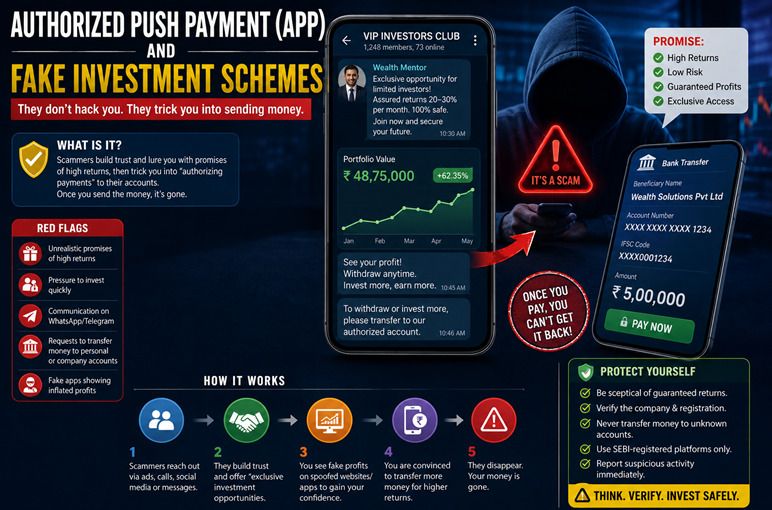
● The Real Scenario: A victim clicks on a Facebook ad showing an AI-deepfake video of Mukesh Ambani or Ratan Tata promoting a "high-yield institutional trading app."
● How It Works: The victim is added to a VIP Telegram group where fake "market experts" share stock tips. They download a fake trading app that falsely shows their wealth skyrocketing. Trusting the data, the victim authorizes a massive Rs 10 Lakh transfer, only to find their funds completely locked when they try to withdraw.
● How to Avoid: Verify all trading platforms with the SEBI (Securities and Exchange Board of India) registry. If a platform is not SEBI-registered, it is illegal and a guaranteed fraud.
David-Jan Janse, Chief Executive Officer of SurePay has cited that Digital Identity and Confirmation of Payee are a valuable combination for both efficient onboarding, as well as preventing fraud and money laundering."
Visa explains that APP fraud works differently from conventional credential theft because APP scams manipulate victims into authorising instant payments to fraudulent accounts. The organization further notes that scammers exploit the human element rather than necessarily compromising the underlying payment system.
Scale of Investment Frauds (2026 Data)
● The 60% Danger Zone: According to the latest data from the Telangana Cyber Security Bureau (TGCSB), fake stock market and trading investment scams now account for a staggering 60% of all financial cybercrime losses.
● Massive Individual Losses: Unlike simpler phishing tricks that target Rs 10,000–Rs 50,000, APP investment frauds systematically drain life savings. Average individual losses tracked by police departments frequently span between Rs 2 Lakhs to Rs 3 Crores per victim.
● Deepfakes as the Bait: Over 80% of fake ad campaigns on platforms like Meta use sophisticated AI video cloning to mimic industrial leaders like Mukesh Ambani or Ratan Tata to establish absolute, immediate trust.
● Industrial-Scale Mule Pipelines: Police sweeps in metro hubs like Hyderabad have exposed single mule accounts routing over Rs 1.10 Crore to Rs 3.37 Crore in short cycles, linked to up to 26 different cyber cases across India
Last year, 21.77 lakh complaints
registered on the National Cyber Crime Reporting Portal.
SEBI issued a specific warning in February 2026 about stock-market scams involving account-handling services.
SEBI has also warned about fake trading apps and describes the typical scam sequence:
social-media hook → fake expert → fake trading app → fake profits → increased investment → blocked withdrawal → additional fees.
In March 2026, SEBI introduced a Verified Label for stock-trading apps of SEBI-registered brokers on Google Play Store as an investor-protection measure
SEBI issued a specific warning in February 2026 about stock-market scams involving account-handling services.