Government Schemes: Leveraging Your Rights on Kamgar Din
Kamgar Din is not only a day of reflection but also a powerful moment to take stock of the legal rights and government schemes for women's economic empowerment in 2026 that exist to protect and advance female workers across India. Many working women - particularly in the informal sector - remain unaware of the protections available to them.
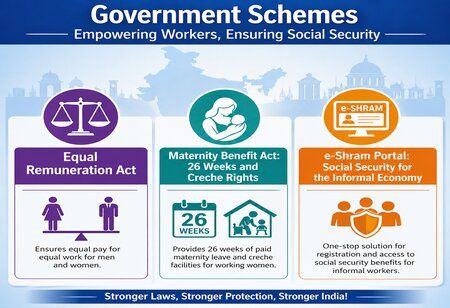
Equal Remuneration Act
The Equal Remuneration Act states that men and women must be paid equally for the same work or work of similar nature. This is enshrined in the Code on Wages under the new Labour Codes regime. Women who believe they have been discriminated against in terms of wages can lodge a complaint with the appropriate authority and employers found guilty of discrimination are liable for penalties. Reporting wage inequality to HR is not only supported by law, but also widely anticipated by the ESG (Environmental, Social, and Governance) reporting standards followed by listed Indian companies.
Maternity Benefit Act: 26 Weeks and Creche Rights
Women employees in organisations with ten or more employees are entitled to 26 weeks of paid maternity leave under the Maternity Benefit Act - one of the highest in the world amongst large economies. Furthermore, according to the Act's creche provisions, an organisation employing 50 or more workers is legally obligated to have creche facilities, either on the premises or nearby. Women employees are entitled to four creche visits a day. These are not privileges, but rights, and non-compliance can result in fines under women's labour laws in India 2026.
e-Shram Portal: Social Security for the Informal Economy
India's women workforce, around 90% of whom work in the informal or unorganized sector as domestic workers, street vendors, construction workers and home-based artisans, are excluded from social security schemes. The Ministry of Labour & Employment's e-Shram Portal provides unorganized sector workers such as these with a Universal Account Number (UAN) to access social security benefits and insurance in the event of an accident, a pension and housing welfare. With more than 30 crore workers registered by early 2026, rural women workers are still unaware of this scheme. This Kamgar Din, e-Shram registration is the biggest single thing an unorganized sector woman worker can do.
Conclusion: Kamgar Din, a Catalyst, not a Memorial
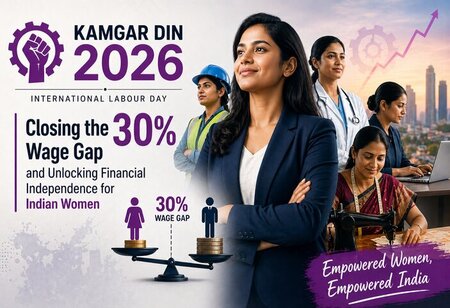
India's gender wage gap is not a niche element of GDP growth - it is one of the biggest untapped sources of wealth. Moving from the current 30% to parity, according to the McKinsey Global Institute, would increase India's GDP by more than $700 billion by 2030. Even more importantly, it would translate into millions of women living lives of enhanced dignity, safety and freedom.
Kamgar Din 2026 is a call - to employers, policymakers, families, and women - to stop thinking that wage equity and women's economic independence are aspirational but impractical or unachievable goals. The laws exist. The schemes exist. The investment tools exist. All that is required is knowledge, action and accountability.