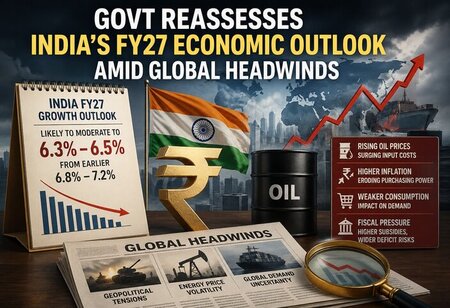
India’s FY27 economic outlook is turning more cautious as the government reassesses growth expectations in the face of rising geopolitical tensions and surging energy prices.
Key Highlights
- India’s FY27 economic outlook moderates to 6.3–6.5% amid geopolitical tensions and rising energy prices concerns.
- High crude oil prices risk inflation, fiscal strain, weaker consumption, challenging overall macroeconomic stability prospects.
According to reports, the central government is internally reassessing its growth assumptions, with estimates likely to moderate toward the 6.3–6.5% range, if external pressures persist lower than earlier expectations outlined in the Economic Survey 2026, which pegged growth at 6.8–7.2%.
Global Institutions Maintain Moderate Growth View
Despite domestic caution, global institutions continue to project stable, albeit moderated, growth. The International Monetary Fund has forecast India’s GDP growth at around 6.5% for FY27, even as it warns that geopolitical tensions could dampen global demand and push inflation higher.
Similarly, the World Bank estimates growth at approximately 6.6%, noting that higher energy prices linked to the West Asia crisis could weigh on consumption and industrial activity.
A recent Reuters poll of economists also highlighted a broad projection range of 5.9% to 7.5%, underscoring uncertainty around the trajectory of global risks.
Oil Prices, Inflation Key Risks
At the core of the government’s concern is the sustained rise in crude oil prices, which has significant macroeconomic implications. Brent crude has surged amid fears of supply disruptions through the Strait of Hormuz, raising input costs across sectors.
Higher energy prices are expected to:
- Push up retail inflation
- Erode household purchasing power
- Impact private consumption and demand
Economists warn that prolonged high oil prices could “squeeze real incomes and elevate industrial costs,” potentially dragging growth lower.
Also Read: IMF Revises India's GDP Growth Projection to 6.5% for FY27
Fiscal Pressure Mounts
Higher energy costs are also expected to complicate fiscal management. The government may need to increase spending on fuel and fertiliser subsidies to cushion consumers, putting pressure on the fiscal deficit.
The Centre has budgeted total expenditure of Rs 53.5 lakh crore for FY27, with a fiscal deficit target of 4.3% of GDP. However, rising subsidy requirements could strain these projections, especially if commodity prices remain elevated.
Global agencies have echoed similar concerns. Moody’s has warned that prolonged energy disruptions could widen India’s trade deficit and strain public finances, potentially impacting growth and investor sentiment.
RBI and Policy Outlook
The Reserve Bank of India has already adopted a cautious stance, projecting FY27 growth at around 6.9% while highlighting risks from oil price volatility and geopolitical uncertainty. The central bank has also indicated that monetary policy has limited ability to address supply-side shocks like oil-driven inflation, reinforcing the need for calibrated fiscal responses.
Balancing Growth and Stability
Despite near-term concerns, India continues to remain among the fastest-growing major economies globally, supported by strong domestic demand, resilient banking systems, and infrastructure spending.
However, policymakers are increasingly aware that the balance between growth and macroeconomic stability will depend on:
- Evolution of the West Asia conflict.
- Trajectory of global energy prices.
- Inflation management and fiscal discipline.
Outlook
While baseline projections remain intact, risks are now “clearly tilted to the downside,” with policymakers preparing contingency responses if global conditions worsen. The coming quarters will be critical in determining whether India can sustain its growth momentum or faces a sharper slowdown amid persistent global headwinds.