
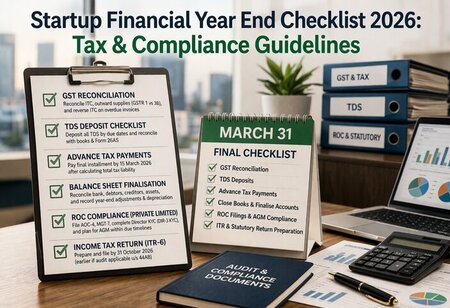
With the Financial Year End Checklist 2026 in sight, Indian startups should be keen on meeting the statutory deadlines, tax returns, and reconciliation assignments in time before the end of March 2026 checklist. Still wondering how to close financial year for startups or even seeking to be investment ready in India through startup tax compliance, this easy to understand step by step guide provides all startup, finance, and compliance leaders with everything they need to close books, stay compliant, and be investment ready.
Why Year‑End Compliance Matters for Startups
Making sure that the books are closed at the end of the year is not just a formality, but a way to guarantee legal status, avoiding fines, and to make the books auditing or fundraising easier. Accounts and statutory compliance are examined by investors and VCs, and sloppy financials may lose trust and valuation.
The statutory tips that are being posted on Indian finance portals are a clear indication that the reconstruction of GST ledgers, compliance with TDS, and ROC returns filing is one of the highest must do job before the end of March every year.
Pre‑March 31 Tax Planning for FY 2025‑26
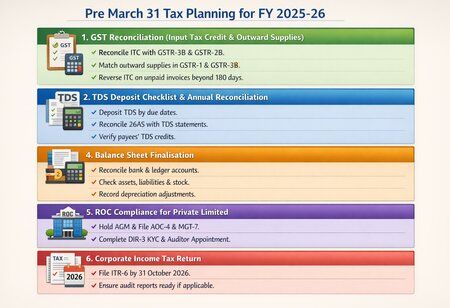
1. GST Reconciliation (Input Tax Credit & Outward Supplies)
GST is a critical piece of startup tax compliance India:
- Reconcile Input Tax Credit (ITC) between books, GSTR‑3B, and GSTR‑2B. Any mismatch could lead to disallowance or notices.
- Match outward supplies reported in GSTR‑1 with accounting ledgers and GSTR‑3B.
- Reverse ITC on invoices unpaid beyond 180 days as mandated.
- Confirm GST paid on advances, RCM liabilities, and blocked credits.
Starting new series for invoice numbers and ensuring e‑invoice/e‑way bills match sales ledgers reduces reconciliation risks.
2. TDS Deposit Checklist & Annual Reconciliation
TDS remains an ongoing and year‑end priority.
- Ensure all TDS deducted during FY 2025‑26 are correctly deposited by due dates (e.g., Feb TDS by 7 March 2026; March by 7 April 2026).
- Reconcile TDS statements with your books and ensure all Payees have the correct credit showing on the Income Tax e‑filing portal.
- Prepare the TDS deposit checklist and address any mismatches before filing income tax returns.
3. Advanced Tax Payments
Many startups, especially profitable ones or those with substantial income outside payroll or vendor payments, must pay advance tax in instalments:
- Final installment for FY 2025‑26 is generally due by 15 March 2026.
- Calculate total liability, deduct TDS credits, and pay any shortfall to avoid interest.
4. Balance Sheet Finalisation
Before closing:
- Reconcile bank, supplier, and customer statements.
- Confirm asset, liability, and closing stock levels.
- Record depreciation and year‑end adjustments (including forex gain/loss if any).
Tax tasks form only part of the compliance landscape. Statutory norms under the Companies Act, 2013 and MCA/ROC rules govern annual government filings:
5. ROC Compliance for Private Limited
Private limited startups must complete ROC filings and corporate duties:
- Hold an Annual General Meeting (AGM) within 6 months of FY end (usually by Sept 30).
- File annual financial statements (AOC‑4) and annual return (MGT‑7) within their respective due dates.
- Director KYC (DIR‑3 KYC) and auditor appointment (ADT‑1) also need tracking.
Missing even one ROC deadline can attract daily penalties of up to ₹100/form with no upper cap - a common and unnecessary cost startups tend to incur.
6. Corporate Income Tax Return
Most private limited companies file ITR‑6 by 31 October 2026. If audits are mandatory (e.g., under Section 44AB), ensure auditor reports are ready well before the income tax filing deadline.
While compliance is about adhering to legal requirements, optimising tax liabilities is about smart financial planning:
- Use allowable deductions like business expenses, rent, salaries, R&D costs, amortisation, and interest expenses.
- Make timely advance tax payments to avoid interest costs.
- Plan payroll taxes like PF, ESI, and profession tax before year‑end.
- Consult a CA early - many founders find outsourcing monthly bookkeeping & compliance frees up time to focus on core growth.
Audit‑Readiness & Investment Impact
An FY close that’s free from errors is “audit‑ready” - a term founders should take seriously. Investors review GST reconciliations, TDS compliance, ROC histories, and audited financials before committing - sloppy records slow down funding rounds and due diligence.
Final March 31 Checklist for Startups
To help you stay organised, here’s a compact roundup:
- Reconcile GST ITC, outward supplies, and RCM.
- Complete TDS deposits and reconcile statements.
- Pay final advance tax instalment.
- Finalise books, bank statements & ledgers.
- Prepare financials & tax schedules for audit.
- Ensure ROC filings and AGM records are slated.
- Plan and start preparations for ITR and statutory returns.
Also Read: India's New Labor Codes 2026: Impact on Salary, PF, and Work Culture
Bottom Line
Closing the books as part of a Financial Year End Checklist 2026 isn’t just another administrative task - it’s a strategic moment to reinforce governance, clarity, and confidence. From startup tax compliance India to closing books for startups and ROC compliance for private limited companies, ticking all these boxes protects your business, avoids penalties, and keeps the path clear for growth and investment.
Stay proactive, document thoroughly, and when in doubt, seek professional guidance - your startup’s future depends on it.
.jpg)