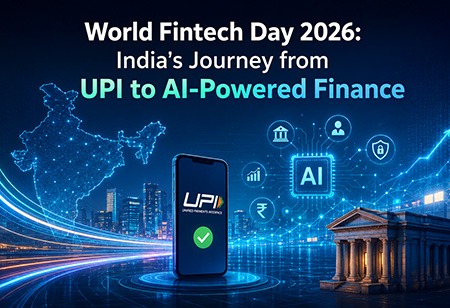
On World Fintech Day 2026, it is an apt time to acknowledge the strides India has made in an incredibly brief span of time. Ten years ago, the nation was still very much dependent on cash: only 20% of adults had a bank account, and digital payments made up a negligible amount of transactions. Today, India is generating more real-time digital transactions than any country in the world, and is moving towards the next phase: AI-powered finance that will take credit, wealth management and insurance into the next domain of intelligence.
This change is not an incident. It was created by conscious policy, a visionary approach to infrastructure, and a cohort of fintech entrepreneurs who weren't intimidated by the prospect of breaking into an unbankable India, but saw it as the most promising opportunity to create financial service products from the ground up.
Building the Digital Payments Foundation
The journey of Indian fintech industry started with the Digital Public Infrastructure (DPI) stack that the government and NPCI developed through the 2010s. Aadhaar was used for the identity layer. By allowing citizens who had been previously 'unbanked' to open a bank account, Jan Dhan hit the 530 million mark. India's payments revolution took to the rails of UPI - the Unified Payments Interface.
According to NPCI June UPI Data, India recorded 22 billion transactions and the monthly transaction value also crossed Rs 28 lakh crore. In 2022, the number of merchant acceptance points stood at around 30 million and by mid-2026 had grown to 180 million, extending to India's villages, kirans and street vendors.
The Indian fintech industry is now the second largest in the world in terms of the number of deals struck, and the government's vision of a $1 trillion digital economy by 2028 might soon become a reality, with the fintech industry being one of its most powerful drivers.
The 2nd World Fintech Summit, held in Bengaluru in May 2026, captured this momentum precisely. Digital payments to financial intelligence via artificial intelligence (AI) was the clear-cut message at the summit as policy makers, fintech founders, banking leaders, and tech companies discussed the next steps in the financial services transformation journey that India is already on.
The AI Turn - From Transactions to Intelligence
If Phase One was about reaching Indians digitally, Phase Two is about serving them intelligently. In fact, India's fintech industry is now leveraging AI in all the key verticals; credit, wealth management, insurance underwriting, fraud detection and regulatory compliance, among others, with such speed and scale that it now attracts global attention.
AI in Lending: Digital lenders are using machine learning models that analyse credit-worthiness based on alternative data sources like supply chain data, utility payments, GST filing history and so on, thus helping millions of small business owners and the population with thin or no credit files to access credit. This creates faster, more equitable, and more inclusive credit underwriting that the legacy banking system can't do this big.
AI in WealthTech: A new generation of platforms is making advanced investment techniques, which were once the privilege of HNI customers in private banks, available to the first generation of retail investors from Tier 2 and Tier 3 cities.
AI in Fraud Detection: If there are billions of transactions happening each month, fraud prevention at scale is only possible with AI. Fintech start-ups and banks alike are adopting real-time anomaly detection, behavioural biometrics, and network-graph analysis to ensure the integrity of India's payment system.
Embedded Finance: The embedding of financial services, including credit, insurance, investment products, is likely the most structurally important trend. Agriculture apps offering crop insurance at checkout. E-commerce platforms providing instant credit at the point of purchase. HR software offering salary advances with one tap. The line between a financial product and a consumer platform is disappearing.
Also Read: 10 Women-Led Fintech Startups Transforming India's Financial Landscape
Emerging Startups Shaping India's AI Fintech Wave
Several emerging companies are defining what India's next fintech chapter looks like in practice.
Pune-based Lentra is building the embedded AI backbone for India's banking sector - powering digital loan origination, underwriting, and processing for major banks including HDFC Bank, Federal Bank, Standard Chartered, and IDFC First Bank. Having raised $60 million in Series B funding at a valuation exceeding $400 million, Lentra has processed over 13 billion transactions and $21 billion worth of loans since its launch.
"We built Lentra on a simple conviction: that banks don't need to be replaced they need to be empowered. AI doesn't disintermediate banking; it makes banking dramatically better. Our job is to give every bank in India the intelligence infrastructure to compete in the digital age." - D. Venkatesh, Founder & MD, Lentra.
Scienaptic AI is an AI-powered credit decisioning platform that helps lenders make faster, fairer, and more accurate credit decisions - particularly for borrowers whose creditworthiness cannot be assessed through traditional bureau scores alone. The company was a partner at the 2nd World Fintech Summit 2026 in Bengaluru, reflecting its growing relevance to India's lender ecosystem.
"Credit exclusion in India is not a data problem - it is a model problem. The data exists in every UPI transaction, every utility payment, every GST return. The question is whether your underwriting model is sophisticated enough to read it. That is the problem we solve." - Pankaj Jain, CEO, Scienaptic AI.
Bengaluru-based Indifi Technologies has built a digital lending platform specifically for India's 63 million MSMEs - using alternative data from e-commerce platforms, logistics partners, and accounting software to underwrite businesses that traditional banks routinely reject. Indifi raised Rs 40 crore in debt from BlackSoil Capital in March 2026 to further expand its MSME credit access mission.
"India's MSME credit gap is not a supply problem — there is capital willing to flow. It is an information problem. Once you can accurately read a small business's actual financial health from its digital footprint, credit becomes accessible to everyone. That is what we are building." - Alok Mittal, Co-Founder & CEO, Indifi Technologies.
Fintech Fusion India (FFI) is not a startup but a movement — a platform bringing together policymakers, regulators, banks, global institutions, investors, and fintech innovators to design India's financial infrastructure for the next generation. Its 2026 edition, held on July 23 in Bengaluru, is themed around Building India's Financial Architecture for 2047 — the year India marks its centenary as an independent nation.
"2047 sounds distant, but the financial architecture India will run on then is being decided in rooms like this one, now. FFI 2026 exists to make sure the people writing policy, building products, and deploying capital are making those decisions together, not in parallel." - Suman Bhowmick, Co-Founder & CEO, Idea Simplified & FFI
Bengaluru-based HyperVerge is building the identity and verification infrastructure that makes AI-led financial inclusion possible at scale. Its AI-powered KYC and identity verification platform serves players across India's fintech and banking ecosystem - and from that vantage point, Co-founder and CEO Kedar Kulkarni sees both the extraordinary progress and the work still ahead.
Kedar Kulkarni stated, “Language is another thing the sector is finally getting right. India is an amalgamation of countless languages, and a language wall at onboarding keeps people out before they ever reach a financial product. At HyperVerge, working with players across the industry gives us a unique vantage point on this, and the data is telling: close to 65 percent of video KYC users we see come from Tier 3 cities and towns, with Hindi, Telugu, Marathi, Kannada, and Tamil leading among them. Localization is doing more for inclusion than almost anything else in the stack.”
“Trust is the other half of the inclusion story. We're seeing that deepfakes and identity theft have grown alongside every other advance in the sector, and real-time verification now stops most of it right at the entry point. Every fraud attempt caught keeps the system dependable for the people it was built to serve. The same modern verification is also solving older problems, like the unclaimed funds sitting in Indian banks because outdated KYC records made the right person hard to trace.By the next World Fintech Day, I expect the sector will have carried inclusion further than any of us predict. Because at the end of the day, fintech's real product is trust, and trust compounds when everyone can walk through the door", he further noted.
The Regulatory Backbone: RBI and SEBI Enable the Next Phase
Indian fintech evolution has been enabled - not obstructed - by regulators who have moved faster than their counterparts in most major economies. The RBI's April 2026 regulatory reforms introduced centralized KYC registries, stronger consumer protection frameworks, and liberalized ECB norms that open new capital channels for fintech companies. SEBI's updated Mutual Funds Regulations 2026 introduced lower expense ratio caps, improving outcomes for retail investors on wealthtech platforms.
The introduction of Specialised Investment Funds under SEBI's 2025 framework has created a new, AI-amenable investment vehicle - one that allows quantitative and long-short strategies to be deployed in a regulated, transparent structure accessible to HNI investors. SIF schemes using AI-driven systematic active strategies are already attracting significant interest from family offices and accredited investors.
India is also preparing for the next evolution of its payment rails. As AI agents become more prevalent in commerce, new payment infrastructure will be needed to support machine-to-machine transactions - a space that companies are already positioning for through their agentic payment infrastructure work.
Kedar Kulkarni stated, "Every year, the story of Indian fintech gets a little harder to summarize, because the innovation is happening everywhere at once. Regulatory bodies like the RBI have consistently encouraged technology that brings people from even remote areas into the financial system, and AI is now fueling that effort at every touchpoint of the financial journey. But AI in this context carries a responsibility the industry is still learning to hold. Most AI models were trained largely on non-Indian data, and that creates real inclusivity gaps when onboarding customers across India's demographics. What's encouraging is that many fintechs are now building tools designed specifically to close that gap and perform consistently across race, age, and gender.”
India's Global Fintech Moment
The world has noticed. The 7th Global Fintech Fest will be held in Mumbai from September 8th to 11th, 2026, featuring more than 1000 global fintech leaders, discussing among other topics, the export of India's model of financial services based on AI. The Karnataka government has made it clear that it wants to make Bengaluru a global fintech innovation hub by capturing 50% of India's $1 trillion fintech market by 2030, with the World Fintech Summit being a key tool to achieve these goals.
India's DPI architecture - Aadhaar, UPI, Account Aggregator, and the Unified Lending Interface - is already being studied and replicated by governments across Southeast Asia, Africa, and Latin America. The Global South is increasingly looking to India not just as a case study but as a blueprint.
As Bijith Bhaskar, Partner - Financial Services, Premji Invest observed, reflecting on the fintech sector's trajectory: "The sector had been evolving for a decade, but this was the year when it demonstrated maturity in a visible and undeniable way. It had impact, scale, and finally, legitimacy."
What Comes Next
On this World Fintech Day, the most honest assessment of India's fintech future is this: the first chapter - universal digital access - is largely written. Today, visionaries - entrepreneurs, policymakers and investors - who recognize that scale is not just an opportunity, but a responsibility for India in shaping the second chapter of financial services - intelligent, personalized, AI-powered financial services.
The financial architecture being developed in the fintech labs and policy rooms of India today will impact the lives of a billion people not only in the next 10 years, but for generations to come, which is a remarkable thing to build. And on World Fintech Day 2026, India is unambiguously among the most important places on earth where that building is happening.