
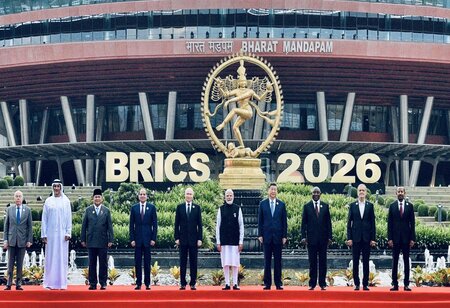
The 18th BRICS Summit 2026, held in New Delhi on September 12–13, placed financial cooperation, cross-border payments, local-currency settlements and reforms to global financial institutions at the centre of discussions as India sought to strengthen the economic voice of the Global South. Hosted under India’s 2026 BRICS chairship, the summit brought together the expanded grouping amid rising trade tensions, geopolitical uncertainty and growing calls for a more representative international financial system. India’s presidency has focused on “Building for Resilience, Innovation, Cooperation and Sustainability,” with economic and financial cooperation forming one of the bloc’s key pillars.
BRICS Pushes Faster Cross-Border Payments and Local Currencies
A key financial topic was speeding up and making cross-border payments between BRICS economies more efficient, reliable and cost-effective. Long before the leaders' meeting, BRICS finance ministers and central bank governors had agreed on efforts to make the payment systems interoperable and on payment settlement in local currencies and increased financial connectivity. The Cross-Border Payments Initiative by the BRICS group is exploring integrating payment and messaging systems, through the Payment Task Force.
The strategy is interesting in the sense that BRICS is now turning towards the implementation of a payment system instead of going straight to the creation of a common currency. The goal is to allow companies to complete more trade and investment deals in national currencies, if possible, to decrease transaction costs and reliance on traditional correspondent banking channels. Meanwhile, the officials of the BRICS bloc have admitted there is no universal model for local-currency settlements as economies of members have different monetary, regulatory and financial systems.
The program would be a good addition to India's growing digital-payments ecosystem. The talks have covered potential synergies between fast payment systems and central bank digital currencies, but major challenges in regulatory, cybersecurity, data-governance and foreign-exchange policy still lie ahead of the way to an interoperable BRICS payment system.
New Development Bank Gets Bigger Financial Role
Another significant development in the financial realm was the New Development Bank (NDB), created by BRICS for financing infrastructure and sustainable development. The New Delhi Declaration urged the bank to enhance its capability to mobilise resources, expand financing in local currencies, diversify financing sources and infrastructure of sustainable-development initiatives.
The push arrives at a time when the NDB has now been in business for 10 years, having made significant lending experience. As of the end of 2025, the bank has approved approximately $43 billion for 139 projects, and its portfolio is currently active with approximately $35.6 billion for 115 projects. Total disbursements amounted to $24.2 billion.
Local-currency financing is also becoming a more important consideration. As of the end of 2025, around $10.4 billion, or 29.3% of NDB's assets under management, were local-currency financing. Local currencies accounted for a record 45.9% of the bank's annual approvals in 2025, underscoring the bank's commitment to mitigate borrowers' exchange-rate risks and boost capital markets in the region.
BRICS Seeks Greater Voice in IMF and World Bank
Another major financial priority was reform of global institutions, particularly the International Monetary Fund (IMF), World Bank and other multilateral development banks. BRICS finance ministers urged more representation of emerging-market and developing economies in these institutions, noting that governance structures need to take into account the increasing importance of emerging markets.
Demand for India and other developing economies is pretty big - greater representation could have an impact on how development finance is decided, global financial stability and economic policy. In lieu of replacing existing institutions, BRICS is more and more looking to advocate for changes in the current international financial architecture as a platform.
Also Read: PM Narendra Modi Hails India's 7.8% GDP Growth Despite Global Conflict
Trade, Tariffs and Economic Resilience
Trade was another important economic concern during the September 12–13 summit. Protectionist practices were condemned by the leaders of the BRICS and the danger of tariffs and non-tariff barriers to world trade and supply chains were emphasized. The bloc also supported greater economic cooperation and actions to enhance global value chains' resilience.
This is especially pertinent for India, given the shifting dynamics of international trade for exporters and importers. Joint efforts of the BRICS economies could open more markets, develop the connectivity of supply chains and provide opportunities for trade settlements in national currencies.
India’s Financial Agenda Gains Global-South Focus
The summit ultimately demonstrated that BRICS’ financial agenda is shifting from broad discussions about de-dollarisation toward practical financial infrastructure. Payment connectivity, local-currency financing, development-bank lending and reform of global financial institutions emerged as more immediate priorities.
The New Delhi Declaration therefore represents a push toward a more diversified financial system rather than an overnight replacement of the US dollar. India's focus on payment interoperability, opportunities for settlement in rupees, development finance and increased voice of the Global South in setting the rules of the global economy dovetails with its overall goal of ensuring a more prominent voice for the Global South in global economic norms.
The BRICS Summit 2026 has thus set the stage for finance to be the pivot for the bloc's future, and the effectiveness of its initiatives will depend, to a large extent, on the pace at which the political agreements can be translated into mutually interoperable payment systems, expanded domestic currency markets and increased access to development financing.