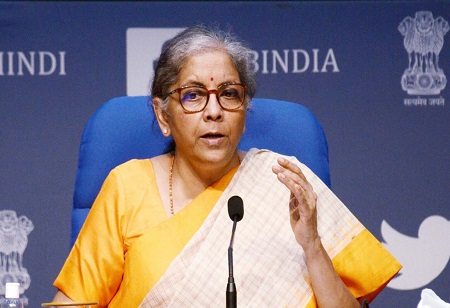
Finance Minister Nirmala Sitharaman on Thursday tabled the Economic Survey in the Lok Sabha, marking the formal start of Parliament’s budget exercise ahead of the Union Budget presentation.
Key Highlights
- Economic Survey 2026 tabled in Lok Sabha ahead of Union Budget
- India Economic Survey highlights growth, inflation and fiscal priorities
The Economic Survey, prepared by the Finance Ministry under the guidance of the Chief Economic Adviser, reviews developments in the Indian economy over the previous financial year and outlines key trends that will influence policy decisions in the year ahead. The document is traditionally presented a day before the Union Budget and serves as the government’s official assessment of economic conditions.
The Survey notes that India has continued to maintain steady growth despite global headwinds such as geopolitical tensions, uneven recovery in major economies, and volatile commodity prices. It highlights domestic demand as a key driver of growth, supported by public capital expenditure, improved corporate balance sheets, and sustained consumption across urban and rural markets.
“The Economic Survey rightly reframes cities as economic infrastructure rather than just population centres. India’s next phase of growth will depend on how effectively we integrate manufacturing, logistics, skills and urban living into a single ecosystem. This is where integrated industrial urban platforms like Reliance MET City become relevant. The future shall not be about only services, but on ground enablement of production, exports and employment at scale. India, today is in possession of a distinct opportunity where we can build economic cities combining infrastructure readiness, sustainability frameworks and policy, to compete at a global stage. That shift will be critical for India to deepen its position in global value chains and sustain high growth to become Vibrant Bharat by 2047,” says Sh. Shrivallabh Goyal, CEO & Whole-Time Director, Model Economic Township Ltd. (Reliance MET City).
“The Economic Survey 2025–26 highlights the central role of real estate in enabling urban growth through housing, mobility, and infrastructure-led development. Its emphasis on improving urban capacity and accessibility is directly relevant across premium housing, branded residences, commercial, and mixed-use developments. At M3M India, we see strong alignment between policy-led urban planning and the need to deliver high-quality, sustainable built environments. As Indian cities evolve, demand will increasingly favour well-designed developments that combine lifestyle, connectivity, and long-term value, supporting balanced and future-ready urban growth” says Yateesh Wahaal, Director Finance, M3M India.
“The Economic Survey 2025–26 reinforces confidence in India’s medium-term growth trajectory, projecting GDP growth of 6.3–6.8% in FY26, supported by domestic consumption, infrastructure investment, and structural reforms. For the real estate and alternative assets sector, the Survey’s focus on urban infrastructure, capital formation, and efficient land use highlights the growing role of institutional capital in shaping India’s next phase of development."
"At Dalcore, we see a strong alignment between the government’s push for resilient urban ecosystems and the rising demand for professionally managed, future-ready commercial assets. As India’s cities evolve into integrated economic engines, capital will increasingly gravitate toward high-quality developments that combine sustainability, operational efficiency, and long-term value creation. This shift is critical to supporting India’s broader ambition of becoming a Viksit Bharat by 2047", says Mr Sidharth Chowdhry, Managing Director, Dalcore.
According to the Survey, inflation management, fiscal consolidation, and employment generation remain central policy priorities. It underlines the importance of keeping prices stable while ensuring adequate support for growth-oriented spending. The report also draws attention to trends in household savings, investment patterns, and credit growth, offering data-driven insights into changes in financial behaviour.
Sector-wise, the Survey reviews performance in agriculture, industry, and services, pointing to improved resilience in manufacturing and continued expansion in services such as information technology, logistics, and financial services. Infrastructure development, including roads, railways, ports, and digital networks, is identified as a key enabler of medium-term growth.
The Economic Survey also discusses structural reforms undertaken in recent years, including tax rationalisation, digital public infrastructure, and measures aimed at improving the ease of doing business. It flags the need for further reforms in areas such as labour markets, skilling, and innovation to sustain long-term growth.
Also Read: US Fed Rate Decision: Key Implications for Indian Markets
The findings and analysis presented in the Survey are expected to frame parliamentary debate and public expectations ahead of the Union Budget, which will outline the government’s fiscal roadmap and spending priorities for the coming financial year.