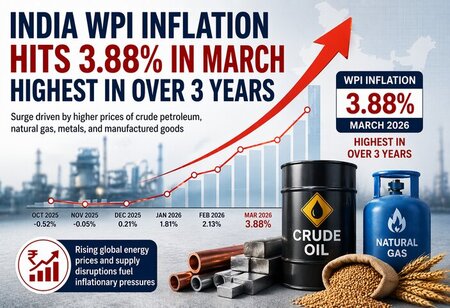
India’s WPI Inflation surged to 3.88% in March 2026, marking its highest level in over three years, driven by rising prices of crude petroleum, natural gas, metals, and manufactured goods, according to government data.
Key Highlights
- India's WPI inflation jumps to 3.88% in March, highest level recorded in over three years.
- Rising crude oil, energy and manufacturing costs drive broad-based increase in wholesale price inflation.
The sharp increase breaks a prolonged period of subdued inflation, during which wholesale prices had either contracted or remained below 1% for several months through late 2025. Inflation had started picking up earlier this year, rising to 1.81% in January and 2.13% in February.
The spike in WPI inflation was largely broad-based, with key contributors including fuel, power, and manufactured products. Rising global energy prices- amid geopolitical tensions in West Asia - played a significant role in pushing up input costs across sectors.
Manufactured products inflation rose to 3.39% in March, up from 2.92% in February, reflecting increasing cost pressures on producers.
At the same time, fuel and power prices also rebounded, while primary articles such as food items and minerals recorded notable increases, adding to overall inflationary pressure.
Inflation in primary articles- including cereals, vegetables, milk, eggs, and crude oil- rose significantly, indicating strong price momentum in essential commodities. This category, which carries substantial weight in the WPI basket, has seen a steady rise since the beginning of 2026.
Also Read: Retail Inflation Rises to 3.40% in March; Food Prices Edge Higher
Highlighting the impact of energy prices, Rahul Agrawal, Senior Economist at ICRA Ltd. said, “WPI inflation nearly doubled to a 38-month high of 3.9% in March 2026 from 2.1% in February 2026, and printed largely in line with expectations. While the uptick was broad-based, the crude petroleum and natural gas, and the fuel and power groups witnessed sizeable hardening in their YoY inflation rates, reflecting the impact of the surge in global energy prices owing to the West Asia crisis. Notably, these two groups together accounted for 150 bps of the 175 bps uptick in the headline print in March 2026 relative to February 2026.”
The rise in wholesale inflation is closely linked to global developments, particularly disruptions in oil supply due to geopolitical tensions. Higher crude oil prices have increased transportation and production costs, feeding into broader inflation across industries.