
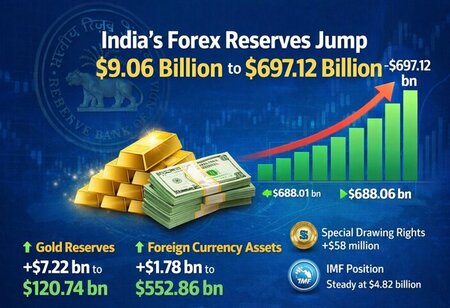
India's forex reserves posted a sharp rebound, rising by $9.063 billion to $697.121 billion for the week ended April 3, 2026, according to data released by the Reserve Bank of India. The recovery comes after a steep decline in the previous week, highlighting renewed stability in India’s external sector.
Key Highlights
- India forex reserves rise $9.06 billion to $697.12 billion, reversing previous week sharp decline.
- Gold reserves surge drives majority gains, strengthening India external buffer amid global volatility.
The latest surge in India's forex reserves follows a significant drop of $10.288 billion in the week ended March 27, when reserves fell to $688.058 billion. The rebound indicates improving liquidity conditions and easing pressure on the Indian rupee amid global uncertainties.
Despite recent volatility driven by geopolitical tensions in West Asia, India’s reserves remain close to their all-time high of $728.494 billion recorded in February 2026.
The Indian rupee has faced pressure due to ongoing global uncertainties, particularly linked to geopolitical developments. The Reserve Bank of India has actively intervened in the forex market through dollar sales and liquidity measures to stabilize the currency.
These interventions temporarily reduced reserves but helped prevent excessive volatility in the rupee exchange rate.
Foreign currency assets (FCA), which form the largest portion of India’s forex reserves, increased by $1.784 billion to $552.856 billion during the week. FCAs are influenced by fluctuations in major global currencies such as the euro, pound, and yen, as well as changes in asset valuations.
A significant portion of the increase in India’s forex reserves was driven by a sharp rise in gold holdings. Gold reserves surged by $7.221 billion to $120.742 billion, contributing the largest share to the overall increase. This reflects both valuation gains and potential strategic accumulation by the central bank.
Also Read: RBI Introduces Fresh Measures to Stabilize the Indian Rupee
Special Drawing Rights (SDRs) rose by $58 million to $18.707 billion. India’s reserve position with the International Monetary Fund (IMF) remained steady at $4.816 billion.
These components, although smaller, play a supporting role in strengthening India’s overall reserve position.
What This Means for India’s Economy
The rebound in India's forex reserves signals resilience in the country’s external finances despite global volatility. Higher reserves provide a cushion against external shocks, support currency stability, and enhance investor confidence.
Analysts believe that sustained reserve levels near $700 billion strengthen India’s ability to manage capital outflows, control inflationary pressures, and maintain macroeconomic stability.